

Primary Productivity of Phytoplankton
209
The bottles (usually duplicate light bottles and one dark bottle) are filled as rapidly
as possible. The tube from the water sampler is inserted to the bottom of the bottle,
and the bottle is flushed continuously for three times as long as it takes to fill the
bottle initially. The bottles then are immediately stoppered and stored in a light-proof
box until all of the samples have been collected. Duplicate oxygen bottles should be
filled at each depth and immediately fixed chemically for measurement of the initial
concentration of dissolved oxygen.
Using a metered suspension line and starting with the samples from the greatest
depth, clip the bottles to the bottle spreaders (metal rods with small eyebolts) so that
the duplicate light bottles are at the ends and the dark bottle is in the center. Better
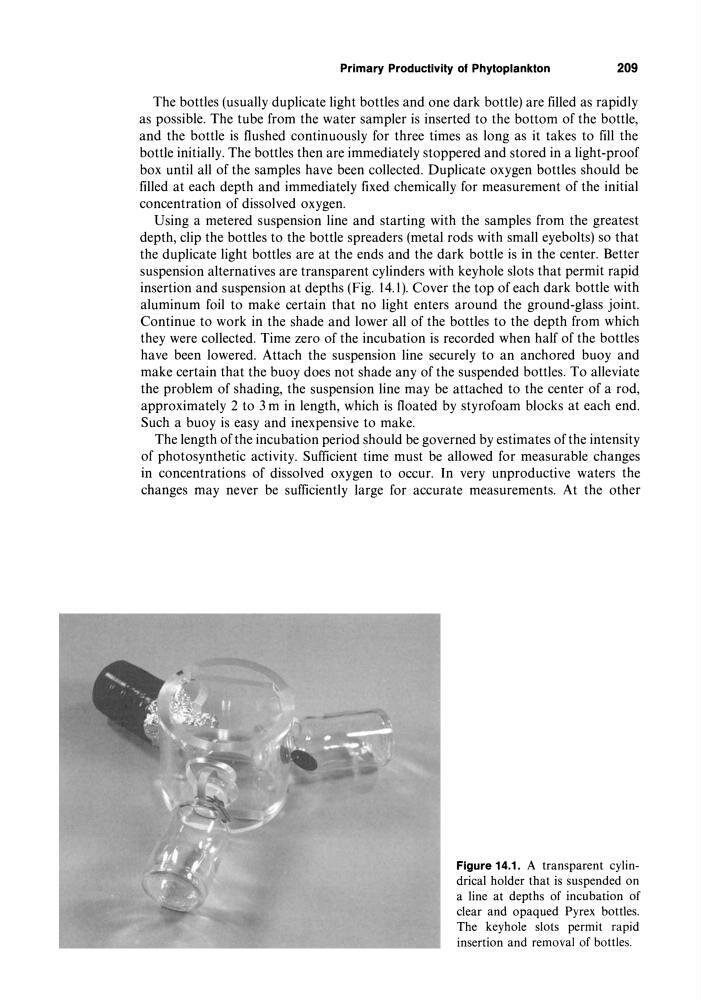
suspension alternatives are transparent cylinders with keyhole slots that permit rapid
insertion and suspension at depths (Fig. 14.1). Cover the top of each dark bottle with
aluminum foil to make certain that no light enters around the ground-glass joint.
Continue to work in the shade and lower all of the bottles to the depth from which
they were collected. Time zero of the incubation is recorded when half of the bottles
have been lowered. Attach the suspension line securely to an anchored buoy and
make certain that the buoy does not shade any of the suspended bottles. To alleviate
the problem of shading, the suspension line may be attached to the center of a rod,
approximately 2 to 3 m in length, which is floated by styrofoam blocks at each end.
Such a buoy is easy and inexpensive to make.
The length of the incubation period should be governed by estimates of the intensity
of photosynthetic activity. Sufficient time must be allowed for measurable changes
in concentrations of dissolved oxygen to occur. In very unproductive waters the
changes may never be sufficiently large for accurate measurements. At the other
Figure 14.1. A transparent cylindrical holder that is suspended on
a line at depths of incubation of
clear and opaqued Pyrex bottles.
The keyhole slots permit rapid
insertion and removal of bottles.
209
The bottles (usually duplicate light bottles and one dark bottle) are filled as rapidly
as possible. The tube from the water sampler is inserted to the bottom of the bottle,
and the bottle is flushed continuously for three times as long as it takes to fill the
bottle initially. The bottles then are immediately stoppered and stored in a light-proof
box until all of the samples have been collected. Duplicate oxygen bottles should be
filled at each depth and immediately fixed chemically for measurement of the initial
concentration of dissolved oxygen.
Using a metered suspension line and starting with the samples from the greatest
depth, clip the bottles to the bottle spreaders (metal rods with small eyebolts) so that
the duplicate light bottles are at the ends and the dark bottle is in the center. Better
suspension alternatives are transparent cylinders with keyhole slots that permit rapid
insertion and suspension at depths (Fig. 14.1). Cover the top of each dark bottle with
aluminum foil to make certain that no light enters around the ground-glass joint.
Continue to work in the shade and lower all of the bottles to the depth from which
they were collected. Time zero of the incubation is recorded when half of the bottles
have been lowered. Attach the suspension line securely to an anchored buoy and
make certain that the buoy does not shade any of the suspended bottles. To alleviate
the problem of shading, the suspension line may be attached to the center of a rod,
approximately 2 to 3 m in length, which is floated by styrofoam blocks at each end.
Such a buoy is easy and inexpensive to make.
The length of the incubation period should be governed by estimates of the intensity
of photosynthetic activity. Sufficient time must be allowed for measurable changes
in concentrations of dissolved oxygen to occur. In very unproductive waters the
changes may never be sufficiently large for accurate measurements. At the other
Figure 14.1. A transparent cylindrical holder that is suspended on
a line at depths of incubation of
clear and opaqued Pyrex bottles.
The keyhole slots permit rapid
insertion and removal of bottles.