

OPTION 2.
Benthic Fauna of Streams
203
net. Carefully invert the net and transfer the sample to a plastic bag (Whirl-a-pac), add
70% alcohol to cover the sample, and transport to the laboratory.
7. Repeat items 3 through 5 above.
8. Using your results, test the variability between types of samplers and among collections
made with each sampler.
9. How many species did you find in the first 100 organisms examined with each sampler?
Prepare a frequency distribution for the number of individuals collected per taxonomic
group. [See Williams (1964).]
10. Answer the questions following Option 2.
In this option we shall examine the downstream transport of organisms and organic debris
by water currents in a small stream. This downstream movement is referred to as drift.
Significant quantities of benthic organisms may drift downstream [e.g., M tiller (1974)] and show
diurnal periodicity [(Waters, 1962, 1972, and Wiley and Kohler (1984)].
Procedures
1. Position three drift nets in the center of a shallow rime area of the stream. Install the nets
so that they will extend above the water surface even if the depth of the water should change
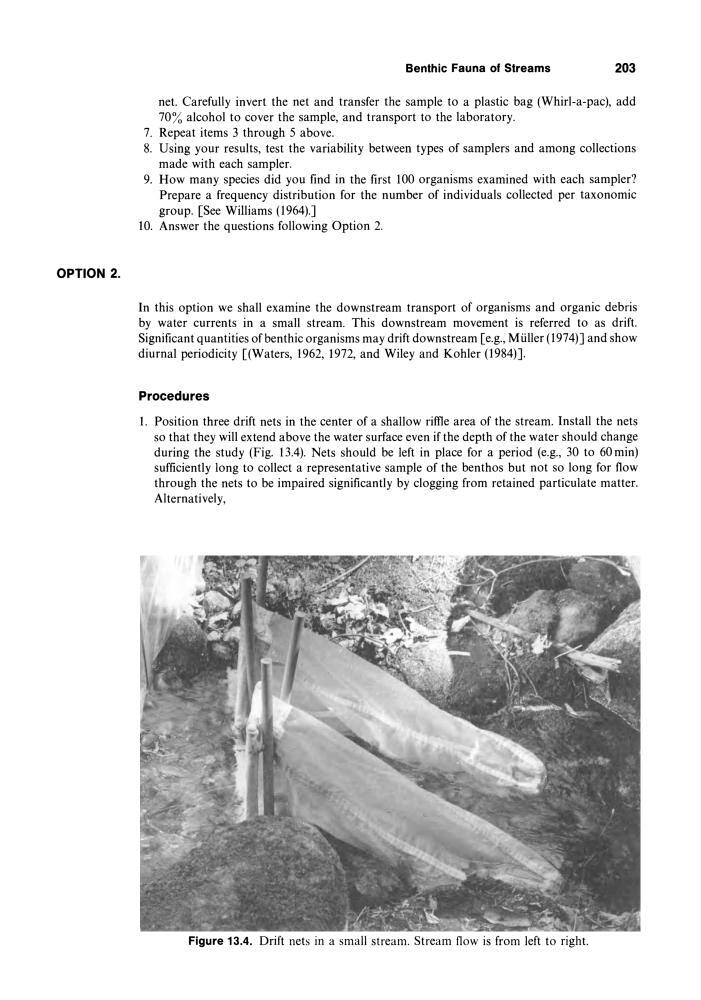
during the study (Fig. 13.4). Nets should be left in place for a period (e.g., 30 to 60min)
sufficiently long to collect a representative sample of the benthos but not so long for flow
through the nets to be impaired significantly by clogging from retained particulate matter.
Alternatively,
Figure 13.4. Drift nets in a small stream. Stream flow is from left to right.
Benthic Fauna of Streams
203
net. Carefully invert the net and transfer the sample to a plastic bag (Whirl-a-pac), add
70% alcohol to cover the sample, and transport to the laboratory.
7. Repeat items 3 through 5 above.
8. Using your results, test the variability between types of samplers and among collections
made with each sampler.
9. How many species did you find in the first 100 organisms examined with each sampler?
Prepare a frequency distribution for the number of individuals collected per taxonomic
group. [See Williams (1964).]
10. Answer the questions following Option 2.
In this option we shall examine the downstream transport of organisms and organic debris
by water currents in a small stream. This downstream movement is referred to as drift.
Significant quantities of benthic organisms may drift downstream [e.g., M tiller (1974)] and show
diurnal periodicity [(Waters, 1962, 1972, and Wiley and Kohler (1984)].
Procedures
1. Position three drift nets in the center of a shallow rime area of the stream. Install the nets
so that they will extend above the water surface even if the depth of the water should change
during the study (Fig. 13.4). Nets should be left in place for a period (e.g., 30 to 60min)
sufficiently long to collect a representative sample of the benthos but not so long for flow
through the nets to be impaired significantly by clogging from retained particulate matter.
Alternatively,
Figure 13.4. Drift nets in a small stream. Stream flow is from left to right.