

200
Exercise 13
and within water bodies [e.g., Rosenberg and
Resh (1982), Flannagan and Rosenberg (1982),
and Lamberti and Resh (1985)].
sampling equipment and problems of obtaining
quantitative estimates of the distribution and
abundance of stream invertebrates.
This exercise briefly introduces some of the
SAMPLING PROCEDURES
It is exceedingly difficult to obtain quantitative samples of the benthic invertebrates
in a stream. Some of the major factors to consider are: (1) heterogeneity of habitat
type and distribution of organisms; (2) depth of organisms in the sediments; (3) stage
in the life cycle of the organisms (many insects may emerge as winged adults); (4)
variations in current velocity; (5) variations in discharge, environmental conditions
(e.g., ice), or both; and (6) movement or transport of organisms. Various types of
procedures and devices have been used to obtain samples, e.g., kicking the bottom
upstream of a net (Frost et aI., 1971), Hess sampler (Hess, 1941), and Ekman grab
samples (Usinger and Needham, 1956). The ponar and corer samplers, discussed in
Exercise 12, are also used in stream ecosystems, particularly when sampling sandy
substrata. Probably the most popular procedure, at least in the United States, has
been to dislodge manually the organisms from the sediments and allow the current
to transport them downstream where they can be filtered from the water with a net.
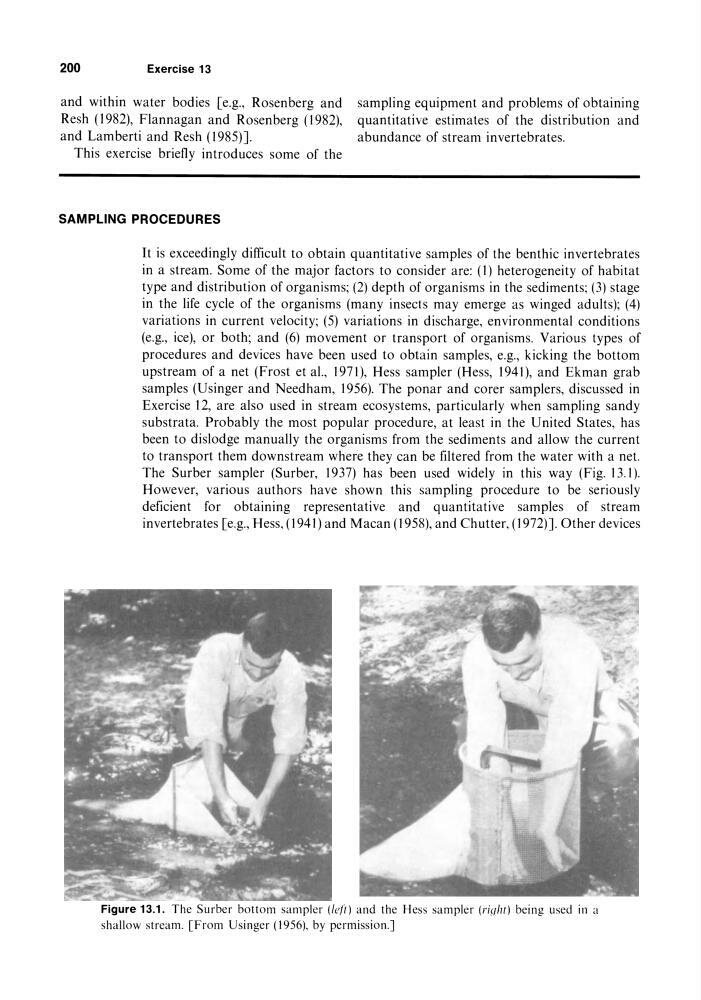
The Surber sampler (Surber, 1937) has been used widely in this way (Fig. 13.1).
However, various authors have shown this sampling procedure to be seriously
deficient for obtaining representative and quantitative samples of stream
invertebrates [e.g., Hess, (1941) and Macan (1958), and Chutter, (1972)]. Other devices
Figure 13.1. The Surber bottom sampler (Ieli) and the Hess sampler (ri!liIr) being llsed in a
shallow stream. [From Usinger (1956), by permission.]
Exercise 13
and within water bodies [e.g., Rosenberg and
Resh (1982), Flannagan and Rosenberg (1982),
and Lamberti and Resh (1985)].
sampling equipment and problems of obtaining
quantitative estimates of the distribution and
abundance of stream invertebrates.
This exercise briefly introduces some of the
SAMPLING PROCEDURES
It is exceedingly difficult to obtain quantitative samples of the benthic invertebrates
in a stream. Some of the major factors to consider are: (1) heterogeneity of habitat
type and distribution of organisms; (2) depth of organisms in the sediments; (3) stage
in the life cycle of the organisms (many insects may emerge as winged adults); (4)
variations in current velocity; (5) variations in discharge, environmental conditions
(e.g., ice), or both; and (6) movement or transport of organisms. Various types of
procedures and devices have been used to obtain samples, e.g., kicking the bottom
upstream of a net (Frost et aI., 1971), Hess sampler (Hess, 1941), and Ekman grab
samples (Usinger and Needham, 1956). The ponar and corer samplers, discussed in
Exercise 12, are also used in stream ecosystems, particularly when sampling sandy
substrata. Probably the most popular procedure, at least in the United States, has
been to dislodge manually the organisms from the sediments and allow the current
to transport them downstream where they can be filtered from the water with a net.
The Surber sampler (Surber, 1937) has been used widely in this way (Fig. 13.1).
However, various authors have shown this sampling procedure to be seriously
deficient for obtaining representative and quantitative samples of stream
invertebrates [e.g., Hess, (1941) and Macan (1958), and Chutter, (1972)]. Other devices
Figure 13.1. The Surber bottom sampler (Ieli) and the Hess sampler (ri!liIr) being llsed in a
shallow stream. [From Usinger (1956), by permission.]