

182
Exercise 12
top of the sampler as it is being brought to the water surface. In addition, the bottom
of the sampler is arc-shaped, so the entire sampler does not penetrate to a uniform
depth; this is an important problem if the number of organisms were to change
markedly with depth. Although the Ekman grab takes large samples, which is
statistically advantageous, the sieving and sorting time is long [cf., Downing (1984)].
Nevertheless, Flannagan (1970) has demonstrated that total organism abundance is
estimated as well with a standard Ekman grab as it is with a diver-operated hand
core (which, theoretically, takes an unbiased sample), although the Ekman grab tends
to underestimate oligochaete density. Burton and Flannagan (1973) have designed a
greatly improved Ekman grab in which the problems of pressure wave and loss of
organisms during retrieval are eliminated. Tests have shown that this device collects
significantly more chironomids and oligochaetes than does the standard Ekman grab.
Petersen-Type Grab Samplers
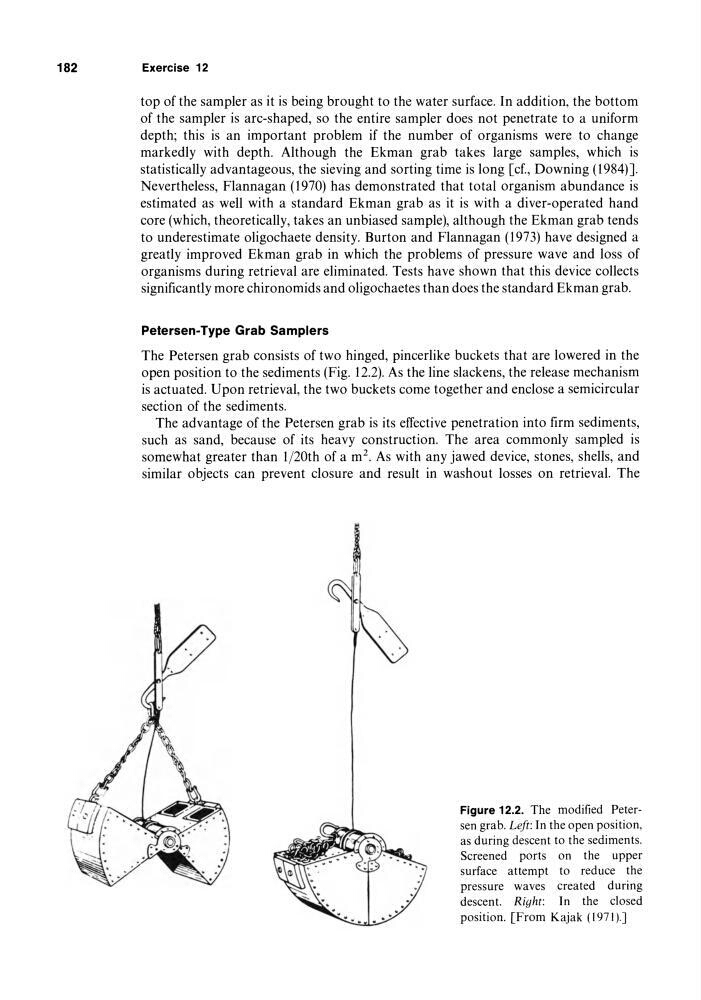
The Petersen grab consists of two hinged, pincerlike buckets that are lowered in the
open position to the sediments (Fig. 12.2). As the line slackens, the release mechanism
is actuated. Upon retrieval, the two buckets come together and enclose a semicircular
section of the sediments.
The advantage of the Petersen grab is its effective penetration into firm sediments,
such as sand, because of its heavy construction. The area commonly sampled is
somewhat greater than 1/20th of a m 2 . As with any jawed device, stones, shells, and
similar objects can prevent closure and result in washout losses on retrieval. The
Figure 12.2. The modified Petersen grab. Left: In the open position,
as during descent to the sediments.
Screened ports on the upper
surface attempt to reduce the
pressure waves created during
descent. Right: In the closed
position. [From Kajak (1971 ).]
Exercise 12
top of the sampler as it is being brought to the water surface. In addition, the bottom
of the sampler is arc-shaped, so the entire sampler does not penetrate to a uniform
depth; this is an important problem if the number of organisms were to change
markedly with depth. Although the Ekman grab takes large samples, which is
statistically advantageous, the sieving and sorting time is long [cf., Downing (1984)].
Nevertheless, Flannagan (1970) has demonstrated that total organism abundance is
estimated as well with a standard Ekman grab as it is with a diver-operated hand
core (which, theoretically, takes an unbiased sample), although the Ekman grab tends
to underestimate oligochaete density. Burton and Flannagan (1973) have designed a
greatly improved Ekman grab in which the problems of pressure wave and loss of
organisms during retrieval are eliminated. Tests have shown that this device collects
significantly more chironomids and oligochaetes than does the standard Ekman grab.
Petersen-Type Grab Samplers
The Petersen grab consists of two hinged, pincerlike buckets that are lowered in the
open position to the sediments (Fig. 12.2). As the line slackens, the release mechanism
is actuated. Upon retrieval, the two buckets come together and enclose a semicircular
section of the sediments.
The advantage of the Petersen grab is its effective penetration into firm sediments,
such as sand, because of its heavy construction. The area commonly sampled is
somewhat greater than 1/20th of a m 2 . As with any jawed device, stones, shells, and
similar objects can prevent closure and result in washout losses on retrieval. The
Figure 12.2. The modified Petersen grab. Left: In the open position,
as during descent to the sediments.
Screened ports on the upper
surface attempt to reduce the
pressure waves created during
descent. Right: In the closed
position. [From Kajak (1971 ).]