

152
••• . .
Exercise 10
...... 01-----r
.... . . .
. . . .
. . . .
. ...
• • • • • • • • • ••• • 40 • • • • • • • • •
• • •• • • • • • • • • •
. . . . . . . . . . . . . . .
· . . . . . . . . . . . . . . .
. . . . . . . . . . . . . . . .
· . . . . . . . . . . . . . . . .
· . . . . . . . . . . . . . . . .
· . . . . . . . . . . . . . . . .
· . . . . . . . . . . . . . . . . .
••••••••••••• SAMPlE.·.·.·.·.·.·.
. . . . . . . . . . . . . . . . . . .
· . . . . . . . . . . . . . . . . .
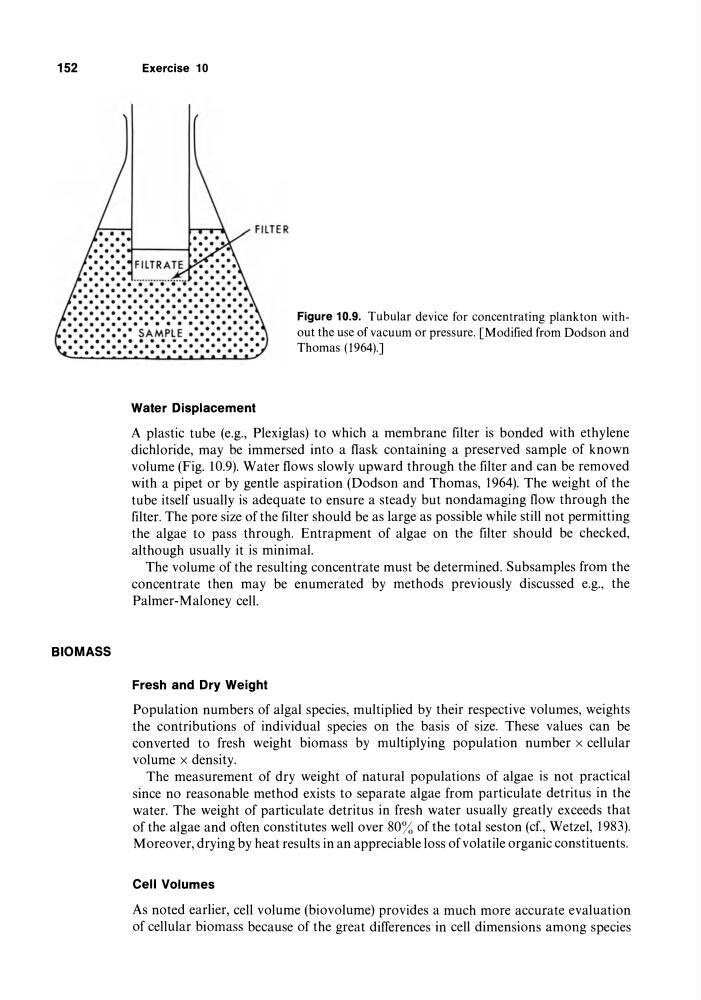
Figure 10.9. Tubular device for concentrating plankton without the use of vacuum or pressure. [Modified from Dodson and
Thomas (1964).J
· . . . . . . . . . . . . . . . .
BIOMASS
Water Displacement
A plastic tube (e.g., Plexiglas) to which a membrane filter is bonded with ethylene
dichloride, may be immersed into a flask containing a preserved sample of known
volume (Fig. 10.9). Water flows slowly upward through the filter and can be removed
with a pipet or by gentle aspiration (Dodson and Thomas, 1964). The weight of the
tube itself usually is adequate to ensure a steady but nondamaging flow through the
filter. The pore size of the filter should be as large as possible while still not permitting
the algae to pass through. Entrapment of algae on the filter should be checked,
although usually it is minimal.
The volume of the resulting concentrate must be determined. Subsamples from the
concentrate then may be enumerated by methods previously discussed e.g., the
Palmer-Maloney cell.
Fresh and Dry Weight
Population numbers of algal species, multiplied by their respective volumes, weights
the contributions of individual species on the basis of size. These values can be
converted to fresh weight biomass by multiplying population number x cellular
volume x density.
The measurement of dry weight of natural populations of algae is not practical
since no reasonable method exists to separate algae from particulate detritus in the
water. The weight of particulate detritus in fresh water usually greatly exceeds that
of the algae and often constitutes well over 80% of the total seston (cf., Wetzel, 1983).
Moreover, drying by heat results in an appreciable loss of volatile organic constituents.
Cell Volumes
As noted earlier, cell volume (biovolume) provides a much more accurate evaluation
of cellular biomass because of the great differences in cell dimensions among species
••• . .
Exercise 10
...... 01-----r
.... . . .
. . . .
. . . .
. ...
• • • • • • • • • ••• • 40 • • • • • • • • •
• • •• • • • • • • • • •
. . . . . . . . . . . . . . .
· . . . . . . . . . . . . . . .
. . . . . . . . . . . . . . . .
· . . . . . . . . . . . . . . . .
· . . . . . . . . . . . . . . . .
· . . . . . . . . . . . . . . . .
· . . . . . . . . . . . . . . . . .
••••••••••••• SAMPlE.·.·.·.·.·.·.
. . . . . . . . . . . . . . . . . . .
· . . . . . . . . . . . . . . . . .
Figure 10.9. Tubular device for concentrating plankton without the use of vacuum or pressure. [Modified from Dodson and
Thomas (1964).J
· . . . . . . . . . . . . . . . .
BIOMASS
Water Displacement
A plastic tube (e.g., Plexiglas) to which a membrane filter is bonded with ethylene
dichloride, may be immersed into a flask containing a preserved sample of known
volume (Fig. 10.9). Water flows slowly upward through the filter and can be removed
with a pipet or by gentle aspiration (Dodson and Thomas, 1964). The weight of the
tube itself usually is adequate to ensure a steady but nondamaging flow through the
filter. The pore size of the filter should be as large as possible while still not permitting
the algae to pass through. Entrapment of algae on the filter should be checked,
although usually it is minimal.
The volume of the resulting concentrate must be determined. Subsamples from the
concentrate then may be enumerated by methods previously discussed e.g., the
Palmer-Maloney cell.
Fresh and Dry Weight
Population numbers of algal species, multiplied by their respective volumes, weights
the contributions of individual species on the basis of size. These values can be
converted to fresh weight biomass by multiplying population number x cellular
volume x density.
The measurement of dry weight of natural populations of algae is not practical
since no reasonable method exists to separate algae from particulate detritus in the
water. The weight of particulate detritus in fresh water usually greatly exceeds that
of the algae and often constitutes well over 80% of the total seston (cf., Wetzel, 1983).
Moreover, drying by heat results in an appreciable loss of volatile organic constituents.
Cell Volumes
As noted earlier, cell volume (biovolume) provides a much more accurate evaluation
of cellular biomass because of the great differences in cell dimensions among species