

118
HARDNESS
Exercise 8
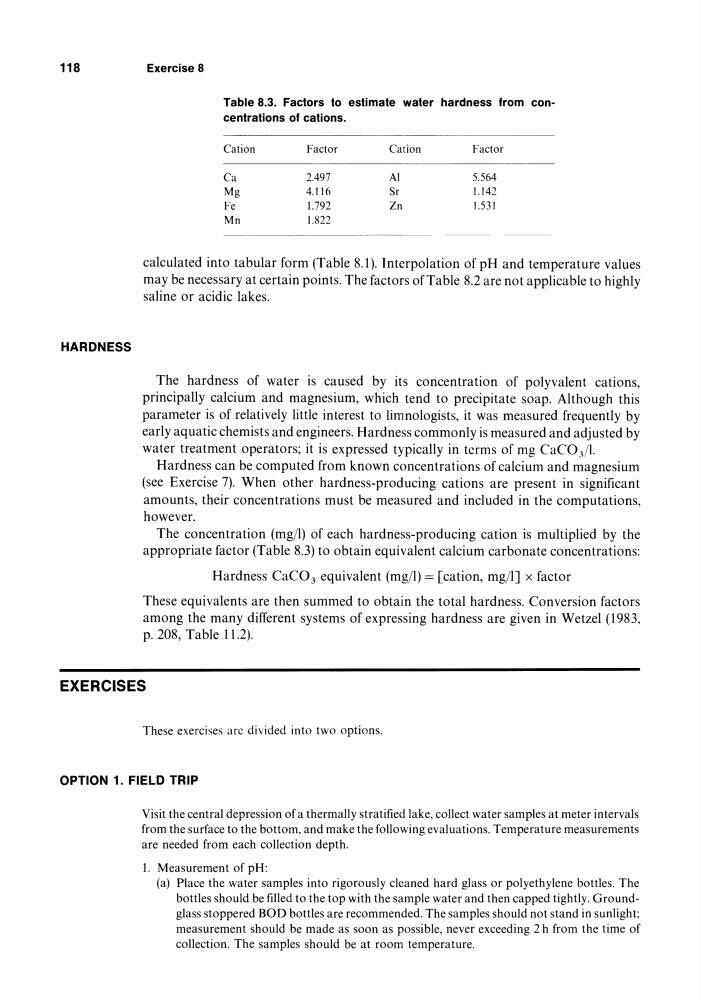
Table 8.3. Factors to estimate water hardness from concentrations of cations.
Cation
Factor
Cation
Factor
Ca
2.497
AI
5.564
Mg
4.116
Sr
1.142
Fe
1.792
Zn
1.531
Mn
1.822
- - - - - -
- - - - - - -
calculated into tabular form (Table 8.1). Interpolation of pH and temperature values
may be necessary at certain points. The factors of Table 8.2 are not applicable to highly
saline or acidic lakes.
The hardness of water is caused by its concentration of polyvalent cations,
principally calcium and magnesium, which tend to precipitate soap. Although this
parameter is of relatively little interest to Iimnologists, it was measured frequently by
early aquatic chemists and engineers. Hardness commonly is measured and adjusted by
water treatment operators; it is expressed typically in terms of mg CaC0 3 /1.
Hardness can be computed from known concentrations of calcium and magnesium
(see Exercise 7). When other hardness-producing cations are present in significant
amounts, their concentrations must be measured and included in the computations,
however.
The concentration (mg/l) of each hardness-producing cation is multiplied by the
appropriate factor (Table 8.3) to obtain equivalent calcium carbonate concentrations:
Hardness CaC0 3 equivalent (mg/I) = [cation, mg/I] x factor
These equivalents are then summed to obtain the total hardness. Conversion factors
among the many different systems of expressing hardness are given in Wetzel (1983.
p. 208, Table 11.2).
EXERCISES
These exercises arc divided into two options.
OPTION 1. FIELD TRIP
Visit the central depression of a thermally stratified lake, collect water samples at meter intervals
from the surface to the bottom, and make the following evaluations. Temperature measurements
are needed from each collection depth.
1. Measurement of pH:
(a) Place the water samples into rigorously cleaned hard glass or polyethylene bottles. The
bottles should be filled to the top with the sample water and then capped tightly. Groundglass stoppered BOD bottles are recommended. The samples should not stand in sunlight;
measurement should be made as soon as possible, never exceeding 2 h from the time of
collection. The samples should be at room temperature.
HARDNESS
Exercise 8
Table 8.3. Factors to estimate water hardness from concentrations of cations.
Cation
Factor
Cation
Factor
Ca
2.497
AI
5.564
Mg
4.116
Sr
1.142
Fe
1.792
Zn
1.531
Mn
1.822
- - - - - -
- - - - - - -
calculated into tabular form (Table 8.1). Interpolation of pH and temperature values
may be necessary at certain points. The factors of Table 8.2 are not applicable to highly
saline or acidic lakes.
The hardness of water is caused by its concentration of polyvalent cations,
principally calcium and magnesium, which tend to precipitate soap. Although this
parameter is of relatively little interest to Iimnologists, it was measured frequently by
early aquatic chemists and engineers. Hardness commonly is measured and adjusted by
water treatment operators; it is expressed typically in terms of mg CaC0 3 /1.
Hardness can be computed from known concentrations of calcium and magnesium
(see Exercise 7). When other hardness-producing cations are present in significant
amounts, their concentrations must be measured and included in the computations,
however.
The concentration (mg/l) of each hardness-producing cation is multiplied by the
appropriate factor (Table 8.3) to obtain equivalent calcium carbonate concentrations:
Hardness CaC0 3 equivalent (mg/I) = [cation, mg/I] x factor
These equivalents are then summed to obtain the total hardness. Conversion factors
among the many different systems of expressing hardness are given in Wetzel (1983.
p. 208, Table 11.2).
EXERCISES
These exercises arc divided into two options.
OPTION 1. FIELD TRIP
Visit the central depression of a thermally stratified lake, collect water samples at meter intervals
from the surface to the bottom, and make the following evaluations. Temperature measurements
are needed from each collection depth.
1. Measurement of pH:
(a) Place the water samples into rigorously cleaned hard glass or polyethylene bottles. The
bottles should be filled to the top with the sample water and then capped tightly. Groundglass stoppered BOD bottles are recommended. The samples should not stand in sunlight;
measurement should be made as soon as possible, never exceeding 2 h from the time of
collection. The samples should be at room temperature.