

Inorganic Nutrients
101
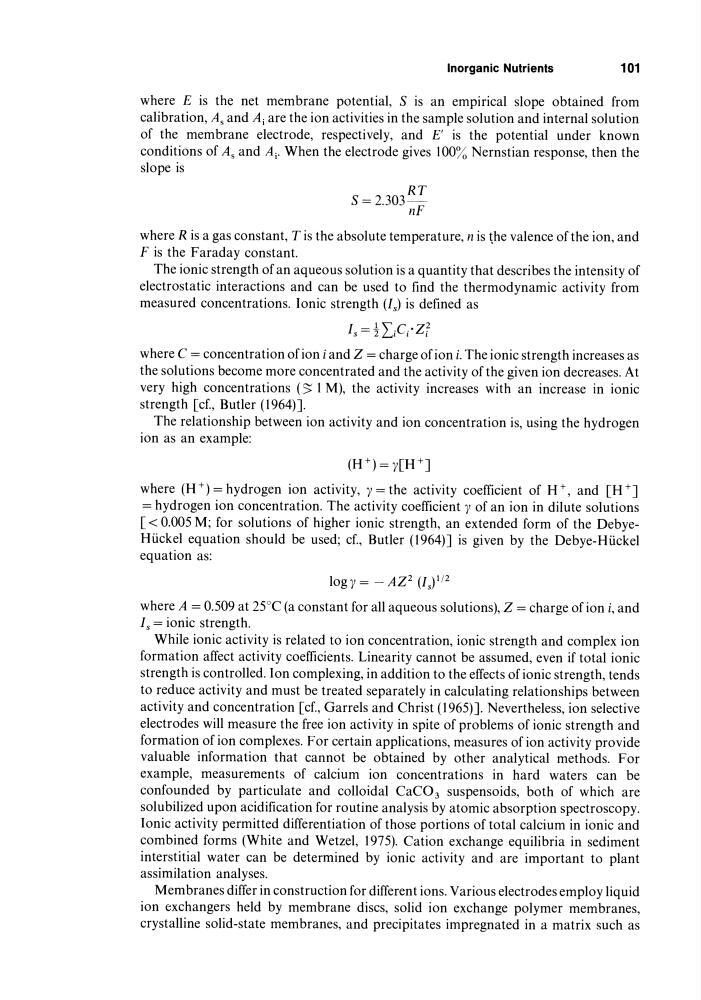
where E is the net membrane potential, S is an empirical slope obtained from
calibration, As and Ai are the ion activities in the sample solution and internal solution
of the membrane electrode, respectively, and E' is the potential under known
conditions of As and Ai' When the electrode gives 100% Nernstian response, then the
slope is
S=2.303 RT
nF
where R is a gas constant, T is the absolute temperature, n is \he valence of the ion, and
F is the Faraday constant.
The ionic strength of an aqueous solution is a quantity that describes the intensity of
electrostatic interactions and can be used to find the thermodynamic activity from
measured concentrations. Ionic strength (Is) is defined as
Is = t LiCi' zf
where C = concentration of ion i and Z = charge of ion i. The ionic strength increases as
the solutions become more concentrated and the activity of the given ion decreases. At
very high concentrations ('> 1 M), the activity increases with an increase in ionic
strength [cf., Butler (1964)].
The relationship between ion activity and ion concentration is, using the hydrogen
ion as an example:
(H+) = 1'[H+]
where (H +) = hydrogen ion activity, l' = the activity coefficient of H +, and [H +]
= hydrogen ion concentration. The activity coefficient l' of an ion in dilute solutions
[ < 0.005 M; for solutions of higher ionic strength, an extended form of the DebyeHiickel equation should be used; cf., Butler (1964)] is given by the Debye-Hiickel
equation as:
logy = -AZ2 (Is)I/2
where A = 0.509 at 25°C (a constant for all aqueous solutions), Z = charge of ion i, and
Is = ionic strength.
While ionic activity is related to ion concentration, ionic strength and complex ion
formation affect activity coefficients. Linearity cannot be assumed, even if total ionic
strength is controlled. Ion complexing, in addition to the effects of ionic strength, tends
to reduce activity and must be treated separately in calculating relationships between
activity and concentration [cf., Garrels and Christ (1965)]. Nevertheless, ion selective
electrodes will measure the free ion activity in spite of problems of ionic strength and
formation of ion complexes. For certain applications, measures of ion activity provide
valuable information that cannot be obtained by other analytical methods. For
example, measurements of calcium ion concentrations in hard waters can be
confounded by particulate and colloidal CaC0 3 suspensoids, both of which are
solubilized upon acidification for routine analysis by atomic absorption spectroscopy.
Ionic activity permitted differentiation of those portions of total calcium in ionic and
combined forms (White and Wetzel, 1975). Cation exchange equilibria in sediment
interstitial water can be determined by ionic activity and are important to plant
assimilation analyses.
Membranes differ in construction for different ions. Various electrodes employ liquid
ion exchangers held by membrane discs, solid ion exchange polymer membranes,
crystalline solid-state membranes, and precipitates impregnated in a matrix such as
101
where E is the net membrane potential, S is an empirical slope obtained from
calibration, As and Ai are the ion activities in the sample solution and internal solution
of the membrane electrode, respectively, and E' is the potential under known
conditions of As and Ai' When the electrode gives 100% Nernstian response, then the
slope is
S=2.303 RT
nF
where R is a gas constant, T is the absolute temperature, n is \he valence of the ion, and
F is the Faraday constant.
The ionic strength of an aqueous solution is a quantity that describes the intensity of
electrostatic interactions and can be used to find the thermodynamic activity from
measured concentrations. Ionic strength (Is) is defined as
Is = t LiCi' zf
where C = concentration of ion i and Z = charge of ion i. The ionic strength increases as
the solutions become more concentrated and the activity of the given ion decreases. At
very high concentrations ('> 1 M), the activity increases with an increase in ionic
strength [cf., Butler (1964)].
The relationship between ion activity and ion concentration is, using the hydrogen
ion as an example:
(H+) = 1'[H+]
where (H +) = hydrogen ion activity, l' = the activity coefficient of H +, and [H +]
= hydrogen ion concentration. The activity coefficient l' of an ion in dilute solutions
[ < 0.005 M; for solutions of higher ionic strength, an extended form of the DebyeHiickel equation should be used; cf., Butler (1964)] is given by the Debye-Hiickel
equation as:
logy = -AZ2 (Is)I/2
where A = 0.509 at 25°C (a constant for all aqueous solutions), Z = charge of ion i, and
Is = ionic strength.
While ionic activity is related to ion concentration, ionic strength and complex ion
formation affect activity coefficients. Linearity cannot be assumed, even if total ionic
strength is controlled. Ion complexing, in addition to the effects of ionic strength, tends
to reduce activity and must be treated separately in calculating relationships between
activity and concentration [cf., Garrels and Christ (1965)]. Nevertheless, ion selective
electrodes will measure the free ion activity in spite of problems of ionic strength and
formation of ion complexes. For certain applications, measures of ion activity provide
valuable information that cannot be obtained by other analytical methods. For
example, measurements of calcium ion concentrations in hard waters can be
confounded by particulate and colloidal CaC0 3 suspensoids, both of which are
solubilized upon acidification for routine analysis by atomic absorption spectroscopy.
Ionic activity permitted differentiation of those portions of total calcium in ionic and
combined forms (White and Wetzel, 1975). Cation exchange equilibria in sediment
interstitial water can be determined by ionic activity and are important to plant
assimilation analyses.
Membranes differ in construction for different ions. Various electrodes employ liquid
ion exchangers held by membrane discs, solid ion exchange polymer membranes,
crystalline solid-state membranes, and precipitates impregnated in a matrix such as