

Inorganic Nutrients
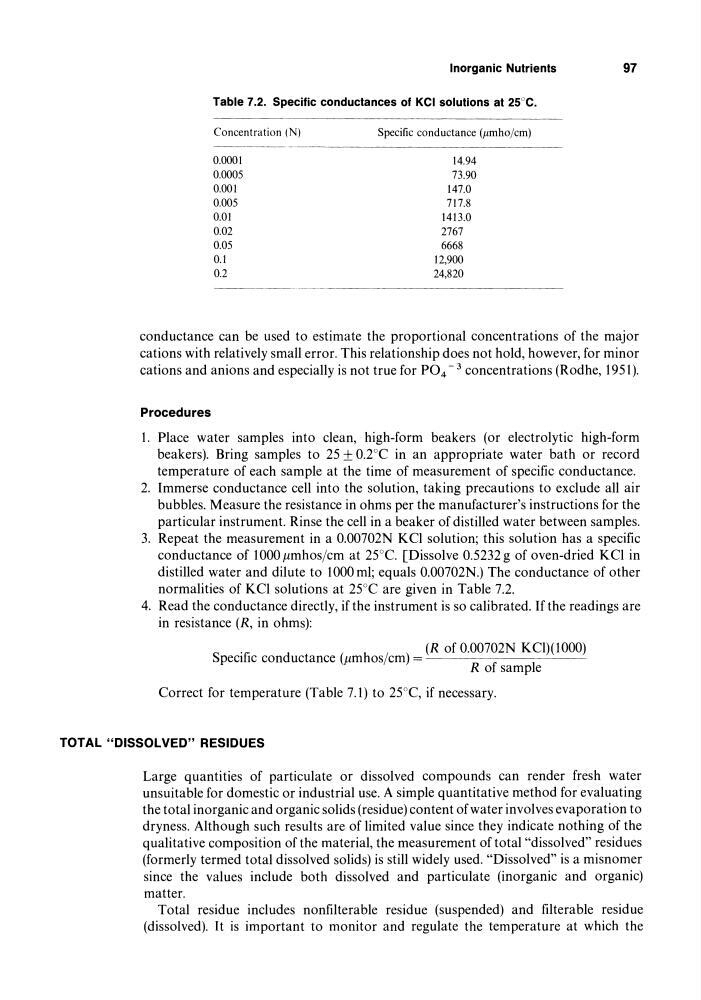
Table 7.2. Specific conductances of KCI solutions at 25°C.
Concentration (N)
0.0001
0.0005
0.001
0.005
0.01
0.02
0.05
0.1
0.2
Specific conductance (Jlmho/cm)
14.94
73.90
147.0
717.8
1413.0
2767
6668
12,900
24,820
97
conductance can be used to estimate the proportional concentrations of the major
cations with relatively small error. This relationship does not hold, however, for minor
cations and anions and especially is not true for P0 4 -3 concentrations (Rod he, 1951).
Procedures
1. Place water samples into clean, high-form beakers (or electrolytic high-form
beakers). Bring samples to 25 ± 0.2°C in an appropriate water bath or record
temperature of each sample at the time of measurement of specific conductance.
2. Immerse conductance cell into the solution, taking precautions to exclude all air
bubbles. Measure the resistance in ohms per the manufacturer's instructions for the
particular instrument. Rinse the cell in a beaker of distilled water between samples.
3. Repeat the measurement in a 0.00702N KCI solution; this solution has a specific
conductance of 1000 .umhos/cm at 25°C. [Dissolve 0.5232 g of oven-dried KCI in
distilled water and dilute to 1000 ml; equals 0.00702N.} The conductance of other
normalities of KCI solutions at 25°C are given in Table 7.2.
4. Read the conductance directly, if the instrument is so calibrated. If the readings are
in resistance (R, in ohms):
.
(R of 0.00702N KCI)(1000)
SpeCIfic conductance (.umhos/cm) =
f
I
R 0 samp e
Correct for temperature (Table 7.1) to 25°C, if necessary.
TOTAL "DISSOLVED" RESIDUES
Large quantities of particulate or dissolved compounds can render fresh water
unsuitable for domestic or industrial use. A simple quantitative method for evaluating
the total inorganic and organic solids (residue) content of water involves evaporation to
dryness. Although such results are of limited value since they indicate nothing of the
qualitative composition of the material, the measurement of total "dissolved" residues
(formerly termed total dissolved solids) is still widely used. "Dissolved" is a misnomer
since the values include both dissolved and particulate (inorganic and organic)
matter.
Total residue includes nonfilterable residue (suspended) and filterable residue
(dissolved). It is important to monitor and regulate the temperature at which the
Table 7.2. Specific conductances of KCI solutions at 25°C.
Concentration (N)
0.0001
0.0005
0.001
0.005
0.01
0.02
0.05
0.1
0.2
Specific conductance (Jlmho/cm)
14.94
73.90
147.0
717.8
1413.0
2767
6668
12,900
24,820
97
conductance can be used to estimate the proportional concentrations of the major
cations with relatively small error. This relationship does not hold, however, for minor
cations and anions and especially is not true for P0 4 -3 concentrations (Rod he, 1951).
Procedures
1. Place water samples into clean, high-form beakers (or electrolytic high-form
beakers). Bring samples to 25 ± 0.2°C in an appropriate water bath or record
temperature of each sample at the time of measurement of specific conductance.
2. Immerse conductance cell into the solution, taking precautions to exclude all air
bubbles. Measure the resistance in ohms per the manufacturer's instructions for the
particular instrument. Rinse the cell in a beaker of distilled water between samples.
3. Repeat the measurement in a 0.00702N KCI solution; this solution has a specific
conductance of 1000 .umhos/cm at 25°C. [Dissolve 0.5232 g of oven-dried KCI in
distilled water and dilute to 1000 ml; equals 0.00702N.} The conductance of other
normalities of KCI solutions at 25°C are given in Table 7.2.
4. Read the conductance directly, if the instrument is so calibrated. If the readings are
in resistance (R, in ohms):
.
(R of 0.00702N KCI)(1000)
SpeCIfic conductance (.umhos/cm) =
f
I
R 0 samp e
Correct for temperature (Table 7.1) to 25°C, if necessary.
TOTAL "DISSOLVED" RESIDUES
Large quantities of particulate or dissolved compounds can render fresh water
unsuitable for domestic or industrial use. A simple quantitative method for evaluating
the total inorganic and organic solids (residue) content of water involves evaporation to
dryness. Although such results are of limited value since they indicate nothing of the
qualitative composition of the material, the measurement of total "dissolved" residues
(formerly termed total dissolved solids) is still widely used. "Dissolved" is a misnomer
since the values include both dissolved and particulate (inorganic and organic)
matter.
Total residue includes nonfilterable residue (suspended) and filterable residue
(dissolved). It is important to monitor and regulate the temperature at which the