

Inorganic Nutrients
91
7. Prepare a standard curve by determining the absorbance (OD std ) of four standard
solutions (e.g., 10, 50, 100, and 500 flg/l) diluted from the stock solution. The
standards are treated in the same fashion as the samples except that the turbiditycolor correction is unnecessary.
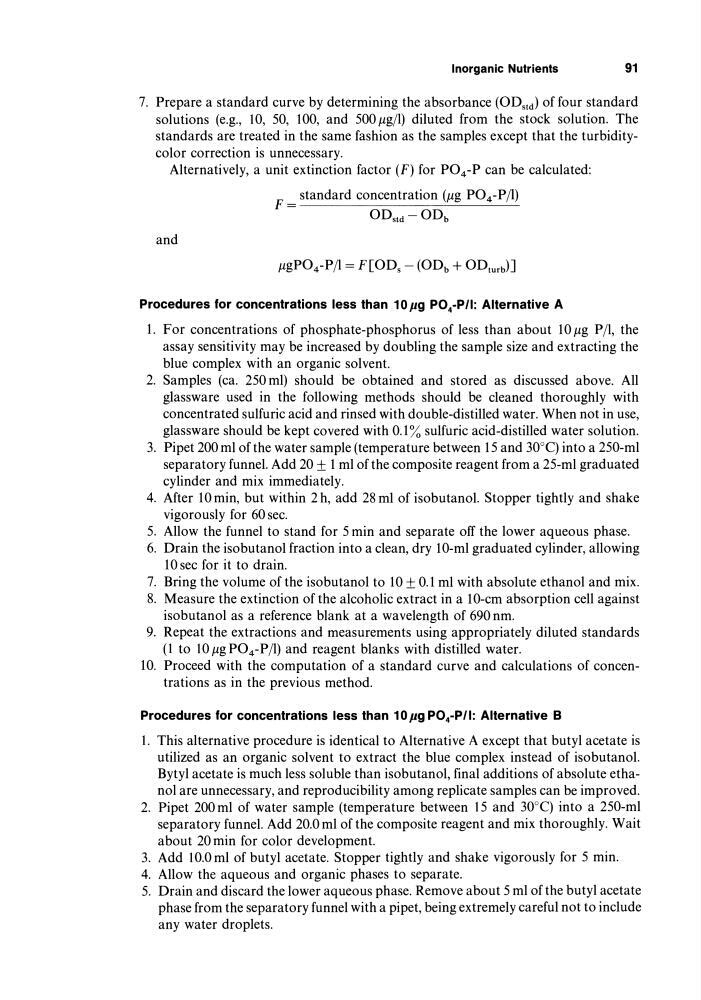
Alternatively, a unit extinction factor (F) for P0 4 -P can be calculated:
and
F = standard concentration (flg P04 -P/I)
ODstd -ODb
Procedures for concentrations less than 10 Jig P0 4 -P/I: Alternative A
1. For concentrations of phosphate-phosphorus of less than about 10 flg PII, the
assay sensitivity may be increased by doubling the sample size and extracting the
blue complex with an organic solvent.
2. Samples (ca. 250 ml) should be obtained and stored as discussed above. All
glassware used in the following methods should be cleaned thoroughly with
concentrated sulfuric acid and rinsed with double-distilled water. When not in use,
glassware should be kept covered with 0.1 % sulfuric acid-distilled water solution.
3. Pipet 200 ml of the water sample (temperature between 15 and 30°C) into a 250-ml
separatory funnel. Add 20 ± 1 ml of the composite reagent from a 25-ml graduated
cylinder and mix immediately.
4. After 10 min, but within 2 h, add 28 ml of isobutanol. Stopper tightly and shake
vigorously for 60 sec.
5. Allow the funnel to stand for 5 min and separate off the lower aqueous phase.
6. Drain the isobutanol fraction into a clean, dry 10-ml graduated cylinder, allowing
10 sec for it to drain.
7. Bring the volume of the isobutanol to 10 ± 0.1 ml with absolute ethanol and mix.
8. Measure the extinction of the alcoholic extract in a lO-cm absorption cell against
isobutanol as a reference blank at a wavelength of 690 nm.
9. Repeat the extractions and measurements using appropriately diluted standards
(1 to 10 flg P0 4 -P/l) and reagent blanks with distilled water.
10. Proceed with the computation of a standard curve and calculations of concentrations as in the previous method.
Procedures for concentrations less than 10JlgP0 4 -P/I: Alternative B
1. This alternative procedure is identical to Alternative A except that butyl acetate is
utilized as an organic solvent to extract the blue complex instead of is 0 butanol.
Bytyl acetate is much less soluble than isobutanol, final additions of absolute ethanol are unnecessary, and reproducibility among replicate samples can be improved.
2. Pipet 200 ml of water sample (temperature between 15 and 30°C) into a 250-ml
separatory funnel. Add 20.0ml of the composite reagent and mix thoroughly. Wait
about 20 min for color development.
3. Add 10.0 ml of butyl acetate. Stopper tightly and shake vigorously for 5 min.
4. Allow the aqueous and organic phases to separate.
5. Drain and discard the lower aq ueous phase. Remove about 5 ml of the butyl acetate
phase from the separatory funnel with a pipet, being extremely careful not to include
any water droplets.
91
7. Prepare a standard curve by determining the absorbance (OD std ) of four standard
solutions (e.g., 10, 50, 100, and 500 flg/l) diluted from the stock solution. The
standards are treated in the same fashion as the samples except that the turbiditycolor correction is unnecessary.
Alternatively, a unit extinction factor (F) for P0 4 -P can be calculated:
and
F = standard concentration (flg P04 -P/I)
ODstd -ODb
Procedures for concentrations less than 10 Jig P0 4 -P/I: Alternative A
1. For concentrations of phosphate-phosphorus of less than about 10 flg PII, the
assay sensitivity may be increased by doubling the sample size and extracting the
blue complex with an organic solvent.
2. Samples (ca. 250 ml) should be obtained and stored as discussed above. All
glassware used in the following methods should be cleaned thoroughly with
concentrated sulfuric acid and rinsed with double-distilled water. When not in use,
glassware should be kept covered with 0.1 % sulfuric acid-distilled water solution.
3. Pipet 200 ml of the water sample (temperature between 15 and 30°C) into a 250-ml
separatory funnel. Add 20 ± 1 ml of the composite reagent from a 25-ml graduated
cylinder and mix immediately.
4. After 10 min, but within 2 h, add 28 ml of isobutanol. Stopper tightly and shake
vigorously for 60 sec.
5. Allow the funnel to stand for 5 min and separate off the lower aqueous phase.
6. Drain the isobutanol fraction into a clean, dry 10-ml graduated cylinder, allowing
10 sec for it to drain.
7. Bring the volume of the isobutanol to 10 ± 0.1 ml with absolute ethanol and mix.
8. Measure the extinction of the alcoholic extract in a lO-cm absorption cell against
isobutanol as a reference blank at a wavelength of 690 nm.
9. Repeat the extractions and measurements using appropriately diluted standards
(1 to 10 flg P0 4 -P/l) and reagent blanks with distilled water.
10. Proceed with the computation of a standard curve and calculations of concentrations as in the previous method.
Procedures for concentrations less than 10JlgP0 4 -P/I: Alternative B
1. This alternative procedure is identical to Alternative A except that butyl acetate is
utilized as an organic solvent to extract the blue complex instead of is 0 butanol.
Bytyl acetate is much less soluble than isobutanol, final additions of absolute ethanol are unnecessary, and reproducibility among replicate samples can be improved.
2. Pipet 200 ml of water sample (temperature between 15 and 30°C) into a 250-ml
separatory funnel. Add 20.0ml of the composite reagent and mix thoroughly. Wait
about 20 min for color development.
3. Add 10.0 ml of butyl acetate. Stopper tightly and shake vigorously for 5 min.
4. Allow the aqueous and organic phases to separate.
5. Drain and discard the lower aq ueous phase. Remove about 5 ml of the butyl acetate
phase from the separatory funnel with a pipet, being extremely careful not to include
any water droplets.