

70
The Radiocarbon Method to Estimate Primary Production
p
P1max
1.0
0.5
o.o.f:-----+----+--- - + -_ _ --+ _ _ _ -t
.'.4 JL
20
40
60
80
100
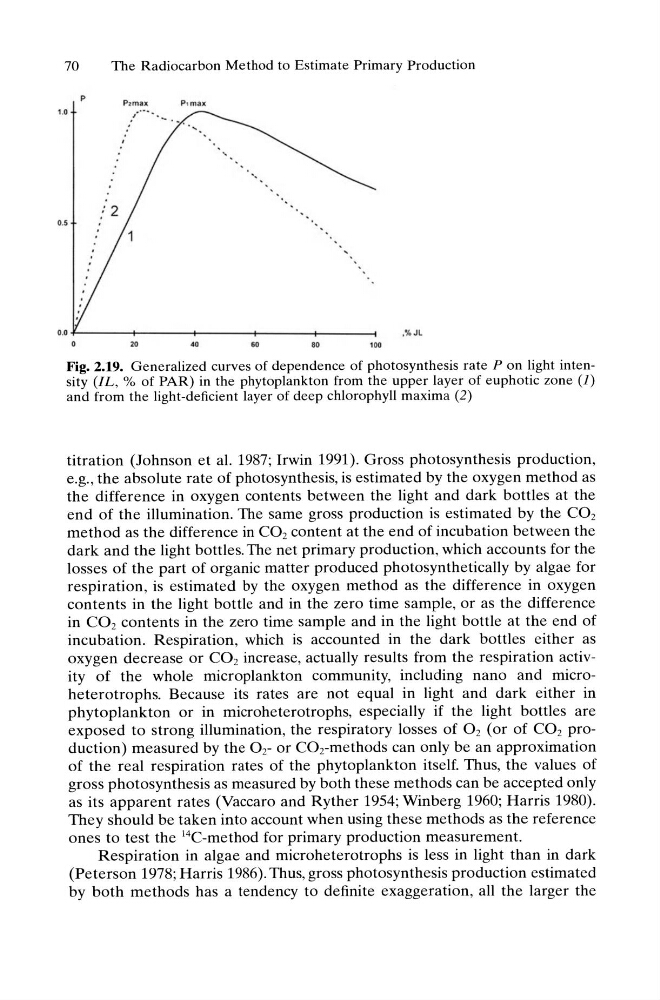
Fig. 2.19. Generalized curves of dependence of photosynthesis rate P on light intensity (1L , % of PAR) in the phytoplankton from the upper layer of euphotic zone (1)
and from the light-deficient layer of deep chlorophyll maxima (2)
titration (Johnson et a1. 1987; Irwin 1991). Gross photosynthesis production,
e.g., the absolute rate of photosynthesis, is estimated by the oxygen method as
the difference in oxygen contents between the light and dark bottles at the
end of the illumination. The same gross production is estimated by the CO2
method as the difference in CO2 content at the end of incubation between the
dark and the light bottles. The net primary production, which accounts for the
losses of the part of organic matter produced photosynthetically by algae for
respiration, is estimated by the oxygen method as the difference in oxygen
contents in the light bottle and in the zero time sample, or as the difference
in CO2 contents in the zero time sample and in the light bottle at the end of
incubation. Respiration, which is accounted in the dark bottles either as
oxygen decrease or CO2 increase, actually results from the respiration activity of the whole microplankton community, including nano and microheterotrophs. Because its rates are not equal in light and dark either in
phytoplankton or in microheterotrophs, especially if the light bottles are
exposed to strong illumination, the respiratory losses of O 2 (or of CO2 production) measured by the Or or COrmethods can only be an approximation
of the real respiration rates of the phytoplankton itself. Thus, the values of
gross photosynthesis as measured by both these methods can be accepted only
as its apparent rates (Vaccaro and Ryther 1954; Winberg 1960; Harris 1980).
They should be taken into account when using these methods as the reference
ones to test the 14C-method for primary production measurement.
Respiration in algae and microheterotrophs is less in light than in dark
(Peterson 1978; Harris 1986). Thus, gross photosynthesis production estimated
by both methods has a tendency to definite exaggeration, all the larger the
The Radiocarbon Method to Estimate Primary Production
p
P1max
1.0
0.5
o.o.f:-----+----+--- - + -_ _ --+ _ _ _ -t
.'.4 JL
20
40
60
80
100
Fig. 2.19. Generalized curves of dependence of photosynthesis rate P on light intensity (1L , % of PAR) in the phytoplankton from the upper layer of euphotic zone (1)
and from the light-deficient layer of deep chlorophyll maxima (2)
titration (Johnson et a1. 1987; Irwin 1991). Gross photosynthesis production,
e.g., the absolute rate of photosynthesis, is estimated by the oxygen method as
the difference in oxygen contents between the light and dark bottles at the
end of the illumination. The same gross production is estimated by the CO2
method as the difference in CO2 content at the end of incubation between the
dark and the light bottles. The net primary production, which accounts for the
losses of the part of organic matter produced photosynthetically by algae for
respiration, is estimated by the oxygen method as the difference in oxygen
contents in the light bottle and in the zero time sample, or as the difference
in CO2 contents in the zero time sample and in the light bottle at the end of
incubation. Respiration, which is accounted in the dark bottles either as
oxygen decrease or CO2 increase, actually results from the respiration activity of the whole microplankton community, including nano and microheterotrophs. Because its rates are not equal in light and dark either in
phytoplankton or in microheterotrophs, especially if the light bottles are
exposed to strong illumination, the respiratory losses of O 2 (or of CO2 production) measured by the Or or COrmethods can only be an approximation
of the real respiration rates of the phytoplankton itself. Thus, the values of
gross photosynthesis as measured by both these methods can be accepted only
as its apparent rates (Vaccaro and Ryther 1954; Winberg 1960; Harris 1980).
They should be taken into account when using these methods as the reference
ones to test the 14C-method for primary production measurement.
Respiration in algae and microheterotrophs is less in light than in dark
(Peterson 1978; Harris 1986). Thus, gross photosynthesis production estimated
by both methods has a tendency to definite exaggeration, all the larger the