

Techniques for the Quantification Density of Microplankton Populations
285
of their density with the aid of the sedimentation method, which is still in use
in this field.
6.1.2.4 Multicellular Microzooplankton
This group of microplankton includes rotifers, young appendicularians, and
small larvae of planktonic and benthic animals, among which the most numerous are the nauplii of copepods, the veligers of mollusks, and the trochophores
of polychaetes. Many of them display features of demersal behavior, coming
up to the water column at night. Correspondingly, the sampling program must
include nocturnal missions. The organisms of this group, despite their small
size, are durable against mechanical impact and fixatives. Therefore, for their
concentration either Lugol sedimentation or the filtration technique may be
used. Traditionally, hydrobiologists used to count this group (or rather, some
of its remains) in net tow samples, thus many times underestimating its density
and obtaining misleading data on its composition. The net of 100-200-~m mesh
size only accidentally catches organisms of 50-150-~m size. The use of denser
plankton nets (20-30-~m mesh) to collect quantitative samples of multicellular microzooplankton is possible only on condition that water samples of
definite volume taken with a water bottle or bucket are passed through a small
net, two thirds of which is immersed in water. Then the net is gently elevated
and its internal area carefully rinsed. The same kind of concentration procedure may be better accomplished using the device shown in Fig. 4.8.
The sample thus concentrated is fixed with Lugol solution and counted under
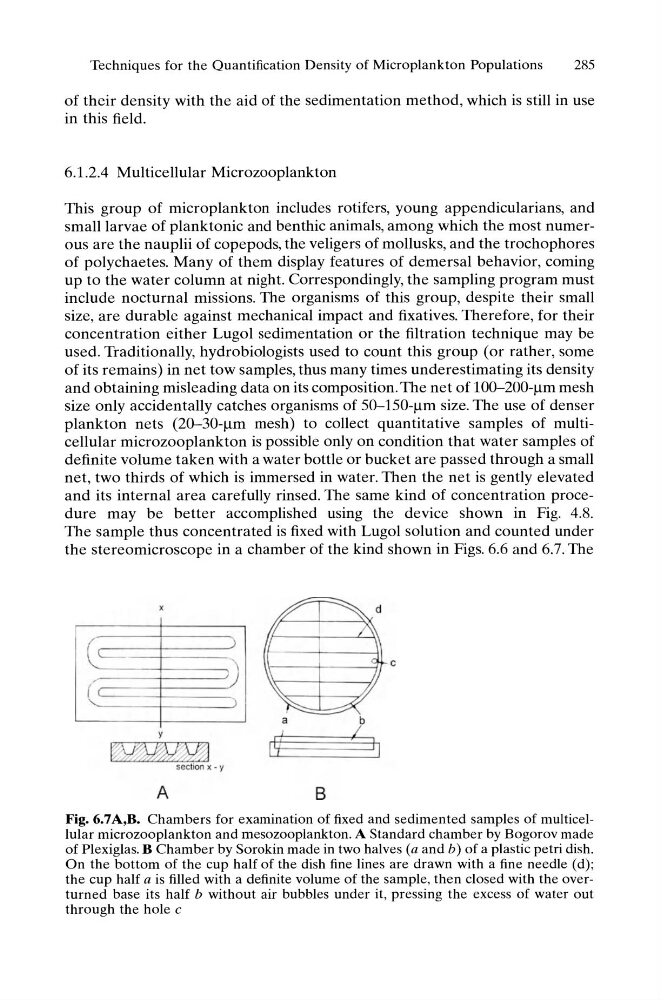
the stereomicroscope in a chamber of the kind shown in Figs. 6.6 and 6.7. The
x
~
(
kY!1!?}2)}ill
sec tion x . y
A
)
))
a
I
I '
I l
c
B
Fig.6.7A,B. Chambers for examination of fixed and sedimented samples of multicellular microzooplankton and mesozooplankton. A Standard chamber by Bogorov made
of Plexiglas. B Chamber by Sorokin made in two halves (a and b) of a plastic petri dish.
On the bottom of the cup half of the dish fine lines are drawn with a fine needle (d);
the cup half a is filled with a definite volume of the sample, then closed with the overturned base its half b without air bubbles under it, pressing the excess of water out
through the hole c
285
of their density with the aid of the sedimentation method, which is still in use
in this field.
6.1.2.4 Multicellular Microzooplankton
This group of microplankton includes rotifers, young appendicularians, and
small larvae of planktonic and benthic animals, among which the most numerous are the nauplii of copepods, the veligers of mollusks, and the trochophores
of polychaetes. Many of them display features of demersal behavior, coming
up to the water column at night. Correspondingly, the sampling program must
include nocturnal missions. The organisms of this group, despite their small
size, are durable against mechanical impact and fixatives. Therefore, for their
concentration either Lugol sedimentation or the filtration technique may be
used. Traditionally, hydrobiologists used to count this group (or rather, some
of its remains) in net tow samples, thus many times underestimating its density
and obtaining misleading data on its composition. The net of 100-200-~m mesh
size only accidentally catches organisms of 50-150-~m size. The use of denser
plankton nets (20-30-~m mesh) to collect quantitative samples of multicellular microzooplankton is possible only on condition that water samples of
definite volume taken with a water bottle or bucket are passed through a small
net, two thirds of which is immersed in water. Then the net is gently elevated
and its internal area carefully rinsed. The same kind of concentration procedure may be better accomplished using the device shown in Fig. 4.8.
The sample thus concentrated is fixed with Lugol solution and counted under
the stereomicroscope in a chamber of the kind shown in Figs. 6.6 and 6.7. The
x
~
(
kY!1!?}2)}ill
sec tion x . y
A
)
))
a
I
I '
I l
c
B
Fig.6.7A,B. Chambers for examination of fixed and sedimented samples of multicellular microzooplankton and mesozooplankton. A Standard chamber by Bogorov made
of Plexiglas. B Chamber by Sorokin made in two halves (a and b) of a plastic petri dish.
On the bottom of the cup half of the dish fine lines are drawn with a fine needle (d);
the cup half a is filled with a definite volume of the sample, then closed with the overturned base its half b without air bubbles under it, pressing the excess of water out
through the hole c