

276
Assay of Some Common Hydrobiological Techniques
from the filtering membrane. The phytoplankton sample thus concentrated is
discharged in the same way into the same serum bottle. The chamber is dismantled and filtering membrane is placed into a petri dish with its filtering
surface placed upwards. Then 5-10ml of water is added to it, and the surface
of the filter is washed with a fine brush to remove the remaining phytoplankton cells. The wash is returned into the same serum bottle. Now the phytoplankton concentrate is ready for counting in any kind of chamber, being
slightly fixed with a very weak Lugol or with 0.3-0.5% (end concentration)
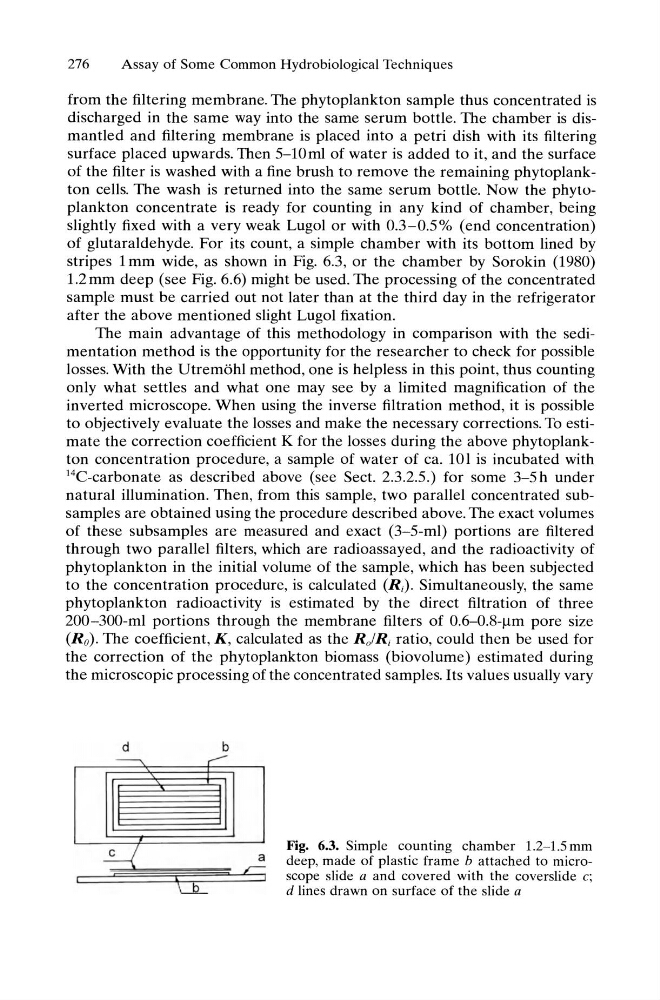
of glutaraldehyde. For its count, a simple chamber with its bottom lined by
stripes 1 mm wide, as shown in Fig. 6.3, or the chamber by Sorokin (1980)
1.2mm deep (see Fig. 6.6) might be used. The processing of the concentrated
sample must be carried out not later than at the third day in the refrigerator
after the above mentioned slight Lugol fixation.
The main advantage of this methodology in comparison with the sedimentation method is the opportunity for the researcher to check for possible
losses. With the Utremohl method, one is helpless in this point, thus counting
only what settles and what one may see by a limited magnification of the
inverted microscope. When using the inverse filtration method, it is possible
to objectively evaluate the losses and make the necessary corrections. To estimate the correction coefficient K for the losses during the above phytoplankton concentration procedure, a sample of water of ca. 101 is incubated with
14C-carbonate as described above (see Sect. 2.3.2.5.) for some 3-5h under
natural illumination. Then, from this sample, two parallel concentrated subsamples are obtained using the procedure described above. The exact volumes
of these subsamples are measured and exact (3-5-ml) portions are filtered
through two parallel filters, which are radioassayed, and the radioactivity of
phytoplankton in the initial volume of the sample, which has been subjected
to the concentration procedure, is calculated (R;). Simultaneously, the same
phytoplankton radioactivity is estimated by the direct filtration of three
200-300-ml portions through the membrane filters of 0.6-0.8-llm pore size
(Ro). The coefficient, K, calculated as the RolRi ratio, could then be used for
the correction of the phytoplankton biomass (biovolume) estimated during
the microscopic processing of the concentrated samples. Its values usually vary
a
G
Fig. 6.3. Simple counting chamber 1.2-1.5 mm
deep, made of plastic frame b attached to microscope slide a and covered with the coverslide c;
d lines drawn on surface of the slide a
Assay of Some Common Hydrobiological Techniques
from the filtering membrane. The phytoplankton sample thus concentrated is
discharged in the same way into the same serum bottle. The chamber is dismantled and filtering membrane is placed into a petri dish with its filtering
surface placed upwards. Then 5-10ml of water is added to it, and the surface
of the filter is washed with a fine brush to remove the remaining phytoplankton cells. The wash is returned into the same serum bottle. Now the phytoplankton concentrate is ready for counting in any kind of chamber, being
slightly fixed with a very weak Lugol or with 0.3-0.5% (end concentration)
of glutaraldehyde. For its count, a simple chamber with its bottom lined by
stripes 1 mm wide, as shown in Fig. 6.3, or the chamber by Sorokin (1980)
1.2mm deep (see Fig. 6.6) might be used. The processing of the concentrated
sample must be carried out not later than at the third day in the refrigerator
after the above mentioned slight Lugol fixation.
The main advantage of this methodology in comparison with the sedimentation method is the opportunity for the researcher to check for possible
losses. With the Utremohl method, one is helpless in this point, thus counting
only what settles and what one may see by a limited magnification of the
inverted microscope. When using the inverse filtration method, it is possible
to objectively evaluate the losses and make the necessary corrections. To estimate the correction coefficient K for the losses during the above phytoplankton concentration procedure, a sample of water of ca. 101 is incubated with
14C-carbonate as described above (see Sect. 2.3.2.5.) for some 3-5h under
natural illumination. Then, from this sample, two parallel concentrated subsamples are obtained using the procedure described above. The exact volumes
of these subsamples are measured and exact (3-5-ml) portions are filtered
through two parallel filters, which are radioassayed, and the radioactivity of
phytoplankton in the initial volume of the sample, which has been subjected
to the concentration procedure, is calculated (R;). Simultaneously, the same
phytoplankton radioactivity is estimated by the direct filtration of three
200-300-ml portions through the membrane filters of 0.6-0.8-llm pore size
(Ro). The coefficient, K, calculated as the RolRi ratio, could then be used for
the correction of the phytoplankton biomass (biovolume) estimated during
the microscopic processing of the concentrated samples. Its values usually vary
a
G
Fig. 6.3. Simple counting chamber 1.2-1.5 mm
deep, made of plastic frame b attached to microscope slide a and covered with the coverslide c;
d lines drawn on surface of the slide a