

254
Use of Radioisotopes to Study Biogeochemical Cycling of Elements
0 10 20 30 40
3
6
9 12
H 0
As
5
3
10
6
15
9
20
12
A
B
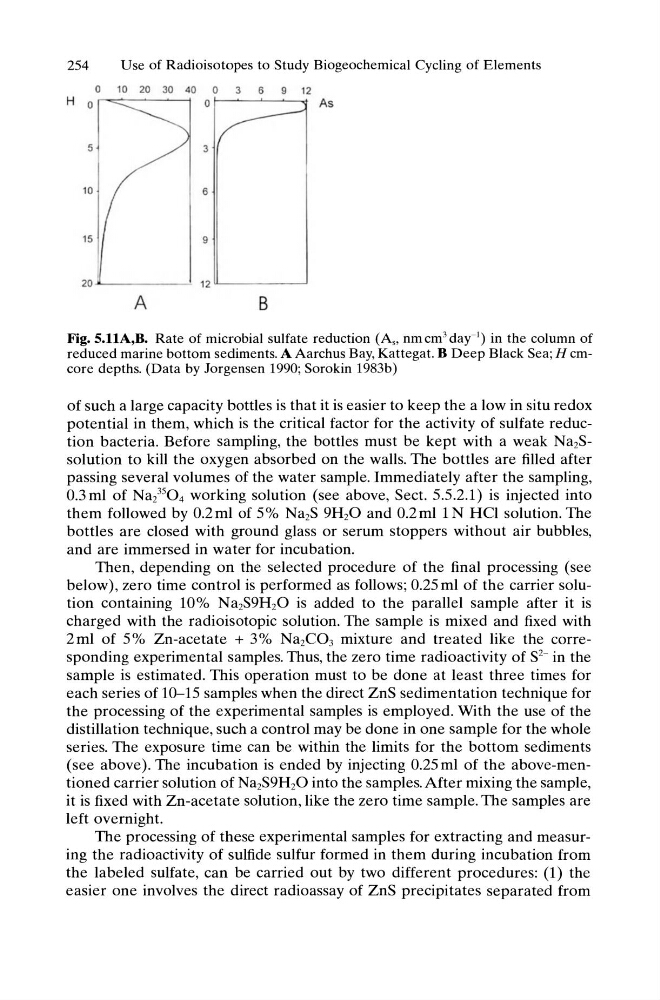
Fig.5.11A,B. Rate of microbial sulfate reduction (A" nmcm 3 day-l) in the column of
reduced marine bottom sediments. A Aarchus Bay, Kattegat. B Deep Black Sea; H cmcore depths. (Data by Jorgensen 1990; Sorokin 1983b)
of such a large capacity bottles is that it is easier to keep the a low in situ redox
potential in them, which is the critical factor for the activity of sulfate reduction bacteria. Before sampling, the bottles must be kept with a weak Na2Ssolution to kill the oxygen absorbed on the walls. The bottles are filled after
passing several volumes of the water sample. Immediately after the sampling,
0.3ml of Na23504 working solution (see above, Sect. 5.5.2.1) is injected into
them followed by 0.2ml of 5% Na2S 9H20 and 0.2ml1N HCl solution. The
bottles are closed with ground glass or serum stoppers without air bubbles,
and are immersed in water for incubation.
Then, depending on the selected procedure of the final processing (see
below), zero time control is performed as follows; 0.25 ml of the carrier solution containing 10% N a2S9H20 is added to the parallel sample after it is
charged with the radioisotopic solution. The sample is mixed and fixed with
2ml of 5% Zn-acetate + 3% Na2C03 mixture and treated like the corresponding experimental samples. Thus, the zero time radioactivity of S2- in the
sample is estimated. This operation must to be done at least three times for
each series of 10--15 samples when the direct ZnS sedimentation technique for
the processing of the experimental samples is employed. With the use of the
distillation technique, such a control may be done in one sample for the whole
series. The exposure time can be within the limits for the bottom sediments
(see above). The incubation is ended by injecting 0.25ml of the above-mentioned carrier solution of N a2S9H20 into the samples. After mixing the sample,
it is fixed with Zn-acetate solution, like the zero time sample. The samples are
left overnight.
The processing of these experimental samples for extracting and measuring the radioactivity of sulfide sulfur formed in them during incubation from
the labeled sulfate, can be carried out by two different procedures: (1) the
easier one involves the direct radioassay of ZnS precipitates separated from
Use of Radioisotopes to Study Biogeochemical Cycling of Elements
0 10 20 30 40
3
6
9 12
H 0
As
5
3
10
6
15
9
20
12
A
B
Fig.5.11A,B. Rate of microbial sulfate reduction (A" nmcm 3 day-l) in the column of
reduced marine bottom sediments. A Aarchus Bay, Kattegat. B Deep Black Sea; H cmcore depths. (Data by Jorgensen 1990; Sorokin 1983b)
of such a large capacity bottles is that it is easier to keep the a low in situ redox
potential in them, which is the critical factor for the activity of sulfate reduction bacteria. Before sampling, the bottles must be kept with a weak Na2Ssolution to kill the oxygen absorbed on the walls. The bottles are filled after
passing several volumes of the water sample. Immediately after the sampling,
0.3ml of Na23504 working solution (see above, Sect. 5.5.2.1) is injected into
them followed by 0.2ml of 5% Na2S 9H20 and 0.2ml1N HCl solution. The
bottles are closed with ground glass or serum stoppers without air bubbles,
and are immersed in water for incubation.
Then, depending on the selected procedure of the final processing (see
below), zero time control is performed as follows; 0.25 ml of the carrier solution containing 10% N a2S9H20 is added to the parallel sample after it is
charged with the radioisotopic solution. The sample is mixed and fixed with
2ml of 5% Zn-acetate + 3% Na2C03 mixture and treated like the corresponding experimental samples. Thus, the zero time radioactivity of S2- in the
sample is estimated. This operation must to be done at least three times for
each series of 10--15 samples when the direct ZnS sedimentation technique for
the processing of the experimental samples is employed. With the use of the
distillation technique, such a control may be done in one sample for the whole
series. The exposure time can be within the limits for the bottom sediments
(see above). The incubation is ended by injecting 0.25ml of the above-mentioned carrier solution of N a2S9H20 into the samples. After mixing the sample,
it is fixed with Zn-acetate solution, like the zero time sample. The samples are
left overnight.
The processing of these experimental samples for extracting and measuring the radioactivity of sulfide sulfur formed in them during incubation from
the labeled sulfate, can be carried out by two different procedures: (1) the
easier one involves the direct radioassay of ZnS precipitates separated from