

252
Use of Radioisotopes to Study Biogeochemical Cycling of Elements
R.x S x 24 X 10 3
2
3
-1
2
3
1
I
r
flgS -dm- day , or flg at S -dm- day- , if R; is
txV
radioactivity of S2- sulfur measured in the whole volume of absorbing liquid
and corrected for Ro, cpm; t is the incubation time, h; V is the volume of wet
sediment taken into the experimental vessels, cm 3 .
5.6.2.3 The Core Method
The procedure given here is a modified version of that by Jorgensen (1978).
The deviations from the original are: (1) presence of a carrier in the 35S0/-_
solution injected into the cores, (2) increased number of vertical punctures and
reduced amount of sectors taken for analysis, and (3) softened procedure of
H 2S distillation to reduce the losses of 35S2- radioactivity during the formation
of pyrite and So.
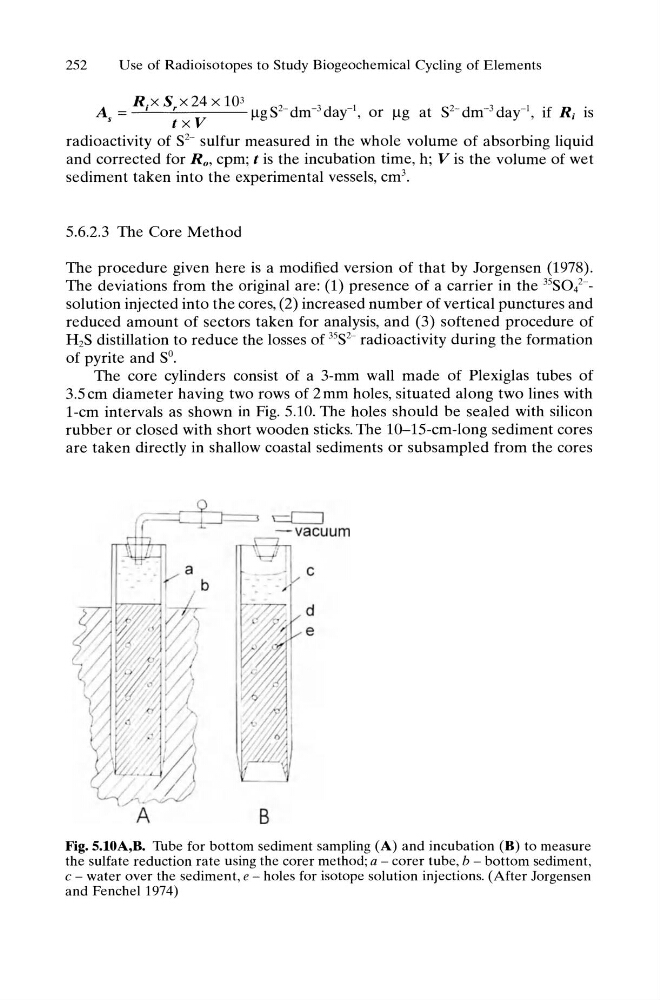
The core cylinders consist of a 3-mm wall made of Plexiglas tubes of
3.5 cm diameter having two rows of 2 mm holes, situated along two lines with
1-cm intervals as shown in Fig. 5.10. The holes should be sealed with silicon
rubber or closed with short wooden sticks. The 1O-15-cm-Iong sediment cores
are taken directly in shallow coastal sediments or subsampled from the cores
c=e:=::J
- vacuum
c
d
e
Fig.5.10A,B. Tube for bottom sediment sampling (A) and incubation (B) to measure
the sulfate reduction rate using the corer method; a - corer tube, b - bottom sediment,
c - water over the sediment, e - holes for isotope solution injections. (After Jorgensen
and Fenchel 1974)
Use of Radioisotopes to Study Biogeochemical Cycling of Elements
R.x S x 24 X 10 3
2
3
-1
2
3
1
I
r
flgS -dm- day , or flg at S -dm- day- , if R; is
txV
radioactivity of S2- sulfur measured in the whole volume of absorbing liquid
and corrected for Ro, cpm; t is the incubation time, h; V is the volume of wet
sediment taken into the experimental vessels, cm 3 .
5.6.2.3 The Core Method
The procedure given here is a modified version of that by Jorgensen (1978).
The deviations from the original are: (1) presence of a carrier in the 35S0/-_
solution injected into the cores, (2) increased number of vertical punctures and
reduced amount of sectors taken for analysis, and (3) softened procedure of
H 2S distillation to reduce the losses of 35S2- radioactivity during the formation
of pyrite and So.
The core cylinders consist of a 3-mm wall made of Plexiglas tubes of
3.5 cm diameter having two rows of 2 mm holes, situated along two lines with
1-cm intervals as shown in Fig. 5.10. The holes should be sealed with silicon
rubber or closed with short wooden sticks. The 1O-15-cm-Iong sediment cores
are taken directly in shallow coastal sediments or subsampled from the cores
c=e:=::J
- vacuum
c
d
e
Fig.5.10A,B. Tube for bottom sediment sampling (A) and incubation (B) to measure
the sulfate reduction rate using the corer method; a - corer tube, b - bottom sediment,
c - water over the sediment, e - holes for isotope solution injections. (After Jorgensen
and Fenchel 1974)