

Determination of Microbial Production
211
3.2
"c
2.8
2.4
2.0
6
6
• •
1.6 616
. .
t
•
1.2
••
• - 1
..
0.8
•
6- 2
«t.
6 •
0.4
. • •
0
0.4
0 .8 1.2 1.6 2.0
3H
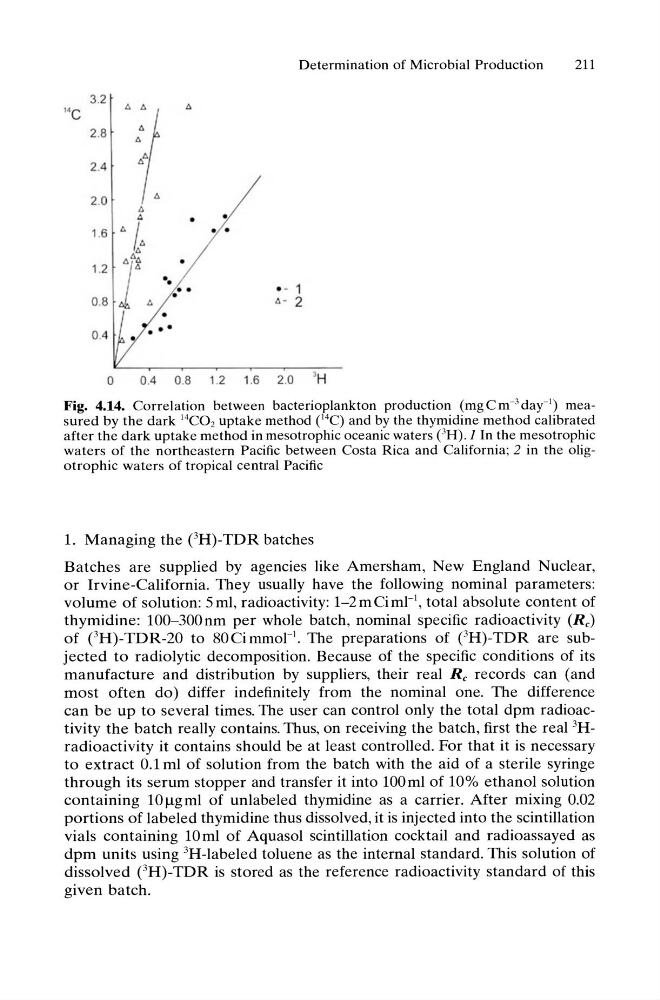
Fig. 4.14. Correlation between bacterioplankton production (mg C m- 3 day-I) measured by the dark 14C02 uptake method C 4 C) and by the thymidine method calibrated
after the dark uptake method in mesotrophic oceanic waters eH).l In the mesotrophic
waters of the northeastern Pacific between Costa Rica and California; 2 in the oligotrophic waters of tropical central Pacific
1. Managing the CH)-TDR batches
Batches are supplied by agencies like Amersham, New England Nuclear,
or Irvine-California. They usually have the following nominal parameters:
volume of solution: Sml, radioactivity: 1-2mCiml-\ total absolute content of
thymidine: 100-300nm per whole batch, nominal specific radioactivity (Re)
of CH)-TDR-20 to 80Cimmol- l . The preparations of CH)-TDR are subjected to radiolytic decomposition. Because of the specific conditions of its
manufacture and distribution by suppliers, their real Rc records can (and
most often do) differ indefinitely from the nominal one. The difference
can be up to several times. The user can control only the total dpm radioactivity the batch really contains. Thus, on receiving the batch, first the real 3H_
radioactivity it contains should be at least controlled. For that it is necessary
to extract 0.1 ml of solution from the batch with the aid of a sterile syringe
through its serum stopper and transfer it into 100ml of 10% ethanol solution
containing 10~gml of unlabeled thymidine as a carrier. After mixing 0.02
portions of labeled thymidine thus dissolved, it is injected into the scintillation
vials containing 10ml of Aquasol scintillation cocktail and radioassayed as
dpm units using 3H-Iabeled toluene as the internal standard. This solution of
dissolved CH)-TDR is stored as the reference radioactivity standard of this
given batch.
211
3.2
"c
2.8
2.4
2.0
6
6
• •
1.6 616
. .
t
•
1.2
••
• - 1
..
0.8
•
6- 2
«t.
6 •
0.4
. • •
0
0.4
0 .8 1.2 1.6 2.0
3H
Fig. 4.14. Correlation between bacterioplankton production (mg C m- 3 day-I) measured by the dark 14C02 uptake method C 4 C) and by the thymidine method calibrated
after the dark uptake method in mesotrophic oceanic waters eH).l In the mesotrophic
waters of the northeastern Pacific between Costa Rica and California; 2 in the oligotrophic waters of tropical central Pacific
1. Managing the CH)-TDR batches
Batches are supplied by agencies like Amersham, New England Nuclear,
or Irvine-California. They usually have the following nominal parameters:
volume of solution: Sml, radioactivity: 1-2mCiml-\ total absolute content of
thymidine: 100-300nm per whole batch, nominal specific radioactivity (Re)
of CH)-TDR-20 to 80Cimmol- l . The preparations of CH)-TDR are subjected to radiolytic decomposition. Because of the specific conditions of its
manufacture and distribution by suppliers, their real Rc records can (and
most often do) differ indefinitely from the nominal one. The difference
can be up to several times. The user can control only the total dpm radioactivity the batch really contains. Thus, on receiving the batch, first the real 3H_
radioactivity it contains should be at least controlled. For that it is necessary
to extract 0.1 ml of solution from the batch with the aid of a sterile syringe
through its serum stopper and transfer it into 100ml of 10% ethanol solution
containing 10~gml of unlabeled thymidine as a carrier. After mixing 0.02
portions of labeled thymidine thus dissolved, it is injected into the scintillation
vials containing 10ml of Aquasol scintillation cocktail and radioassayed as
dpm units using 3H-Iabeled toluene as the internal standard. This solution of
dissolved CH)-TDR is stored as the reference radioactivity standard of this
given batch.