

188
Use of Radioisotopic Methodology in Aquatic Microbial Ecology
Ri
8
Pb
1,2
0 ,8
0 ,6
0,4
0,2
0
o
4
8
12
16
20
24 t
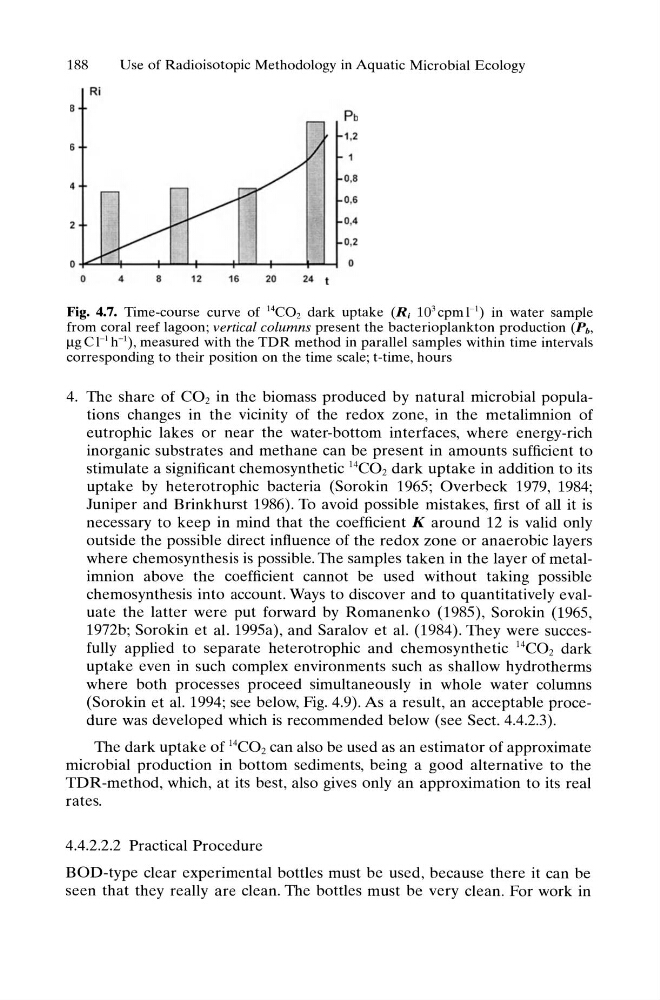
Fig. 4.7. Time-course curve of 14C02 dark uptake (R; l03 cpm l-l) in water sample
from coral reef lagoon; vertical columns present the bacterioplankton production (Pb,
IlgCl-lh-I), measured with the TDR method in parallel samples within time intervals
corresponding to their position on the time scale; t-time, hours
4. The share of CO2 in the biomass produced by natural microbial populations changes in the vicinity of the redox zone, in the metalimnion of
eutrophic lakes or near the water-bottom interfaces, where energy-rich
inorganic substrates and methane can be present in amounts sufficient to
stimulate a significant chemosynthetic 14C02 dark uptake in addition to its
uptake by heterotrophic bacteria (Sorokin 1965; Overbeck 1979, 1984;
Juniper and Brinkhurst 1986). To avoid possible mistakes, first of all it is
necessary to keep in mind that the coefficient K around 12 is valid only
outside the possible direct influence of the redox zone or anaerobic layers
where chemosynthesis is possible. The samples taken in the layer of metalimnion above the coefficient cannot be used without taking possible
chemosynthesis into account. Ways to discover and to quantitatively evaluate the latter were put forward by Romanenko (1985), Sorokin (1965,
1972b; Sorokin et al. 1995a), and Saralov et al. (1984). They were succesfully applied to separate heterotrophic and chemosynthetic 14C02 dark
uptake even in such complex environments such as shallow hydrotherms
where both processes proceed simultaneously in whole water columns
(Sorokin et al. 1994; see below, Fig. 4.9). As a result, an acceptable procedure was developed which is recommended below (see Sect. 4.4.2.3).
The dark uptake of 14C02 can also be used as an estimator of approximate
microbial production in bottom sediments, being a good alternative to the
TDR-method, which, at its best, also gives only an approximation to its real
rates.
4.4.2.2.2 Practical Procedure
BOD-type clear experimental bottles must be used, because there it can be
seen that they really are clean. The bottles must be very clean. For work in
Use of Radioisotopic Methodology in Aquatic Microbial Ecology
Ri
8
Pb
1,2
0 ,8
0 ,6
0,4
0,2
0
o
4
8
12
16
20
24 t
Fig. 4.7. Time-course curve of 14C02 dark uptake (R; l03 cpm l-l) in water sample
from coral reef lagoon; vertical columns present the bacterioplankton production (Pb,
IlgCl-lh-I), measured with the TDR method in parallel samples within time intervals
corresponding to their position on the time scale; t-time, hours
4. The share of CO2 in the biomass produced by natural microbial populations changes in the vicinity of the redox zone, in the metalimnion of
eutrophic lakes or near the water-bottom interfaces, where energy-rich
inorganic substrates and methane can be present in amounts sufficient to
stimulate a significant chemosynthetic 14C02 dark uptake in addition to its
uptake by heterotrophic bacteria (Sorokin 1965; Overbeck 1979, 1984;
Juniper and Brinkhurst 1986). To avoid possible mistakes, first of all it is
necessary to keep in mind that the coefficient K around 12 is valid only
outside the possible direct influence of the redox zone or anaerobic layers
where chemosynthesis is possible. The samples taken in the layer of metalimnion above the coefficient cannot be used without taking possible
chemosynthesis into account. Ways to discover and to quantitatively evaluate the latter were put forward by Romanenko (1985), Sorokin (1965,
1972b; Sorokin et al. 1995a), and Saralov et al. (1984). They were succesfully applied to separate heterotrophic and chemosynthetic 14C02 dark
uptake even in such complex environments such as shallow hydrotherms
where both processes proceed simultaneously in whole water columns
(Sorokin et al. 1994; see below, Fig. 4.9). As a result, an acceptable procedure was developed which is recommended below (see Sect. 4.4.2.3).
The dark uptake of 14C02 can also be used as an estimator of approximate
microbial production in bottom sediments, being a good alternative to the
TDR-method, which, at its best, also gives only an approximation to its real
rates.
4.4.2.2.2 Practical Procedure
BOD-type clear experimental bottles must be used, because there it can be
seen that they really are clean. The bottles must be very clean. For work in