

178
Use of Radioisotopic Methodology in Aquatic Microbial Ecology
rongro/cd
producliol1 of
spring
dimom~
"blooms"
Fossi l
melhane
("alch
mnmmalian
I) "
:!
ScdimCllb
~
o
o
Allochthonous
organic
arri\ I!d
from Ihe
la nd
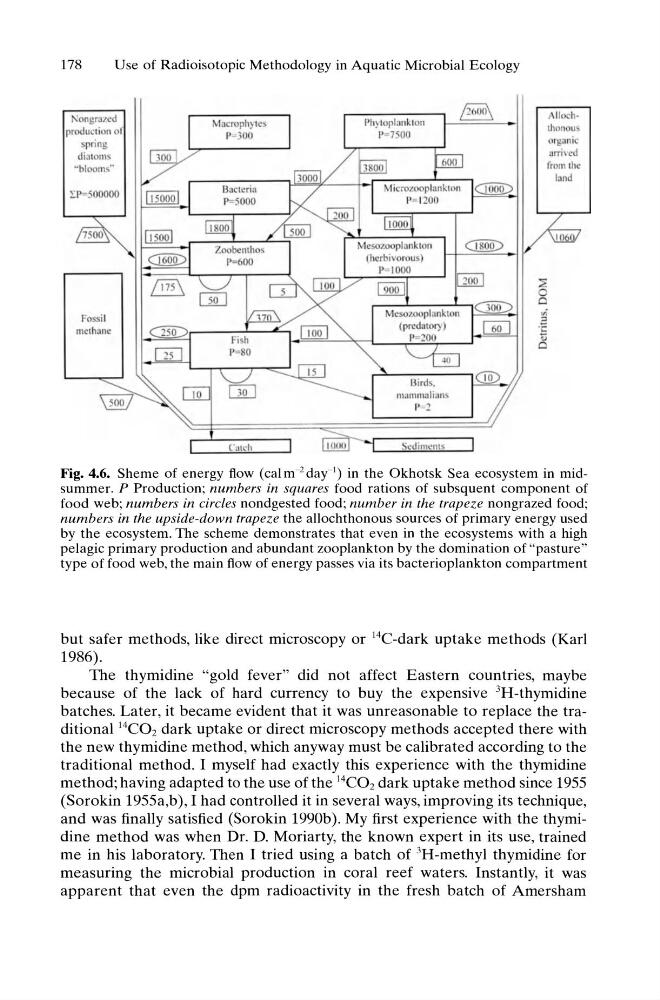
Fig. 4.6. Sheme of energy flow (cal m- 2 day-I) in the Okhotsk Sea ecosystem in midsummer. P Production; numbers in squares food rations of subsquent component of
food web; numbers in circles nondgested food; number in the trapeze nongrazed food;
numbers in the upside-down trapeze the allochthonous sources of primary energy used
by the ecosystem. The scheme demonstrates that even in the ecosystems with a high
pelagic primary production and abundant zooplankton by the domination of "pasture"
type of food web, the main flow of energy passes via its bacterioplankton compartment
but safer methods, like direct microscopy or 14C-dark uptake methods (Karl
1986).
The thymidine "gold fever" did not affect Eastern countries, maybe
because of the lack of hard currency to buy the expensive 3H-thymidine
batches. Later, it became evident that it was unreasonable to replace the traditional 14C02 dark uptake or direct microscopy methods accepted there with
the new thymidine method, which anyway must be calibrated according to the
traditional method. I myself had exactly this experience with the thymidine
method; having adapted to the use of the 14C02 dark uptake method since 1955
(Sorokin 1955a,b), I had controlled it in several ways, improving its technique,
and was finally satisfied (Sorokin 1990b). My first experience with the thymidine method was when Dr. D. Moriarty, the known expert in its use, trained
me in his laboratory. Then I tried using a batch of 3H-methyl thymidine for
measuring the microbial production in coral reef waters. Instantly, it was
apparent that even the dpm radioactivity in the fresh batch of Amersham
Use of Radioisotopic Methodology in Aquatic Microbial Ecology
rongro/cd
producliol1 of
spring
dimom~
"blooms"
Fossi l
melhane
("alch
mnmmalian
I) "
:!
ScdimCllb
~
o
o
Allochthonous
organic
arri\ I!d
from Ihe
la nd
Fig. 4.6. Sheme of energy flow (cal m- 2 day-I) in the Okhotsk Sea ecosystem in midsummer. P Production; numbers in squares food rations of subsquent component of
food web; numbers in circles nondgested food; number in the trapeze nongrazed food;
numbers in the upside-down trapeze the allochthonous sources of primary energy used
by the ecosystem. The scheme demonstrates that even in the ecosystems with a high
pelagic primary production and abundant zooplankton by the domination of "pasture"
type of food web, the main flow of energy passes via its bacterioplankton compartment
but safer methods, like direct microscopy or 14C-dark uptake methods (Karl
1986).
The thymidine "gold fever" did not affect Eastern countries, maybe
because of the lack of hard currency to buy the expensive 3H-thymidine
batches. Later, it became evident that it was unreasonable to replace the traditional 14C02 dark uptake or direct microscopy methods accepted there with
the new thymidine method, which anyway must be calibrated according to the
traditional method. I myself had exactly this experience with the thymidine
method; having adapted to the use of the 14C02 dark uptake method since 1955
(Sorokin 1955a,b), I had controlled it in several ways, improving its technique,
and was finally satisfied (Sorokin 1990b). My first experience with the thymidine method was when Dr. D. Moriarty, the known expert in its use, trained
me in his laboratory. Then I tried using a batch of 3H-methyl thymidine for
measuring the microbial production in coral reef waters. Instantly, it was
apparent that even the dpm radioactivity in the fresh batch of Amersham