

c
e
Determination of the in Situ Decomposition Rates
175
0 - -
~
9
I
to vacuum
e
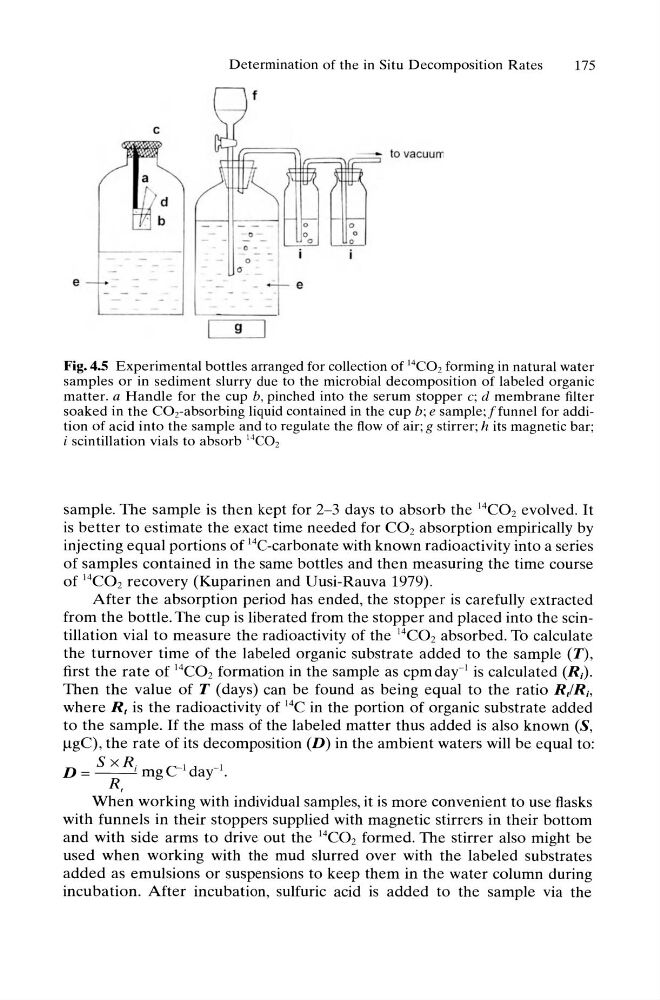
Fig.4.5 Experimental bottles arranged for collection of 14C02 forming in natural water
samples or in sediment slurry due to the microbial decomposition of labeled organic
matter. a Handle for the cup b, pinched into the serum stopper c; d membrane filter
soaked in the COz-absorbing liquid contained in the cup b; e sample;ffunnel for addition of acid into the sample and to regulate the flow of air; g stirrer; h its magnetic bar;
i scintillation vials to absorb 14C02
sample. The sample is then kept for 2-3 days to absorb the 14C02 evolved. It
is better to estimate the exact time needed for CO2 absorption empirically by
injecting equal portions of 14C-carbonate with known radioactivity into a series
of samples contained in the same bottles and then measuring the time course
of 14C02 recovery (Kuparinen and Uusi-Rauva 1979).
After the absorption period has ended, the stopper is carefully extracted
from the bottle. The cup is liberated from the stopper and placed into the scintillation vial to measure the radioactivity of the 14C02 absorbed. To calculate
the turnover time of the labeled organic substrate added to the sample (T),
first the rate of 14C02 formation in the sample as cpmday-l is calculated (R;).
Then the value of T (days) can be found as being equal to the ratio R/R;,
where R t is the radioactivity of 14C in the portion of organic substrate added
to the sample. If the mass of the labeled matter thus added is also known (S,
J.!gC), the rate of its decomposition (D) in the ambient waters will be equal to:
D = S X Ri mg C- 1 day-I.
R,
When working with individual samples, it is more convenient to use flasks
with funnels in their stoppers supplied with magnetic stirrers in their bottom
and with side arms to drive out the 14C02 formed. The stirrer also might be
used when working with the mud slurred over with the labeled substrates
added as emulsions or suspensions to keep them in the water column during
incubation. After incubation, sulfuric acid is added to the sample via the
e
Determination of the in Situ Decomposition Rates
175
0 - -
~
9
I
to vacuum
e
Fig.4.5 Experimental bottles arranged for collection of 14C02 forming in natural water
samples or in sediment slurry due to the microbial decomposition of labeled organic
matter. a Handle for the cup b, pinched into the serum stopper c; d membrane filter
soaked in the COz-absorbing liquid contained in the cup b; e sample;ffunnel for addition of acid into the sample and to regulate the flow of air; g stirrer; h its magnetic bar;
i scintillation vials to absorb 14C02
sample. The sample is then kept for 2-3 days to absorb the 14C02 evolved. It
is better to estimate the exact time needed for CO2 absorption empirically by
injecting equal portions of 14C-carbonate with known radioactivity into a series
of samples contained in the same bottles and then measuring the time course
of 14C02 recovery (Kuparinen and Uusi-Rauva 1979).
After the absorption period has ended, the stopper is carefully extracted
from the bottle. The cup is liberated from the stopper and placed into the scintillation vial to measure the radioactivity of the 14C02 absorbed. To calculate
the turnover time of the labeled organic substrate added to the sample (T),
first the rate of 14C02 formation in the sample as cpmday-l is calculated (R;).
Then the value of T (days) can be found as being equal to the ratio R/R;,
where R t is the radioactivity of 14C in the portion of organic substrate added
to the sample. If the mass of the labeled matter thus added is also known (S,
J.!gC), the rate of its decomposition (D) in the ambient waters will be equal to:
D = S X Ri mg C- 1 day-I.
R,
When working with individual samples, it is more convenient to use flasks
with funnels in their stoppers supplied with magnetic stirrers in their bottom
and with side arms to drive out the 14C02 formed. The stirrer also might be
used when working with the mud slurred over with the labeled substrates
added as emulsions or suspensions to keep them in the water column during
incubation. After incubation, sulfuric acid is added to the sample via the