

Determination of the in Situ Decomposition Rates
171
When using TDR as an indicator of relative microbial activity in these
experiments, in general their protocol remains the same, with one difference.
The samples are charged with 0.02-ml portions of TDR working solution prepared as described above in point (1) just after the specific organic substrate
is added to them. They are incubated at 18-20DC for 3-5h. Then they are
filtered through 0.45-llm Sartorius membrane filters, which are rinsed once
with 3 ml of prefiltered natural water, three times with 1 ml of 5% ice cold
trichloroacetic acid (TCA), and then radioassayed. Again, a relative abundance of specific heterotrophic bacteria able to decompose a given organic
substrate is related to the difference in radioactivity measured in samples with
and without this substrate added.
4.3 Determination of the in situ Decomposition Rates
4.3.1 General Remarks
Decomposition of organic matter is a basic function of aquatic microbial populations. As in a single bacterial cell, it occurs in them due to the participation
of oxidative assimilation mechanisms. It means that one larger part of organic
substrate involved in this process is respired by bacteria and the other is
incorporated in their cells via mechanisms of active transport and used for
biosynthesis and growth. The efficiency of the use of assimilated organic
matter for growth in bacteria (Krcoefficient) varies, depending upon its composition from 0.4 in relation to the easily utilizable proteinaceous substrates
or amino acids to moderate (0.3) in relation to sugars, fatty acids, and natural
dissolved organic matter, and down to values as low as 0.20 to 0.25 in relation
to polymers like polysaccharides, or to compounds with complex molecules
like hydrocarbons. Because of this coupling of growth and respiration in
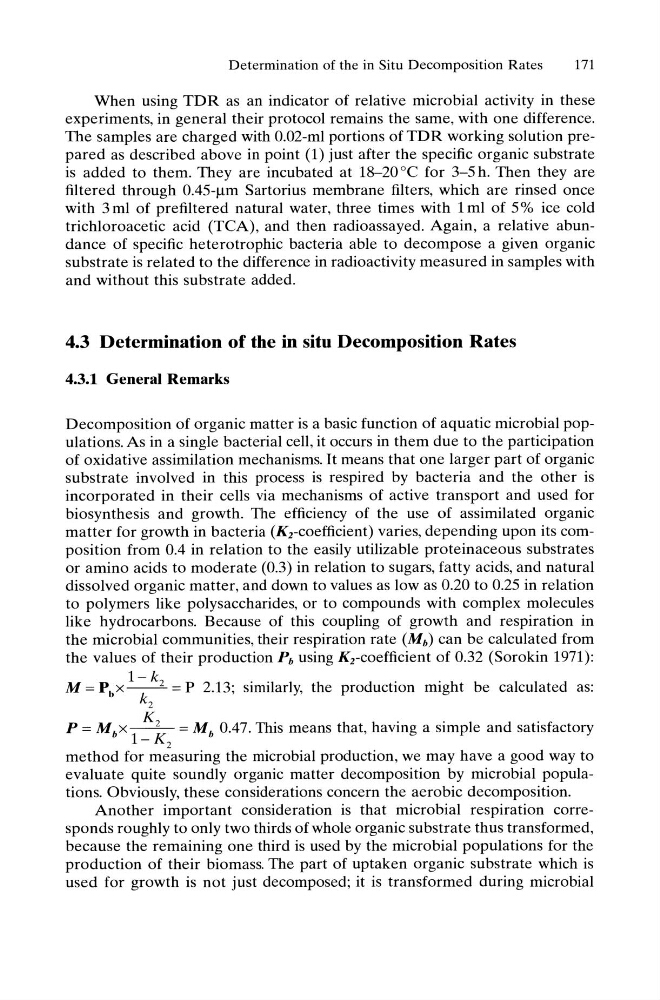
the microbial communities, their respiration rate (Mb) can be calculated from
the values of their production P b using Krcoefficient of 0.32 (Sorokin 1971):
1-k
M = Pbx-_ Z = P 2.13; similarly, the production might be calculated as:
k z
P = MbX~ = Mb 0.47. This means that, having a simple and satisfactory
1-K2
method for measuring the microbial production, we may have a good way to
evaluate quite soundly organic matter decomposition by microbial populations. Obviously, these considerations concern the aerobic decomposition.
Another important consideration is that microbial respiration corresponds roughly to only two thirds of whole organic substrate thus transformed,
because the remaining one third is used by the microbial populations for the
production of their biomass. The part of uptaken organic substrate which is
used for growth is not just decomposed; it is transformed during microbial
171
When using TDR as an indicator of relative microbial activity in these
experiments, in general their protocol remains the same, with one difference.
The samples are charged with 0.02-ml portions of TDR working solution prepared as described above in point (1) just after the specific organic substrate
is added to them. They are incubated at 18-20DC for 3-5h. Then they are
filtered through 0.45-llm Sartorius membrane filters, which are rinsed once
with 3 ml of prefiltered natural water, three times with 1 ml of 5% ice cold
trichloroacetic acid (TCA), and then radioassayed. Again, a relative abundance of specific heterotrophic bacteria able to decompose a given organic
substrate is related to the difference in radioactivity measured in samples with
and without this substrate added.
4.3 Determination of the in situ Decomposition Rates
4.3.1 General Remarks
Decomposition of organic matter is a basic function of aquatic microbial populations. As in a single bacterial cell, it occurs in them due to the participation
of oxidative assimilation mechanisms. It means that one larger part of organic
substrate involved in this process is respired by bacteria and the other is
incorporated in their cells via mechanisms of active transport and used for
biosynthesis and growth. The efficiency of the use of assimilated organic
matter for growth in bacteria (Krcoefficient) varies, depending upon its composition from 0.4 in relation to the easily utilizable proteinaceous substrates
or amino acids to moderate (0.3) in relation to sugars, fatty acids, and natural
dissolved organic matter, and down to values as low as 0.20 to 0.25 in relation
to polymers like polysaccharides, or to compounds with complex molecules
like hydrocarbons. Because of this coupling of growth and respiration in
the microbial communities, their respiration rate (Mb) can be calculated from
the values of their production P b using Krcoefficient of 0.32 (Sorokin 1971):
1-k
M = Pbx-_ Z = P 2.13; similarly, the production might be calculated as:
k z
P = MbX~ = Mb 0.47. This means that, having a simple and satisfactory
1-K2
method for measuring the microbial production, we may have a good way to
evaluate quite soundly organic matter decomposition by microbial populations. Obviously, these considerations concern the aerobic decomposition.
Another important consideration is that microbial respiration corresponds roughly to only two thirds of whole organic substrate thus transformed,
because the remaining one third is used by the microbial populations for the
production of their biomass. The part of uptaken organic substrate which is
used for growth is not just decomposed; it is transformed during microbial