

Estimation of Relative Microbial Activity in Aquatic Habitats
169
glutamate its dilution in natural waters can be ignored. During the calculation
of absolute incorporation rates it will be negligible. Concerning protein
hydrolyzate (or more exactly algal hydrolyzate), such a correction may be
introduced if the approximate amino acid content in the water of a given basin
is known; but this correction cannot in any case be expected to be more than
5-10%, and thus may also be neglected without sigmticant error.
The value of R;-radioactivity of bacteria counted on filters corresponds
only to the incorporated part of the labeled organic substrate consumed by
them. Its whole amount taken up by bacteria (RJ is equal to the sum of Ri
plus its respired part (Rm). The efficiency of the use of consumed organic
matter to growth (K2 ) natural bacterioplankton in accordance with different
data ranges between 0.21 to 0.60 (Sorokin 1971; Pedros Alio and Brock 1982;
Kuparinen 1984; Romanenko 1985; Bjornsen and Kuparinen 1991). We have
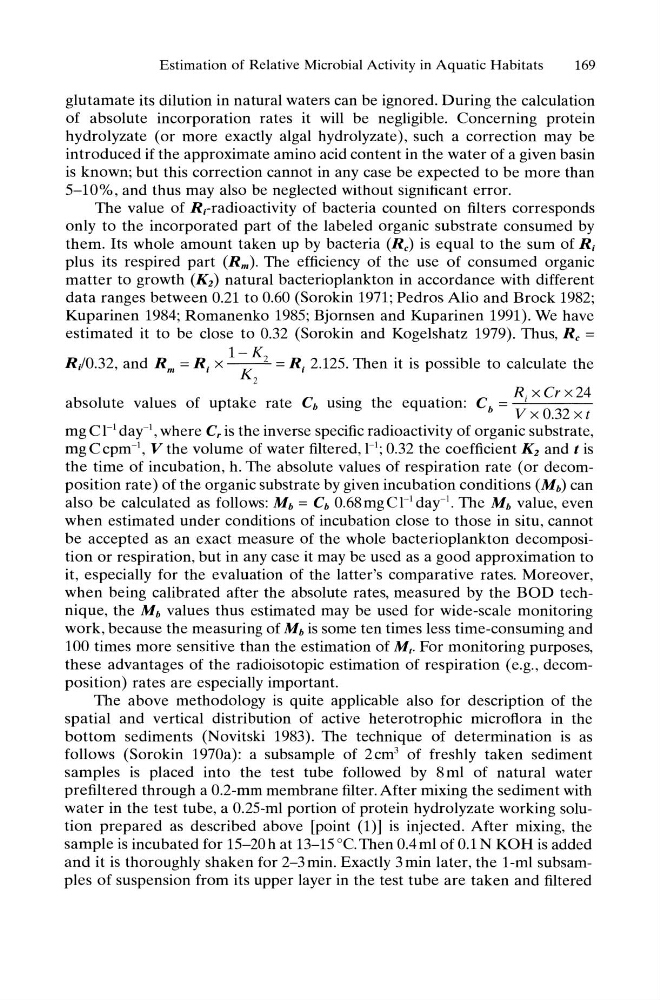
estimated it to be close to 0.32 (Sorokin and Kogelshatz 1979). Thus, Re =
1-K
R;l0.32, and Rm = Ri X T = Ri 2.125. Then it is possible to calculate the
2
.
R. xCrx24
absolute values of uptake rate Cb usmg the equation: C b = ---'-,---Vx 0.32 Xl
mg Cl- 1 day-I, where Cr is the inverse specific radioactivity of organic substrate,
mg C cpm- l , V the volume of water filtered, 1-1; 0.32 the coefficient K2 and tis
the time of incubation, h. The absolute values of respiration rate (or decomposition rate) of the organic substrate by given incubation conditions (Mb) can
also be calculated as follows: Mb = Cb 0.68mgCI- 1 day-l. The Mb value, even
when estimated under conditions of incubation close to those in situ, cannot
be accepted as an exact measure of the whole bacterioplankton decomposition or respiration, but in any case it may be used as a good approximation to
it, especially for the evaluation of the latter's comparative rates. Moreover,
when being calibrated after the absolute rates, measured by the BOD technique, the Mb values thus estimated may be used for wide-scale monitoring
work, because the measuring of Mb is some ten times less time-consuming and
100 times more sensitive than the estimation of M,. For monitoring purposes,
these advantages of the radioisotopic estimation of respiration (e.g., decomposition) rates are especially important.
The above methodology is quite applicable also for description of the
spatial and vertical distribution of active heterotrophic microfiora in the
bottom sediments (Novitski 1983). The technique of determination is as
follows (Sorokin 1970a): a subsample of 2cm 3 of freshly taken sediment
samples is placed into the test tube followed by 8 ml of natural water
prefiltered through a O.2-mm membrane filter. After mixing the sediment with
water in the test tube, a 0.25-ml portion of protein hydrolyzate working solution prepared as described above [point (1)] is injected. After mixing, the
sample is incubated for 15-20h at 13-15 0c. Then O.4ml of 0.1 N KOH is added
and it is thoroughly shaken for 2-3 min. Exactly 3 min later, the 1-ml subsampIes of suspension from its upper layer in the test tube are taken and filtered
169
glutamate its dilution in natural waters can be ignored. During the calculation
of absolute incorporation rates it will be negligible. Concerning protein
hydrolyzate (or more exactly algal hydrolyzate), such a correction may be
introduced if the approximate amino acid content in the water of a given basin
is known; but this correction cannot in any case be expected to be more than
5-10%, and thus may also be neglected without sigmticant error.
The value of R;-radioactivity of bacteria counted on filters corresponds
only to the incorporated part of the labeled organic substrate consumed by
them. Its whole amount taken up by bacteria (RJ is equal to the sum of Ri
plus its respired part (Rm). The efficiency of the use of consumed organic
matter to growth (K2 ) natural bacterioplankton in accordance with different
data ranges between 0.21 to 0.60 (Sorokin 1971; Pedros Alio and Brock 1982;
Kuparinen 1984; Romanenko 1985; Bjornsen and Kuparinen 1991). We have
estimated it to be close to 0.32 (Sorokin and Kogelshatz 1979). Thus, Re =
1-K
R;l0.32, and Rm = Ri X T = Ri 2.125. Then it is possible to calculate the
2
.
R. xCrx24
absolute values of uptake rate Cb usmg the equation: C b = ---'-,---Vx 0.32 Xl
mg Cl- 1 day-I, where Cr is the inverse specific radioactivity of organic substrate,
mg C cpm- l , V the volume of water filtered, 1-1; 0.32 the coefficient K2 and tis
the time of incubation, h. The absolute values of respiration rate (or decomposition rate) of the organic substrate by given incubation conditions (Mb) can
also be calculated as follows: Mb = Cb 0.68mgCI- 1 day-l. The Mb value, even
when estimated under conditions of incubation close to those in situ, cannot
be accepted as an exact measure of the whole bacterioplankton decomposition or respiration, but in any case it may be used as a good approximation to
it, especially for the evaluation of the latter's comparative rates. Moreover,
when being calibrated after the absolute rates, measured by the BOD technique, the Mb values thus estimated may be used for wide-scale monitoring
work, because the measuring of Mb is some ten times less time-consuming and
100 times more sensitive than the estimation of M,. For monitoring purposes,
these advantages of the radioisotopic estimation of respiration (e.g., decomposition) rates are especially important.
The above methodology is quite applicable also for description of the
spatial and vertical distribution of active heterotrophic microfiora in the
bottom sediments (Novitski 1983). The technique of determination is as
follows (Sorokin 1970a): a subsample of 2cm 3 of freshly taken sediment
samples is placed into the test tube followed by 8 ml of natural water
prefiltered through a O.2-mm membrane filter. After mixing the sediment with
water in the test tube, a 0.25-ml portion of protein hydrolyzate working solution prepared as described above [point (1)] is injected. After mixing, the
sample is incubated for 15-20h at 13-15 0c. Then O.4ml of 0.1 N KOH is added
and it is thoroughly shaken for 2-3 min. Exactly 3 min later, the 1-ml subsampIes of suspension from its upper layer in the test tube are taken and filtered