

4
General Features of Radioisotopic Methodology
efficiency of counting its radioactivity, and the specific radioactivity of labeling with a given radioisotope substance or biological material.
Atomic disintegration proceeds according to the exponential law
described by the equation: Nt =0 No e- l , if No is the initial number of atoms of
a given radioisotope (as recorded by measuring radioactivity), Nt the same
number of atoms at time t, and e- the disintegration constant. In semilogarithmic coordinates the curves of disintegration in time are represented by
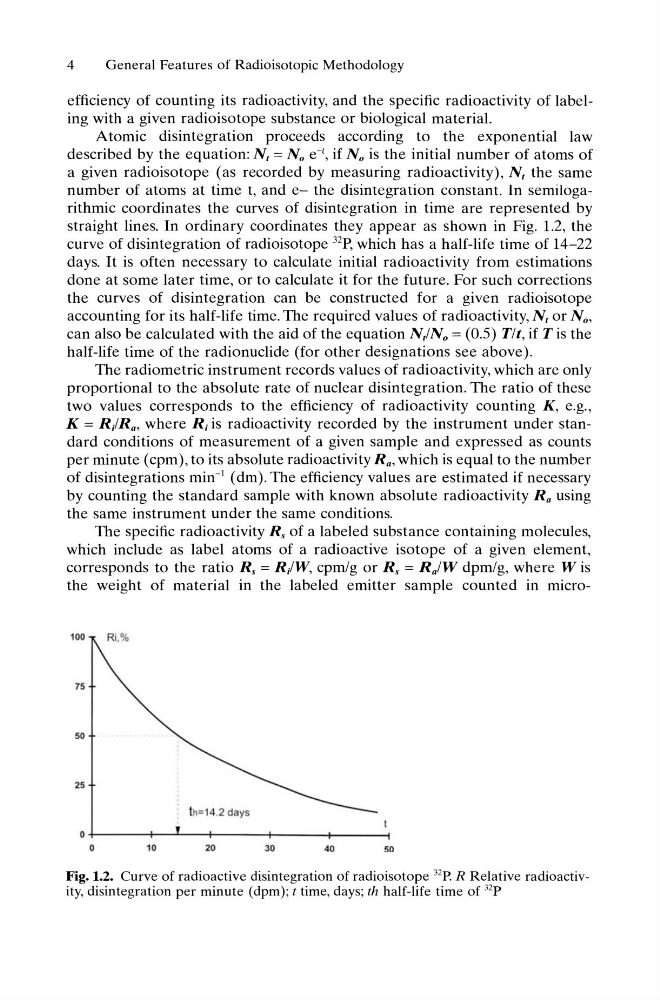
straight lines. In ordinary coordinates they appear as shown in Fig. 1.2, the
curve of disintegration of radioisotope 32p, which has a half-life time of 14-22
days. It is often necessary to calculate initial radioactivity from estimations
done at some later time, or to calculate it for the future. For such corrections
the curves of disintegration can be constructed for a given radioisotope
accounting for its half-life time. The required values of radioactivity, Nt or No,
can also be calculated with the aid of the equation N/No = (0.5) Tit, if T is the
half-life time of the radionuclide (for other designations see above).
The radiometric instrument records values of radioactivity, which are only
proportional to the absolute rate of nuclear disintegration. The ratio of these
two values corresponds to the efficiency of radioactivity counting K, e.g.,
K =0 R;lRa, where R; is radioactivity recorded by the instrument under standard conditions of measurement of a given sample and expressed as counts
per minute (cpm), to its absolute radioactivity R a, which is equal to the number
of disintegrations min- 1 (dm). The efficiency values are estimated if necessary
by counting the standard sample with known absolute radioactivity Ra using
the same instrument under the same conditions.
The specific radioactivity Rs of a labeled substance containing molecules,
which include as label atoms of a radioactive isotope of a given element,
corresponds to the ratio R, =0 R;lW, cpmlg or Rs =0 RJW dpmlg, where W is
the weight of material in the labeled emitter sample counted in micro100
Ri,%
75
50
25
th=14 ,2 days
O+-----~~-L--_+------~------+_----~
o
10
20
30
40
50
Fig. 1.2. Curve of radioactive disintegration of radioisotope 32p' R Relative radioactivity, disintegration per minute (dpm); t time, days; th half-life time of 32p
General Features of Radioisotopic Methodology
efficiency of counting its radioactivity, and the specific radioactivity of labeling with a given radioisotope substance or biological material.
Atomic disintegration proceeds according to the exponential law
described by the equation: Nt =0 No e- l , if No is the initial number of atoms of
a given radioisotope (as recorded by measuring radioactivity), Nt the same
number of atoms at time t, and e- the disintegration constant. In semilogarithmic coordinates the curves of disintegration in time are represented by
straight lines. In ordinary coordinates they appear as shown in Fig. 1.2, the
curve of disintegration of radioisotope 32p, which has a half-life time of 14-22
days. It is often necessary to calculate initial radioactivity from estimations
done at some later time, or to calculate it for the future. For such corrections
the curves of disintegration can be constructed for a given radioisotope
accounting for its half-life time. The required values of radioactivity, Nt or No,
can also be calculated with the aid of the equation N/No = (0.5) Tit, if T is the
half-life time of the radionuclide (for other designations see above).
The radiometric instrument records values of radioactivity, which are only
proportional to the absolute rate of nuclear disintegration. The ratio of these
two values corresponds to the efficiency of radioactivity counting K, e.g.,
K =0 R;lRa, where R; is radioactivity recorded by the instrument under standard conditions of measurement of a given sample and expressed as counts
per minute (cpm), to its absolute radioactivity R a, which is equal to the number
of disintegrations min- 1 (dm). The efficiency values are estimated if necessary
by counting the standard sample with known absolute radioactivity Ra using
the same instrument under the same conditions.
The specific radioactivity Rs of a labeled substance containing molecules,
which include as label atoms of a radioactive isotope of a given element,
corresponds to the ratio R, =0 R;lW, cpmlg or Rs =0 RJW dpmlg, where W is
the weight of material in the labeled emitter sample counted in micro100
Ri,%
75
50
25
th=14 ,2 days
O+-----~~-L--_+------~------+_----~
o
10
20
30
40
50
Fig. 1.2. Curve of radioactive disintegration of radioisotope 32p' R Relative radioactivity, disintegration per minute (dpm); t time, days; th half-life time of 32p