

Measurements of Feeding, Food Assimilability, and Respiration
149
Pocillopora
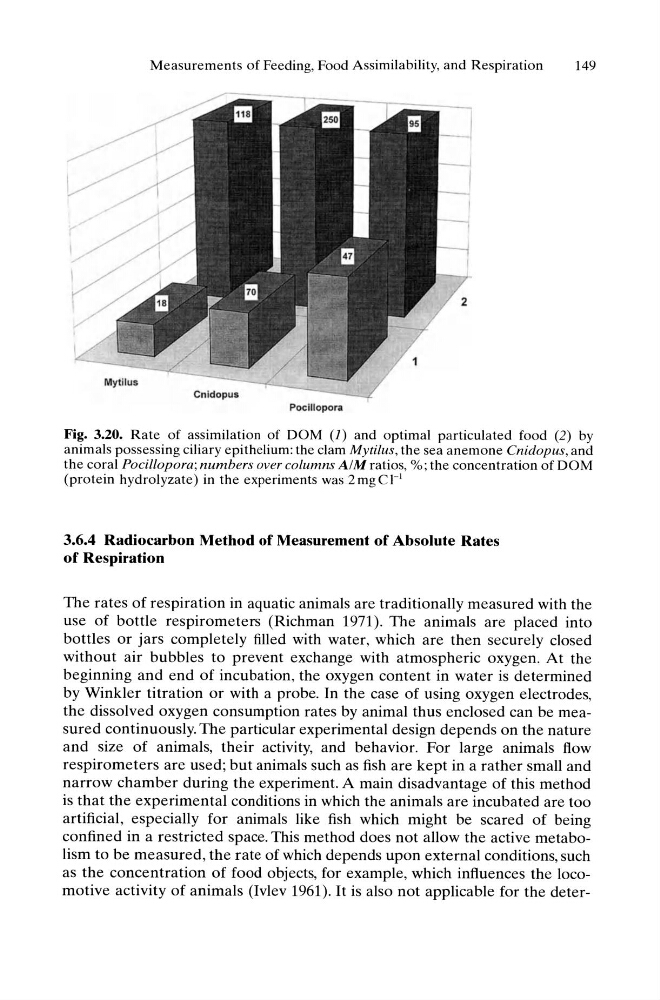
Fig. 3.20. Rate of assimilation of DOM (1) and optimal particulated food (2) by
animals possessing ciliary epithelium : the clam Mytilus , the sea anemone Cnidopus, and
the coral Pocillopora; numbers over columns A IM ratios, %; the concentration of DOM
(protein hydrolyzate) in the experiments was 2 mg C I- l
3.6.4 Radiocarbon Method of Measurement of Absolute Rates
of Respiration
The rates of respiration in aquatic animals are traditionally measured with the
use of bottle respirometers (Richman 1971). The animals are placed into
bottles or jars completely filled with water, which are then securely closed
without air bubbles to prevent exchange with atmospheric oxygen. At the
beginning and end of incubation, the oxygen content in water is determined
by Winkler titration or with a probe. In the case of using oxygen electrodes,
the dissolved oxygen consumption rates by animal thus enclosed can be measured continuously. The particular experimental design depends on the nature
and size of animals, their activity, and behavior. For large animals flow
respirometers are used; but animals such as fish are kept in a rather small and
narrow chamber during the experiment. A main disadvantage of this method
is that the experimental conditions in which the animals are incubated are too
artificial, especially for animals like fish which might be scared of being
confined in a restricted space. This method does not allow the active metabolism to be measured, the rate of which depends upon external conditions, such
as the concentration of food objects, for example, which influences the locomotive activity of animals (Ivlev 1961). It is also not applicable for the deter-
149
Pocillopora
Fig. 3.20. Rate of assimilation of DOM (1) and optimal particulated food (2) by
animals possessing ciliary epithelium : the clam Mytilus , the sea anemone Cnidopus, and
the coral Pocillopora; numbers over columns A IM ratios, %; the concentration of DOM
(protein hydrolyzate) in the experiments was 2 mg C I- l
3.6.4 Radiocarbon Method of Measurement of Absolute Rates
of Respiration
The rates of respiration in aquatic animals are traditionally measured with the
use of bottle respirometers (Richman 1971). The animals are placed into
bottles or jars completely filled with water, which are then securely closed
without air bubbles to prevent exchange with atmospheric oxygen. At the
beginning and end of incubation, the oxygen content in water is determined
by Winkler titration or with a probe. In the case of using oxygen electrodes,
the dissolved oxygen consumption rates by animal thus enclosed can be measured continuously. The particular experimental design depends on the nature
and size of animals, their activity, and behavior. For large animals flow
respirometers are used; but animals such as fish are kept in a rather small and
narrow chamber during the experiment. A main disadvantage of this method
is that the experimental conditions in which the animals are incubated are too
artificial, especially for animals like fish which might be scared of being
confined in a restricted space. This method does not allow the active metabolism to be measured, the rate of which depends upon external conditions, such
as the concentration of food objects, for example, which influences the locomotive activity of animals (Ivlev 1961). It is also not applicable for the deter-