

Measurements of Feeding, Food Assimilability, and Respiration
145
115
A
AIM ,';'
60
140
4S
105
70
30
35
15
0,5
1,S
2,5
Ke
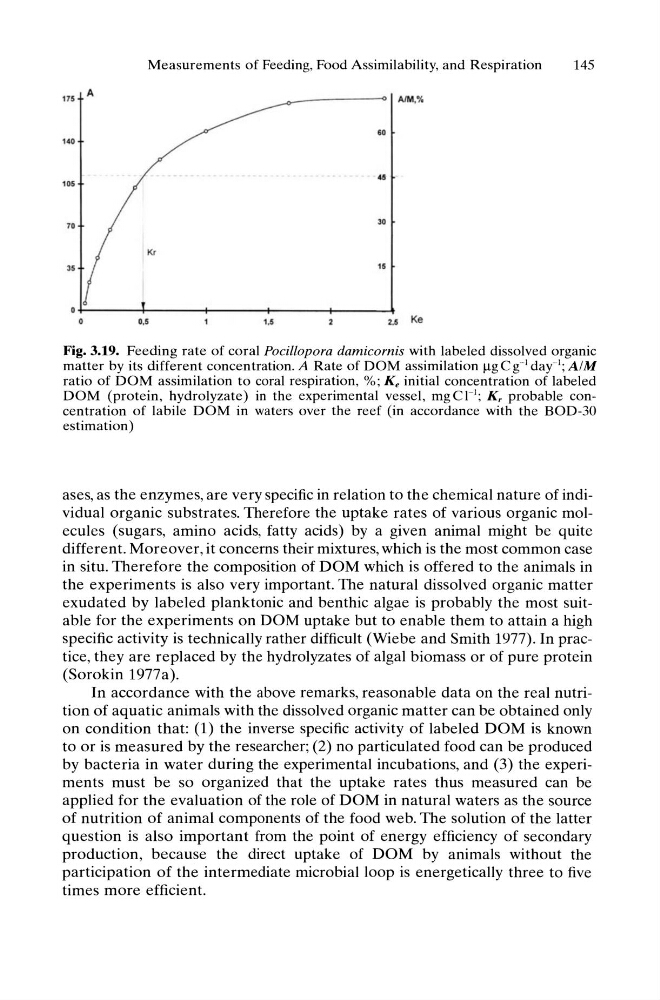
Fig. 3.19. Feeding rate of coral Pocillopora damicornis with labeled dissolved organic
matter by its different concentration. A Rate of DOM assimilation Ilg C g-I day-I; AIM
ratio of DOM assimilation to coral respiration, %; Ke initial concentration of labeled
DOM (protein, hydrolyzate) in the experimental vessel, mg C I-I; Kr probable concentration of labile DOM in waters over the reef (in accordance with the 800-30
estimation)
ases, as the enzymes, are very specific in relation to the chemical nature of individual organic substrates. Therefore the uptake rates of various organic molecules (sugars, amino acids, fatty acids) by a given animal might be quite
different. Moreover, it concerns their mixtures, which is the most common case
in situ. Therefore the composition of DOM which is offered to the animals in
the experiments is also very important. The natural dissolved organic matter
exudated by labeled planktonic and benthic algae is probably the most suitable for the experiments on DOM uptake but to enable them to attain a high
specific activity is technically rather difficult (Wiebe and Smith 1977). In practice, they are replaced by the hydrolyzates of algal biomass or of pure protein
(Sorokin 1977a).
In accordance with the above remarks, reasonable data on the real nutrition of aquatic animals with the dissolved organic matter can be obtained only
on condition that: (1) the inverse specific activity of labeled DOM is known
to or is measured by the researcher; (2) no particulated food can be produced
by bacteria in water during the experimental incubations, and (3) the experiments must be so organized that the uptake rates thus measured can be
applied for the evaluation of the role of DOM in natural waters as the source
of nutrition of animal components of the food web. The solution of the latter
question is also important from the point of energy efficiency of secondary
production, because the direct uptake of DOM by animals without the
participation of the intermediate microbial loop is energetically three to five
times more efficient.
145
115
A
AIM ,';'
60
140
4S
105
70
30
35
15
0,5
1,S
2,5
Ke
Fig. 3.19. Feeding rate of coral Pocillopora damicornis with labeled dissolved organic
matter by its different concentration. A Rate of DOM assimilation Ilg C g-I day-I; AIM
ratio of DOM assimilation to coral respiration, %; Ke initial concentration of labeled
DOM (protein, hydrolyzate) in the experimental vessel, mg C I-I; Kr probable concentration of labile DOM in waters over the reef (in accordance with the 800-30
estimation)
ases, as the enzymes, are very specific in relation to the chemical nature of individual organic substrates. Therefore the uptake rates of various organic molecules (sugars, amino acids, fatty acids) by a given animal might be quite
different. Moreover, it concerns their mixtures, which is the most common case
in situ. Therefore the composition of DOM which is offered to the animals in
the experiments is also very important. The natural dissolved organic matter
exudated by labeled planktonic and benthic algae is probably the most suitable for the experiments on DOM uptake but to enable them to attain a high
specific activity is technically rather difficult (Wiebe and Smith 1977). In practice, they are replaced by the hydrolyzates of algal biomass or of pure protein
(Sorokin 1977a).
In accordance with the above remarks, reasonable data on the real nutrition of aquatic animals with the dissolved organic matter can be obtained only
on condition that: (1) the inverse specific activity of labeled DOM is known
to or is measured by the researcher; (2) no particulated food can be produced
by bacteria in water during the experimental incubations, and (3) the experiments must be so organized that the uptake rates thus measured can be
applied for the evaluation of the role of DOM in natural waters as the source
of nutrition of animal components of the food web. The solution of the latter
question is also important from the point of energy efficiency of secondary
production, because the direct uptake of DOM by animals without the
participation of the intermediate microbial loop is energetically three to five
times more efficient.