

124
Radioisotopic Methods for the Study of Nutrition in Aquatic Animals
the values of I received in this simple way can be an acceptable approximation, especially as this parameter is among the most important in studies of
trophodynamics in aquatic environments.
3. Estimation of the index of assimilation of labeled food (CalC)
The index of assimilation ~CjC) is an excellent criterion to cvaluatc the comparative intensity of feeding by aquatic animals with labeled food. Its determination greatly assists the study of the ecological features of the process of
nutrition as related to feeding of an animal with different kinds of food.
Among the important questions which can be resolved by use of CalC estimations is the dependence of the rate of feeding and assimilation of bacteria
of algae on their concentration in water, on the sample or size of their cells,
and on the degree of aggregation, as well as on their taxonomy.
The magnitude of the index of assimilation corresponds to the percent
ratio of the amount of carbon in labeled food incorporated by animal consumers over a 24-h period, to the mean carbon content in their bodies. The
procedure is as follows: animals are fed with labeled food for 5-12 h, washed
free of the labeled food, and placed into a vessel containing nonlabeled food
for 1-2 h. The radioactivity of the carbon in their bodies is then measured (Ra,
cpmsp.-l), thus permitting calculation of the CalC value, if the mean content
of organic carbon in the animals (W, llgCsP.-l.) is known:
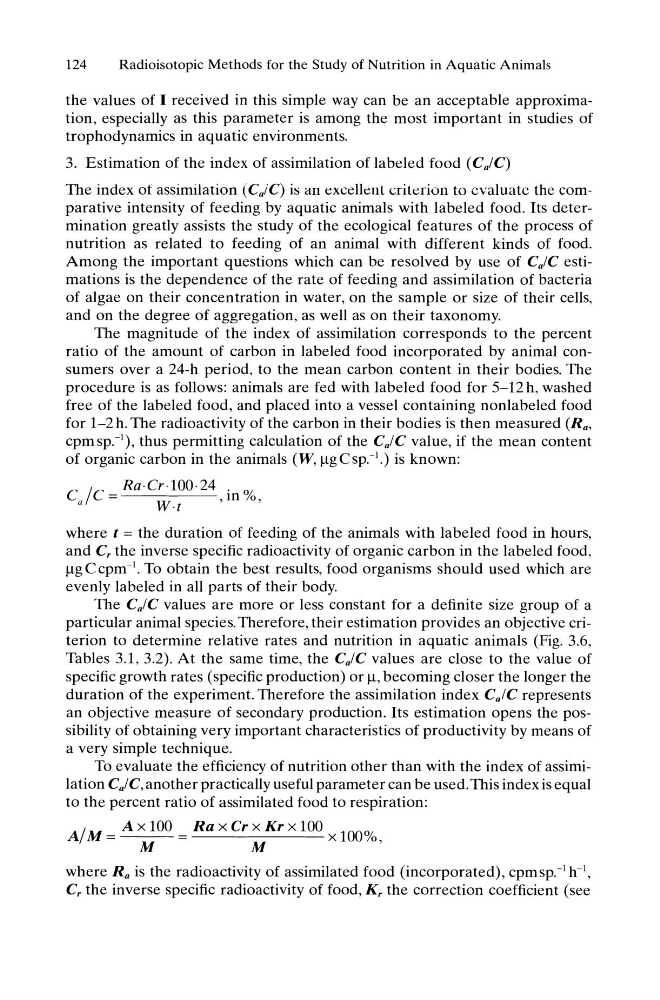
C IC = Ra·Cr·100· 24, in %,
a
W.t
where t = the duration of feeding of the animals with labeled food in hours,
and C the inverse specific radioactivity of organic carbon in the labeled food,
llgCcpm- 1 • To obtain the best results, food organisms should used which are
evenly labeled in all parts of their body.
The CjC values are more or less constant for a definite size group of a
particular animal species. Therefore, their estimation provides an objective criterion to determine relative rates and nutrition in aquatic animals (Fig. 3.6,
Tables 3.1,3.2). At the same time, the CalC values are close to the value of
specific growth rates (specific production) or ll, becoming closer the longer the
duration of the experiment. Therefore the assimilation index CalC represents
an objective measure of secondary production. Its estimation opens the possibility of obtaining very important characteristics of productivity by means of
a very simple technique.
To evaluate the efficiency of nutrition other than with the index of assimilation CalC, another practically useful parameter can be used. This index is equal
to the percent ratio of assimilated food to respiration:
A/M= Ax100 = RaxCrxKrx100 x 100%
M
M
'
where Ra is the radioactivity of assimilated food (incorporated), cpmsp.-l h- 1 ,
C r the inverse specific radioactivity of food, Kr the correction coefficient (see
Radioisotopic Methods for the Study of Nutrition in Aquatic Animals
the values of I received in this simple way can be an acceptable approximation, especially as this parameter is among the most important in studies of
trophodynamics in aquatic environments.
3. Estimation of the index of assimilation of labeled food (CalC)
The index of assimilation ~CjC) is an excellent criterion to cvaluatc the comparative intensity of feeding by aquatic animals with labeled food. Its determination greatly assists the study of the ecological features of the process of
nutrition as related to feeding of an animal with different kinds of food.
Among the important questions which can be resolved by use of CalC estimations is the dependence of the rate of feeding and assimilation of bacteria
of algae on their concentration in water, on the sample or size of their cells,
and on the degree of aggregation, as well as on their taxonomy.
The magnitude of the index of assimilation corresponds to the percent
ratio of the amount of carbon in labeled food incorporated by animal consumers over a 24-h period, to the mean carbon content in their bodies. The
procedure is as follows: animals are fed with labeled food for 5-12 h, washed
free of the labeled food, and placed into a vessel containing nonlabeled food
for 1-2 h. The radioactivity of the carbon in their bodies is then measured (Ra,
cpmsp.-l), thus permitting calculation of the CalC value, if the mean content
of organic carbon in the animals (W, llgCsP.-l.) is known:
C IC = Ra·Cr·100· 24, in %,
a
W.t
where t = the duration of feeding of the animals with labeled food in hours,
and C the inverse specific radioactivity of organic carbon in the labeled food,
llgCcpm- 1 • To obtain the best results, food organisms should used which are
evenly labeled in all parts of their body.
The CjC values are more or less constant for a definite size group of a
particular animal species. Therefore, their estimation provides an objective criterion to determine relative rates and nutrition in aquatic animals (Fig. 3.6,
Tables 3.1,3.2). At the same time, the CalC values are close to the value of
specific growth rates (specific production) or ll, becoming closer the longer the
duration of the experiment. Therefore the assimilation index CalC represents
an objective measure of secondary production. Its estimation opens the possibility of obtaining very important characteristics of productivity by means of
a very simple technique.
To evaluate the efficiency of nutrition other than with the index of assimilation CalC, another practically useful parameter can be used. This index is equal
to the percent ratio of assimilated food to respiration:
A/M= Ax100 = RaxCrxKrx100 x 100%
M
M
'
where Ra is the radioactivity of assimilated food (incorporated), cpmsp.-l h- 1 ,
C r the inverse specific radioactivity of food, Kr the correction coefficient (see