

120
Radioisotopic Methods for the Study of Nutrition in Aquatic Animals
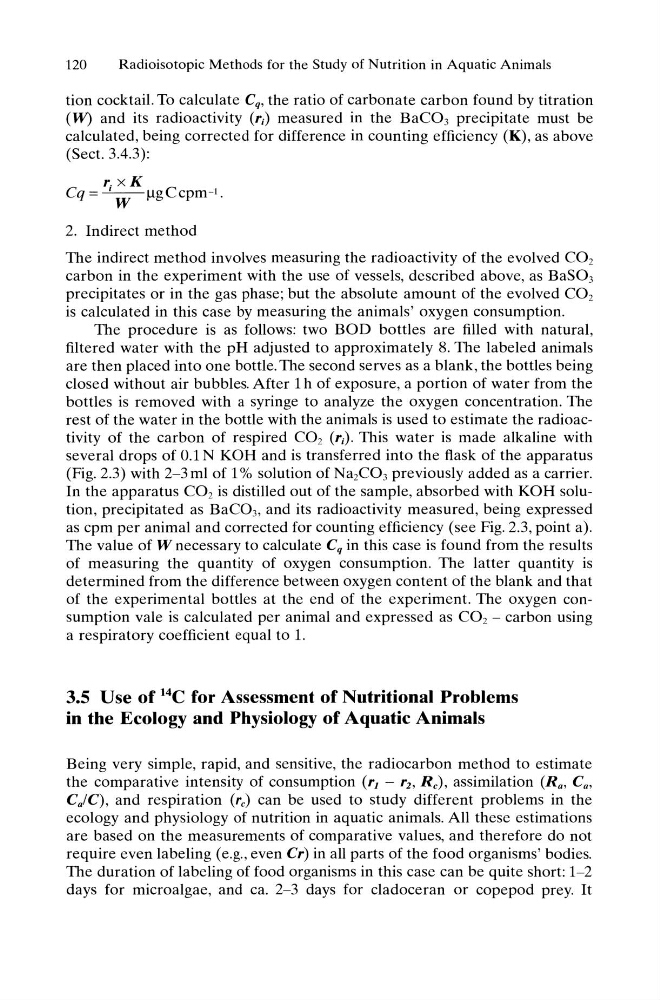
tion cocktail. To calculate Cq, the ratio of carbonate carbon found by titration
(W) and its radioactivity (ri) measured in the BaC03 precipitate must be
calculated, being corrected for difference in counting efficiency (K), as above
(Sect. 3.4.3):
r.xK
Cq = -'--llgCcpm-1.
W
2. Indirect method
The indirect method involves measuring the radioactivity of the evolved CO2
carbon in the experiment with the use of vessels, described above, as BaS03
precipitates or in the gas phase; but the absolute amount of the evolved CO2
is calculated in this case by measuring the animals' oxygen consumption.
The procedure is as follows: two BOD bottles are filled with natural,
filtered water with the pH adjusted to approximately 8. The labeled animals
are then placed into one bottle. The second serves as a blank, the bottles being
closed without air bubbles. After 1 h of exposure, a portion of water from the
bottles is removed with a syringe to analyze the oxygen concentration. The
rest of the water in the bottle with the animals is used to estimate the radioactivity of the carbon of respired CO2 (r;). This water is made alkaline with
several drops of 0.1 N KOH and is transferred into the flask of the apparatus
(Fig. 2.3) with 2-3 ml of 1 % solution of Na2C03 previously added as a carrier.
In the apparatus CO2 is distilled out of the sample, absorbed with KOH solution, precipitated as BaC03, and its radioactivity measured, being expressed
as cpm per animal and corrected for counting efficiency (see Fig. 2.3, point a).
The value of W necessary to calculate Cq in this case is found from the results
of measuring the quantity of oxygen consumption. The latter quantity is
determined from the difference between oxygen content of the blank and that
of the experimental bottles at the end of the experiment. The oxygen consumption vale is calculated per animal and expressed as CO2 - carbon using
a respiratory coefficient equal to 1.
3.5 Use of 14C for Assessment of Nutritional Problems
in the Ecology and Physiology of Aquatic Animals
Being very simple, rapid, and sensitive, the radiocarbon method to estimate
the comparative intensity of consumption (rJ - r2, R c), assimilation (Ra, Ca,
CalC), and respiration (rc) can be used to study different problems in the
ecology and physiology of nutrition in aquatic animals. All these estimations
are based on the measurements of comparative values, and therefore do not
require even labeling (e.g., even Cr) in all parts of the food organisms' bodies.
The duration of labeling of food organisms in this case can be quite short: 1-2
days for microalgae, and ca. 2-3 days for cladoceran or copepod prey. It
Radioisotopic Methods for the Study of Nutrition in Aquatic Animals
tion cocktail. To calculate Cq, the ratio of carbonate carbon found by titration
(W) and its radioactivity (ri) measured in the BaC03 precipitate must be
calculated, being corrected for difference in counting efficiency (K), as above
(Sect. 3.4.3):
r.xK
Cq = -'--llgCcpm-1.
W
2. Indirect method
The indirect method involves measuring the radioactivity of the evolved CO2
carbon in the experiment with the use of vessels, described above, as BaS03
precipitates or in the gas phase; but the absolute amount of the evolved CO2
is calculated in this case by measuring the animals' oxygen consumption.
The procedure is as follows: two BOD bottles are filled with natural,
filtered water with the pH adjusted to approximately 8. The labeled animals
are then placed into one bottle. The second serves as a blank, the bottles being
closed without air bubbles. After 1 h of exposure, a portion of water from the
bottles is removed with a syringe to analyze the oxygen concentration. The
rest of the water in the bottle with the animals is used to estimate the radioactivity of the carbon of respired CO2 (r;). This water is made alkaline with
several drops of 0.1 N KOH and is transferred into the flask of the apparatus
(Fig. 2.3) with 2-3 ml of 1 % solution of Na2C03 previously added as a carrier.
In the apparatus CO2 is distilled out of the sample, absorbed with KOH solution, precipitated as BaC03, and its radioactivity measured, being expressed
as cpm per animal and corrected for counting efficiency (see Fig. 2.3, point a).
The value of W necessary to calculate Cq in this case is found from the results
of measuring the quantity of oxygen consumption. The latter quantity is
determined from the difference between oxygen content of the blank and that
of the experimental bottles at the end of the experiment. The oxygen consumption vale is calculated per animal and expressed as CO2 - carbon using
a respiratory coefficient equal to 1.
3.5 Use of 14C for Assessment of Nutritional Problems
in the Ecology and Physiology of Aquatic Animals
Being very simple, rapid, and sensitive, the radiocarbon method to estimate
the comparative intensity of consumption (rJ - r2, R c), assimilation (Ra, Ca,
CalC), and respiration (rc) can be used to study different problems in the
ecology and physiology of nutrition in aquatic animals. All these estimations
are based on the measurements of comparative values, and therefore do not
require even labeling (e.g., even Cr) in all parts of the food organisms' bodies.
The duration of labeling of food organisms in this case can be quite short: 1-2
days for microalgae, and ca. 2-3 days for cladoceran or copepod prey. It