

98
The Radiocarbon Method to Estimate Primary Production
1985), plus 15% correction for underestimation entailed by the retardation of
14C02 uptake at the initial period of light incubation (Sondergaard and SandJensen 1979; Kemp et a1. 1986).
The R,-values using in this formula directly represent the counting rates
recorded by the scaler, and recalculated per g-l dry weight of initial plant material with correction for CO2 dark incubation. As was mentioned above (Sect.
2.5.5), no quench correction should be needed if the stipulation has been
satisfied as to the equalization of counting conditions during radio assay of
plant material (Re) and of 14C-carbonate added into the experimental vessels
(R;) see Sect. 2.5.3. The simplified mode of Cr determination and its features
of stability were also mentioned there.
The values of photosynthesis rate Cp thus found are then used to calculate primary production in benthic plants and their associations per day (Cpd).
For this the coefficients K, are used, which can be determined with the aid of
the curve of the diurnal course of photosynthesis (see Sect. 2.5.4). Thus Cpd =
C p K, mgCg- I day-I, (or mgCdm- 2 day-l for periphyton or microphytobenthos). For the occasions when the researcher has no possibility of estimating
K,-coefficients for himself, for local conditions of weather and duration of the
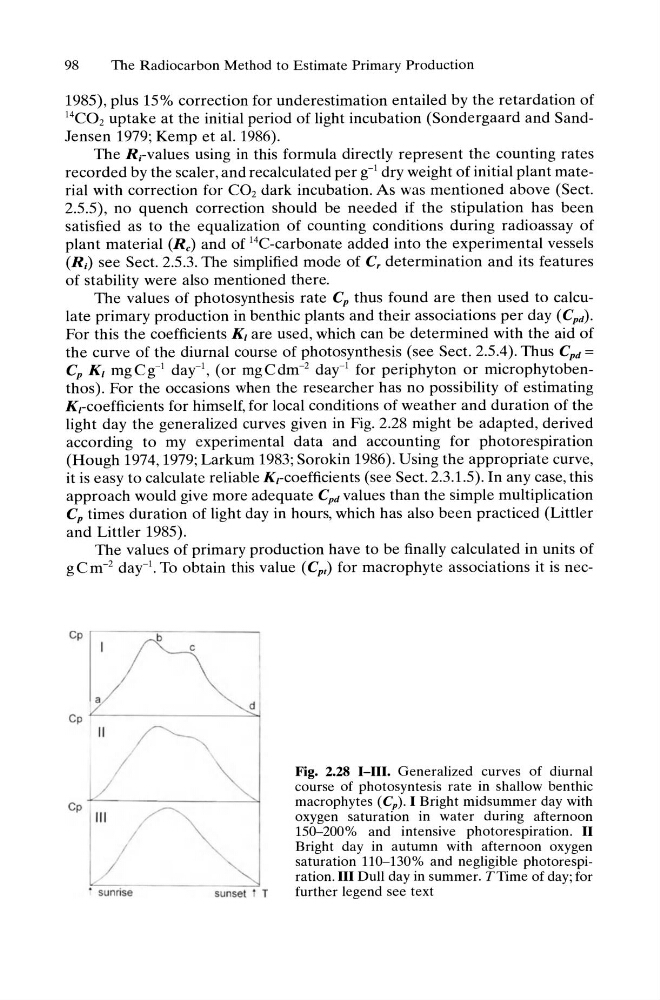
light day the generalized curves given in Fig. 2.28 might be adapted, derived
according to my experimental data and accounting for photorespiration
(Hough 1974, 1979; Larkum 1983; Sorokin 1986). Using the appropriate curve,
it is easy to calculate reliable K,-coefficients (see Sect. 2.3.1.5) . In any case, this
approach would give more adequate Cpd values than the simple multiplication
Cp times duration of light day in hours, which has also been practiced (Littler
and Littler 1985).
The values of primary production have to be finally calculated in units of
g C m- 2 day-I. To obtain this value (Cpt) for macrophyte associations it is necC l
c
d
cp L-----------------~
1 /
Co l' " /~
/
~---:---- - - -
• sunrise
sunset T T
Fig. 2.28 I-III. Generalized curves of diurnal
course of photosyntesis rate in shallow benthic
macrophytes (Cp ) . I Bright midsummer day with
oxygen saturation in water during afternoon
150-200% and intensive photorespiration. II
Bright day in autumn with afternoon oxygen
saturation 110-130% and negligible photorespiration . III Dull day in summer. TTime of day; for
further legend see text
The Radiocarbon Method to Estimate Primary Production
1985), plus 15% correction for underestimation entailed by the retardation of
14C02 uptake at the initial period of light incubation (Sondergaard and SandJensen 1979; Kemp et a1. 1986).
The R,-values using in this formula directly represent the counting rates
recorded by the scaler, and recalculated per g-l dry weight of initial plant material with correction for CO2 dark incubation. As was mentioned above (Sect.
2.5.5), no quench correction should be needed if the stipulation has been
satisfied as to the equalization of counting conditions during radio assay of
plant material (Re) and of 14C-carbonate added into the experimental vessels
(R;) see Sect. 2.5.3. The simplified mode of Cr determination and its features
of stability were also mentioned there.
The values of photosynthesis rate Cp thus found are then used to calculate primary production in benthic plants and their associations per day (Cpd).
For this the coefficients K, are used, which can be determined with the aid of
the curve of the diurnal course of photosynthesis (see Sect. 2.5.4). Thus Cpd =
C p K, mgCg- I day-I, (or mgCdm- 2 day-l for periphyton or microphytobenthos). For the occasions when the researcher has no possibility of estimating
K,-coefficients for himself, for local conditions of weather and duration of the
light day the generalized curves given in Fig. 2.28 might be adapted, derived
according to my experimental data and accounting for photorespiration
(Hough 1974, 1979; Larkum 1983; Sorokin 1986). Using the appropriate curve,
it is easy to calculate reliable K,-coefficients (see Sect. 2.3.1.5) . In any case, this
approach would give more adequate Cpd values than the simple multiplication
Cp times duration of light day in hours, which has also been practiced (Littler
and Littler 1985).
The values of primary production have to be finally calculated in units of
g C m- 2 day-I. To obtain this value (Cpt) for macrophyte associations it is necC l
c
d
cp L-----------------~
1 /
Co l' " /~
/
~---:---- - - -
• sunrise
sunset T T
Fig. 2.28 I-III. Generalized curves of diurnal
course of photosyntesis rate in shallow benthic
macrophytes (Cp ) . I Bright midsummer day with
oxygen saturation in water during afternoon
150-200% and intensive photorespiration. II
Bright day in autumn with afternoon oxygen
saturation 110-130% and negligible photorespiration . III Dull day in summer. TTime of day; for
further legend see text