

92
The Radiocarbon Method to Estimate Primary Production
water level
a
b
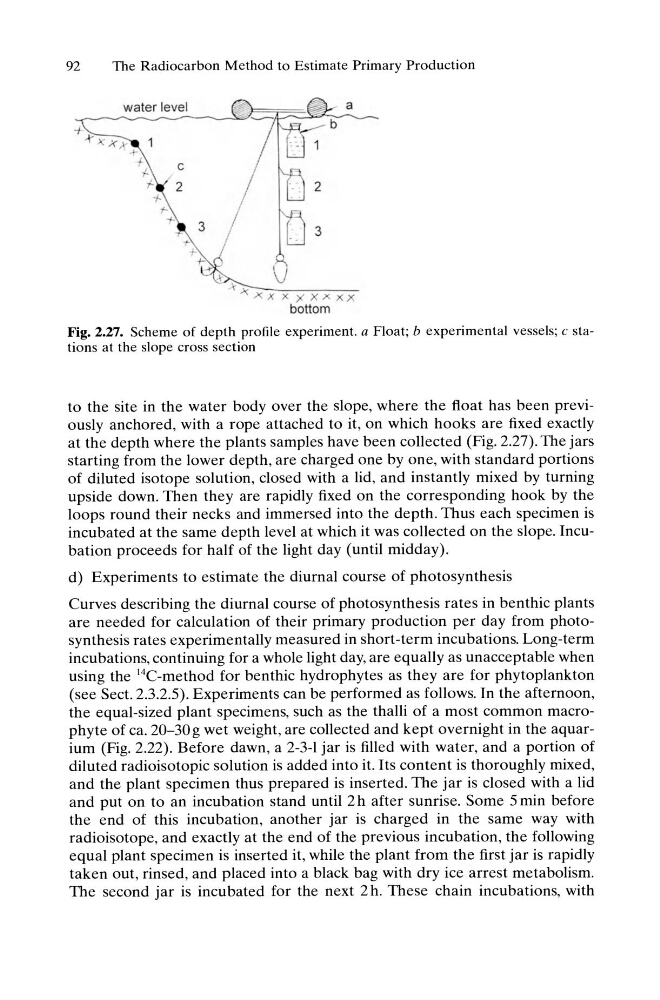
Fig. 2.27. Scheme of depth profile experiment. a Float; b experimental vessels; c stations at the slope cross section
to the site in the water body over the slope, where the float has been previously anchored, with a rope attached to it, on which hooks are fixed exactly
at the depth where the plants samples have been collected (Fig. 2.27). The jars
starting from the lower depth, are charged one by one, with standard portions
of diluted isotope solution, closed with a lid, and instantly mixed by turning
upside down. Then they are rapidly fixed on the corresponding hook by the
loops round their necks and immersed into the depth. Thus each specimen is
incubated at the same depth level at which it was collected on the slope. Incubation proceeds for half of the light day (until midday).
d) Experiments to estimate the diurnal course of photosynthesis
Curves describing the diurnal course of photosynthesis rates in benthic plants
are needed for calculation of their primary production per day from photosynthesis rates experimentally measured in short-term incubations. Long-term
incubations, continuing for a whole light day, are equally as unacceptable when
using the 14C-method for benthic hydrophytes as they are for phytoplankton
(see Sect. 2.3.2.5). Experiments can be performed as follows. In the afternoon,
the equal-sized plant specimens, such as the thalli of a most common macrophyte of ca. 20-30 g wet weight, are collected and kept overnight in the aquarium (Fig. 2.22) . Before dawn, a 2-3-1 jar is filled with water, and a portion of
diluted radioisotopic solution is added into it. Its content is thoroughly mixed,
and the plant specimen thus prepared is inserted. The jar is closed with a lid
and put on to an incubation stand until 2 h after sunrise. Some 5 min before
the end of this incubation, another jar is charged in the same way with
radioisotope, and exactly at the end of the previous incubation, the following
equal plant specimen is inserted it, while the plant from the first jar is rapidly
taken out, rinsed, and placed into a black bag with dry ice arrest metabolism.
The second jar is incubated for the next 2 h. These chain incubations, with
The Radiocarbon Method to Estimate Primary Production
water level
a
b
Fig. 2.27. Scheme of depth profile experiment. a Float; b experimental vessels; c stations at the slope cross section
to the site in the water body over the slope, where the float has been previously anchored, with a rope attached to it, on which hooks are fixed exactly
at the depth where the plants samples have been collected (Fig. 2.27). The jars
starting from the lower depth, are charged one by one, with standard portions
of diluted isotope solution, closed with a lid, and instantly mixed by turning
upside down. Then they are rapidly fixed on the corresponding hook by the
loops round their necks and immersed into the depth. Thus each specimen is
incubated at the same depth level at which it was collected on the slope. Incubation proceeds for half of the light day (until midday).
d) Experiments to estimate the diurnal course of photosynthesis
Curves describing the diurnal course of photosynthesis rates in benthic plants
are needed for calculation of their primary production per day from photosynthesis rates experimentally measured in short-term incubations. Long-term
incubations, continuing for a whole light day, are equally as unacceptable when
using the 14C-method for benthic hydrophytes as they are for phytoplankton
(see Sect. 2.3.2.5). Experiments can be performed as follows. In the afternoon,
the equal-sized plant specimens, such as the thalli of a most common macrophyte of ca. 20-30 g wet weight, are collected and kept overnight in the aquarium (Fig. 2.22) . Before dawn, a 2-3-1 jar is filled with water, and a portion of
diluted radioisotopic solution is added into it. Its content is thoroughly mixed,
and the plant specimen thus prepared is inserted. The jar is closed with a lid
and put on to an incubation stand until 2 h after sunrise. Some 5 min before
the end of this incubation, another jar is charged in the same way with
radioisotope, and exactly at the end of the previous incubation, the following
equal plant specimen is inserted it, while the plant from the first jar is rapidly
taken out, rinsed, and placed into a black bag with dry ice arrest metabolism.
The second jar is incubated for the next 2 h. These chain incubations, with