

3 Processing Remotely Sensed Data: Hardware and Software Considerations
43
Peripheral Devices
Linear Array Scanner
· 4or8mmDAT
'100 MB Zip
• 2 GB Jazz drive
• 6,250 bpi tape
I®
en
Dye sublimati on printer
RAID mass storage
Inlernet
to the
world
8-bit Color Workstations
f::::./R=:IS:::C===:='l\ t:/=RIS::::C===:::j \ f =/ : : : : RISC=====:::;j\
/RISC
\ /RISC
\
1 = . =======, t = . =====:::::JI
24·bit Color Workstations
!.r==~
!.r==~
l =.(:= RI ::: SC=====\::;j, t:(= RI= SC=====\~. t:(:::: RI= SC=====\~.
256 MBRAM
18 GB Hard Disk
24·M color
Software Requirements
Maintenance Aqreements
• Graphical User Interface (GUI) • Hardware
• UNIX or NT Operating System • Applications sollware
• C. FORTRAN Compiler
• Network sollware
• Image Processing Soitware
• GIS Sollware
• Local Area Network
Local Area Network
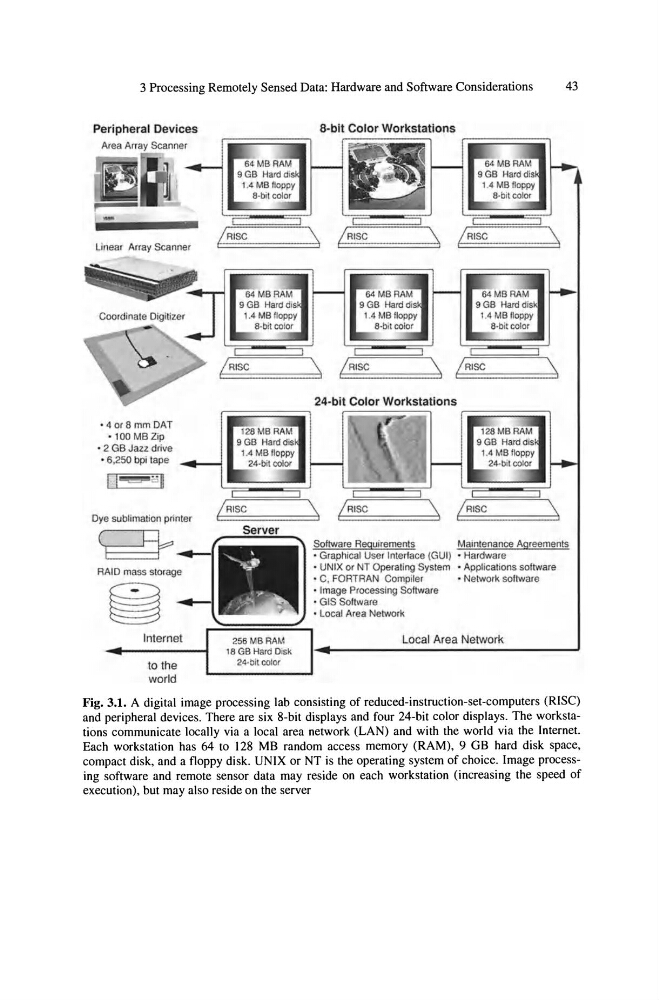
Fig. 3.1. A digital image processing lab consisting of reduced-instruction-set-computers (RISC)
and peripheral devices. There are six 8-bit displays and four 24-bit color displays. The workstations communicate locally via a local area network (LAN) and with the world via the Internet.
Each workstation has 64 to 128 MB random access memory (RAM), 9 GB hard disk space,
compact disk, and a floppy disk. UNIX or NT is the operating system of choice. Image processing software and remote sensor data may reside on each workstation (increasing the speed of
execution), but may also reside on the server
43
Peripheral Devices
Linear Array Scanner
· 4or8mmDAT
'100 MB Zip
• 2 GB Jazz drive
• 6,250 bpi tape
I®
en
Dye sublimati on printer
RAID mass storage
Inlernet
to the
world
8-bit Color Workstations
f::::./R=:IS:::C===:='l\ t:/=RIS::::C===:::j \ f =/ : : : : RISC=====:::;j\
/RISC
\ /RISC
\
1 = . =======, t = . =====:::::JI
24·bit Color Workstations
!.r==~
!.r==~
l =.(:= RI ::: SC=====\::;j, t:(= RI= SC=====\~. t:(:::: RI= SC=====\~.
256 MBRAM
18 GB Hard Disk
24·M color
Software Requirements
Maintenance Aqreements
• Graphical User Interface (GUI) • Hardware
• UNIX or NT Operating System • Applications sollware
• C. FORTRAN Compiler
• Network sollware
• Image Processing Soitware
• GIS Sollware
• Local Area Network
Local Area Network
Fig. 3.1. A digital image processing lab consisting of reduced-instruction-set-computers (RISC)
and peripheral devices. There are six 8-bit displays and four 24-bit color displays. The workstations communicate locally via a local area network (LAN) and with the world via the Internet.
Each workstation has 64 to 128 MB random access memory (RAM), 9 GB hard disk space,
compact disk, and a floppy disk. UNIX or NT is the operating system of choice. Image processing software and remote sensor data may reside on each workstation (increasing the speed of
execution), but may also reside on the server