

28
H. Rott
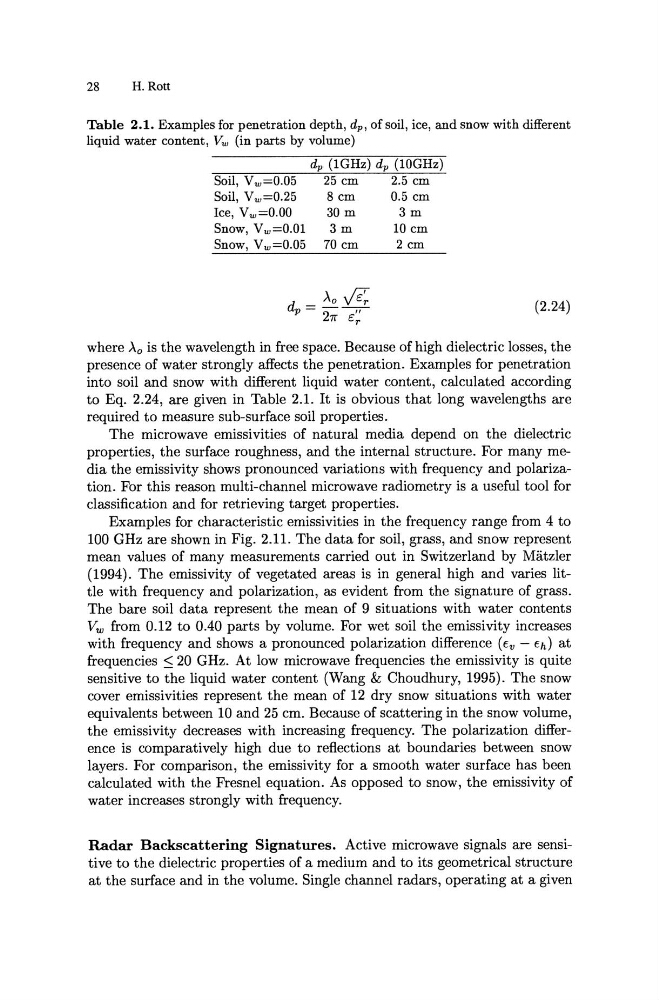
Table 2.1. Examples for penetration depth, dp , of soil, ice, and snow with different
liquid water content, Vw (in parts by volume)
dp (lGHz) dp (lOGHz)
Soil, V w=0.05
Soil, V w=0.25
Ice, Vw=O.OO
Snow, V w=O.Ol
Snow, V w=0.05
25 em
2.5 em
8em
30 m
3m
70 em
d - Ao ,fi';.
p -
27T c~
0.5 em
3m
10 em
2em
(2.24)
where Ao is the wavelength in free space. Because of high dielectric losses, the
presence of water strongly affects the penetration. Examples for penetration
into soil and snow with different liquid water content, calculated according
to Eq. 2.24, are given in Table 2.1. It is obvious that long wavelengths are
required to measure sub-surface soil properties.
The microwave emissivities of natural media depend on the dielectric
properties, the surface roughness, and the internal structure. For many media the emissivity shows pronounced variations with frequency and polarization. For this reason multi-channel microwave radiometry is a useful tool for
classification and for retrieving target properties.
Examples for characteristic emissivities in the frequency range from 4 to
100 GHz are shown in Fig. 2.11. The data for soil, grass, and snow represent
mean values of many measurements carried out in Switzerland by Miitzler
(1994). The emissivity of vegetated areas is in general high and varies little with frequency and polarization, as evident from the signature of grass.
The bare soil data represent the mean of 9 situations with water contents
Vw from 0.12 to DAD parts by volume. For wet soil the emissivity increases
with frequency and shows a pronounced polarization difference (Ev - Eh) at
frequencies :::; 20 GHz. At low microwave frequencies the emissivity is quite
sensitive to the liquid water content (Wang & Choudhury, 1995). The snow
cover emissivities represent the mean of 12 dry snow situations with water
equivalents between 10 and 25 cm. Because of scattering in the snow volume,
the emissivity decreases with increasing frequency. The polarization difference is comparatively high due to reflections at boundaries between snow
layers. For comparison, the emissivity for a smooth water surface has been
calculated with the Fresnel equation. As opposed to snow, the emissivity of
water increases strongly with frequency.
Radar Backscattering Signatures. Active microwave signals are sensitive to the dielectric properties of a medium and to its geometrical structure
at the surface and in the volume. Single channel radars, operating at a given
H. Rott
Table 2.1. Examples for penetration depth, dp , of soil, ice, and snow with different
liquid water content, Vw (in parts by volume)
dp (lGHz) dp (lOGHz)
Soil, V w=0.05
Soil, V w=0.25
Ice, Vw=O.OO
Snow, V w=O.Ol
Snow, V w=0.05
25 em
2.5 em
8em
30 m
3m
70 em
d - Ao ,fi';.
p -
27T c~
0.5 em
3m
10 em
2em
(2.24)
where Ao is the wavelength in free space. Because of high dielectric losses, the
presence of water strongly affects the penetration. Examples for penetration
into soil and snow with different liquid water content, calculated according
to Eq. 2.24, are given in Table 2.1. It is obvious that long wavelengths are
required to measure sub-surface soil properties.
The microwave emissivities of natural media depend on the dielectric
properties, the surface roughness, and the internal structure. For many media the emissivity shows pronounced variations with frequency and polarization. For this reason multi-channel microwave radiometry is a useful tool for
classification and for retrieving target properties.
Examples for characteristic emissivities in the frequency range from 4 to
100 GHz are shown in Fig. 2.11. The data for soil, grass, and snow represent
mean values of many measurements carried out in Switzerland by Miitzler
(1994). The emissivity of vegetated areas is in general high and varies little with frequency and polarization, as evident from the signature of grass.
The bare soil data represent the mean of 9 situations with water contents
Vw from 0.12 to DAD parts by volume. For wet soil the emissivity increases
with frequency and shows a pronounced polarization difference (Ev - Eh) at
frequencies :::; 20 GHz. At low microwave frequencies the emissivity is quite
sensitive to the liquid water content (Wang & Choudhury, 1995). The snow
cover emissivities represent the mean of 12 dry snow situations with water
equivalents between 10 and 25 cm. Because of scattering in the snow volume,
the emissivity decreases with increasing frequency. The polarization difference is comparatively high due to reflections at boundaries between snow
layers. For comparison, the emissivity for a smooth water surface has been
calculated with the Fresnel equation. As opposed to snow, the emissivity of
water increases strongly with frequency.
Radar Backscattering Signatures. Active microwave signals are sensitive to the dielectric properties of a medium and to its geometrical structure
at the surface and in the volume. Single channel radars, operating at a given