

19 Detection of Land Cover Change Tendencies and
their Effect on Water Management
A.H. Schumann and G.A. Schultz
Institute of Hydrology, Water Management and Environmental Techniques,
Ruhr University Bochum, 44780 Bochum, Germany
19.1 General Remarks
Land cover, i.e. the cover of the earth's surface with soil, vegetation, water, cities
etc. depends on natural factors and human activities. The anthropogenic influence
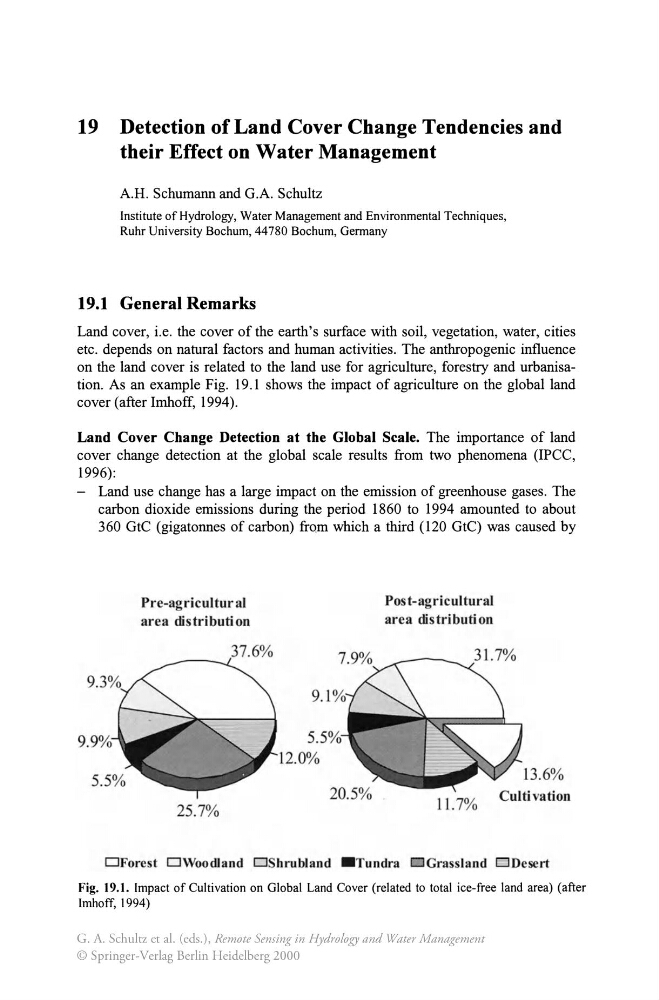
on the land cover is related to the land use for agriculture, forestry and urbanisation. As an example Fig. 19.1 shows the impact of agriculture on the global land
cover (after Imhoff, 1994).
Land Cover Change Detection at the Global Scale. The importance of land
cover change detection at the global scale results from two phenomena (lPCC,
1996):
Land use change has a large impact on the emission of greenhouse gases. The
carbon dioxide emissions during the period 1860 to 1994 amounted to about
360 GtC (gigatonnes of carbon) from which a third (120 GtC) was caused by
Pre-agricultur al
area distributi on
7.6%
25.7%
5.5
12.0%
Post-agricultural
area dis tri buti on
11.7%
l3.6%
DForest DWoodiand DShrubland -Tundra DGrassland DDesert
Fig. 19.1. Impact of Cultivation on Global Land Cover (related to total ice-free land area) (after
Imhoff, 1994)
G. A. Schultz et al. (eds.), Remote Sensing in Hydrology and Water Management
© Springer-Verlag Berlin Heidelberg 2000
their Effect on Water Management
A.H. Schumann and G.A. Schultz
Institute of Hydrology, Water Management and Environmental Techniques,
Ruhr University Bochum, 44780 Bochum, Germany
19.1 General Remarks
Land cover, i.e. the cover of the earth's surface with soil, vegetation, water, cities
etc. depends on natural factors and human activities. The anthropogenic influence
on the land cover is related to the land use for agriculture, forestry and urbanisation. As an example Fig. 19.1 shows the impact of agriculture on the global land
cover (after Imhoff, 1994).
Land Cover Change Detection at the Global Scale. The importance of land
cover change detection at the global scale results from two phenomena (lPCC,
1996):
Land use change has a large impact on the emission of greenhouse gases. The
carbon dioxide emissions during the period 1860 to 1994 amounted to about
360 GtC (gigatonnes of carbon) from which a third (120 GtC) was caused by
Pre-agricultur al
area distributi on
7.6%
25.7%
5.5
12.0%
Post-agricultural
area dis tri buti on
11.7%
l3.6%
DForest DWoodiand DShrubland -Tundra DGrassland DDesert
Fig. 19.1. Impact of Cultivation on Global Land Cover (related to total ice-free land area) (after
Imhoff, 1994)
G. A. Schultz et al. (eds.), Remote Sensing in Hydrology and Water Management
© Springer-Verlag Berlin Heidelberg 2000