

18 Computation of Hydrological Data
409
18.2.3 MODUL III: Estimation of runoff values
The fmal goal of the approach discussed here is the estimation of historical river
flow data on the basis of satellite infonnation alone. This requires a mathematical
transformation into runoff values of the rainfall information obtained from the
satellite imagery by means of a simple parametric rainfall runoff model. A major
constraint to the application of general rainfall runoff models is the nonavailability of data required. More sophisticated physically-based distributed models require large quantities of data which are usually not available in the countries
of the developing world. Therefore the most complex model is not necessarily best
for all purposes, particularly where input data are sparse or nonrepresentative.
A simple model which can be applied under tropical environments is described
by Higgins (1981). This model relates runoff to rainfall by employing a single
equation and a single constraint and was used for estimation of monthly data. The
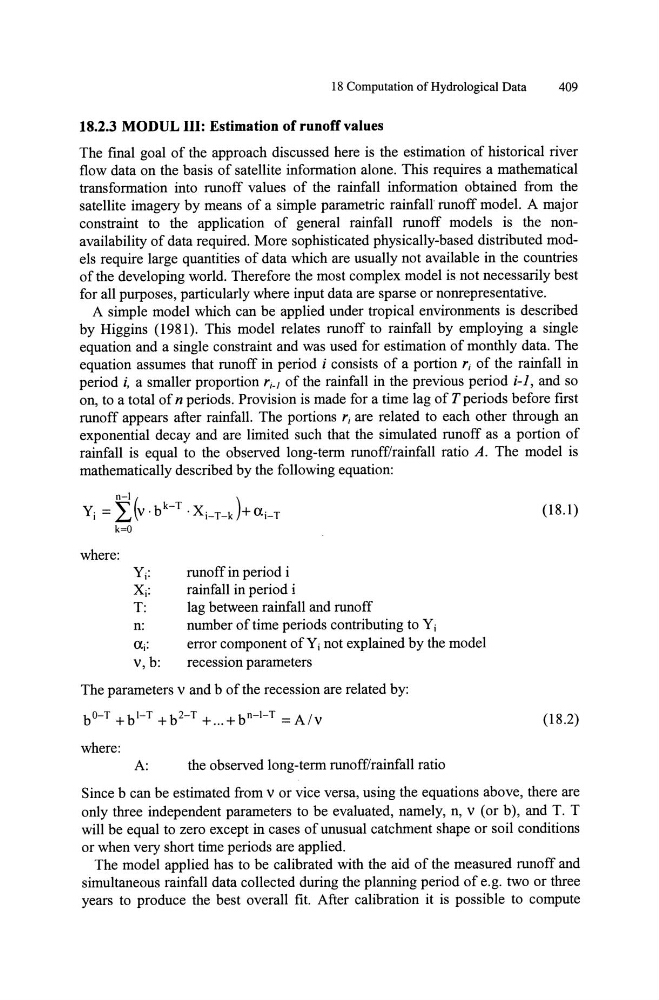
equation assumes that runoff in period i consists of a portion 7i of the rainfall in
period i, a smaller proportion 7i-1 of the rainfall in the previous period i-I, and so
on, to a total of n periods. Provision is made for a time lag of T periods before frrst
runoff appears after rainfall. The portions 7i are related to each other through an
exponential decay and are limited such that the simulated runoff as a portion of
rainfall is equal to the observed long-term runoff/rainfall ratio A. The model is
mathematically described by the following equation:
where:
Yi:
runoff in period i
Xi:
rainfall in period i
T:
lag between rainfall and runoff
n:
number of time periods contributing to Yi
v, b:
recession parameters
The parameters v and b of the recession are related by:
b O - T +b l - T +b 2 - T + ... +b n - 1 - T =A/v
where:
A:
the observed long-term runoff/rainfall ratio
(18.1)
(18.2)
Since b can be estimated from v or vice versa, using the equations above, there are
only three independent parameters to be evaluated, namely, n, v (or b), and T. T
will be equal to zero except in cases of unusual catchment shape or soil conditions
or when very short time periods are applied.
The model applied has to be calibrated with the aid of the measured runoff and
simultaneous rainfall data collected during the planning period of e.g. two or three
years to produce the best overall fit. After calibration it is possible to compute
409
18.2.3 MODUL III: Estimation of runoff values
The fmal goal of the approach discussed here is the estimation of historical river
flow data on the basis of satellite infonnation alone. This requires a mathematical
transformation into runoff values of the rainfall information obtained from the
satellite imagery by means of a simple parametric rainfall runoff model. A major
constraint to the application of general rainfall runoff models is the nonavailability of data required. More sophisticated physically-based distributed models require large quantities of data which are usually not available in the countries
of the developing world. Therefore the most complex model is not necessarily best
for all purposes, particularly where input data are sparse or nonrepresentative.
A simple model which can be applied under tropical environments is described
by Higgins (1981). This model relates runoff to rainfall by employing a single
equation and a single constraint and was used for estimation of monthly data. The
equation assumes that runoff in period i consists of a portion 7i of the rainfall in
period i, a smaller proportion 7i-1 of the rainfall in the previous period i-I, and so
on, to a total of n periods. Provision is made for a time lag of T periods before frrst
runoff appears after rainfall. The portions 7i are related to each other through an
exponential decay and are limited such that the simulated runoff as a portion of
rainfall is equal to the observed long-term runoff/rainfall ratio A. The model is
mathematically described by the following equation:
where:
Yi:
runoff in period i
Xi:
rainfall in period i
T:
lag between rainfall and runoff
n:
number of time periods contributing to Yi
v, b:
recession parameters
The parameters v and b of the recession are related by:
b O - T +b l - T +b 2 - T + ... +b n - 1 - T =A/v
where:
A:
the observed long-term runoff/rainfall ratio
(18.1)
(18.2)
Since b can be estimated from v or vice versa, using the equations above, there are
only three independent parameters to be evaluated, namely, n, v (or b), and T. T
will be equal to zero except in cases of unusual catchment shape or soil conditions
or when very short time periods are applied.
The model applied has to be calibrated with the aid of the measured runoff and
simultaneous rainfall data collected during the planning period of e.g. two or three
years to produce the best overall fit. After calibration it is possible to compute