

17 Irrigation and Drainage
Massimo Menenti
The Winand Staring Centre, P.O.Box 125,6700 AC, Wageningen, The Netherlands
17.1 Introduction
Water allocated to irrigated agriculture worldwide amounts to about 80% of total
water supplies (Seckler et aI., 1997). The impact of irrigation on soil water
balance, vegetation and shallow groundwater bodies within the irrigated perimeter
is significant (e.g. Menenti, 1990). Moreover, the generally low efficiency implies
that the larger part of this water flows back to rivers and acquifers. Excess
irrigation water may accumulate in areas underlain by deposits having low
permeability leading to extensive water logging and salinization. Extensive
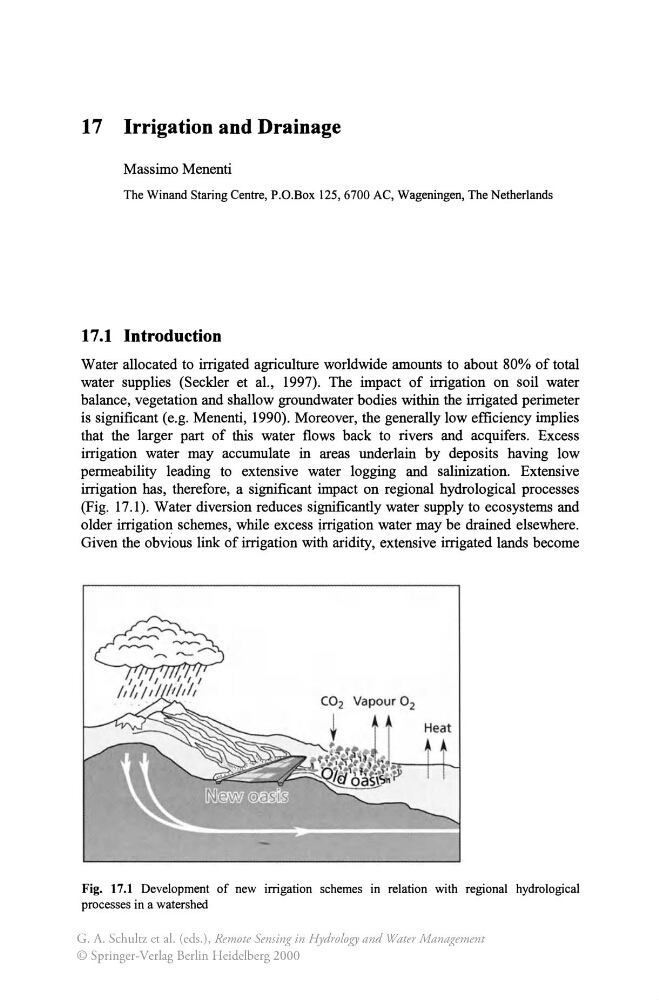
irrigation has, therefore, a significant impact on regional hydrological processes
(Fig. 17.1). Water diversion reduces significantly water supply to ecosystems and
older irrigation schemes, while excess irrigation water may be drained elsewhere.
Given the obvious link of irrigation with aridity, extensive irrigated lands become
~
~
~
...........
---. " -
" ,
I I I
/! I, 1,11/1/,1,
Vapour 02
Heat
Fig. 17.1 Development of new irrigation schemes in relation with regional hydrological
processes in a watershed
G. A. Schultz et al. (eds.), Remote Sensing in Hydrology and Water Management
© Springer-Verlag Berlin Heidelberg 2000
Massimo Menenti
The Winand Staring Centre, P.O.Box 125,6700 AC, Wageningen, The Netherlands
17.1 Introduction
Water allocated to irrigated agriculture worldwide amounts to about 80% of total
water supplies (Seckler et aI., 1997). The impact of irrigation on soil water
balance, vegetation and shallow groundwater bodies within the irrigated perimeter
is significant (e.g. Menenti, 1990). Moreover, the generally low efficiency implies
that the larger part of this water flows back to rivers and acquifers. Excess
irrigation water may accumulate in areas underlain by deposits having low
permeability leading to extensive water logging and salinization. Extensive
irrigation has, therefore, a significant impact on regional hydrological processes
(Fig. 17.1). Water diversion reduces significantly water supply to ecosystems and
older irrigation schemes, while excess irrigation water may be drained elsewhere.
Given the obvious link of irrigation with aridity, extensive irrigated lands become
~
~
~
...........
---. " -
" ,
I I I
/! I, 1,11/1/,1,
Vapour 02
Heat
Fig. 17.1 Development of new irrigation schemes in relation with regional hydrological
processes in a watershed
G. A. Schultz et al. (eds.), Remote Sensing in Hydrology and Water Management
© Springer-Verlag Berlin Heidelberg 2000