

374
G.A. Schultz
into an urban rainfall-runoff model simulating the behaviour of the urban drainage
area together with the flows in the sewer system. Such image sequences are also
used for forecasting rainfall intensities during the time increments of the next
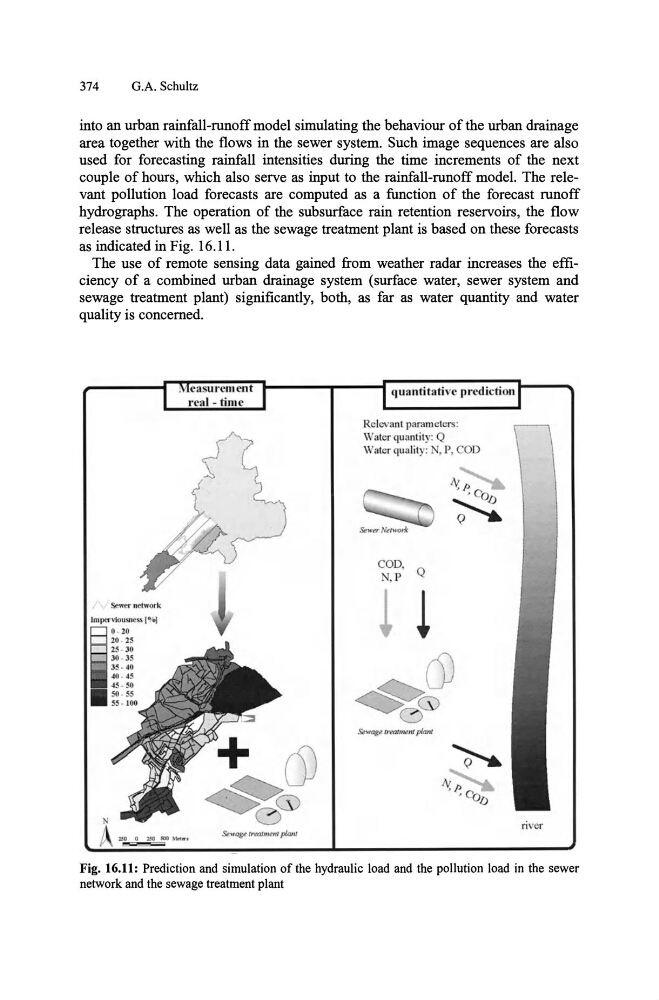
couple of hours, which also serve as input to the rainfall-runoff model. The relevant pollution load forecasts are computed as a function of the forecast runoff
hydro graphs. The operation of the subsurface rain retention reservoirs, the flow
release structures as well as the sewage treatment plant is based on these forecasts
as indicated in Fig. 16.11.
The use of remote sensing data gained from weather radar increases the efficiency of a combined urban drainage system (surface water, sewer system and
sewage treatment plant) significantly, both, as far as water quantity and water
quality is concerned.
lnt pef"Yio u~le s.." 1 %I
O· 20
20 - 25
25 · J O
J O- J 5
J 5 . '0
.0 - '5
015 · so
•
SO · 55
55 - 100
q uantit;ttivc pred icti on
Relevant parameters:
Watcrquantity: Q
Water quality: N, P,
0
coo, Q
, P
ri ver
Fig. 16.11: Prediction and simulation of the hydraulic load and the pollution load in the sewer
network and the sewage treatment plant
G.A. Schultz
into an urban rainfall-runoff model simulating the behaviour of the urban drainage
area together with the flows in the sewer system. Such image sequences are also
used for forecasting rainfall intensities during the time increments of the next
couple of hours, which also serve as input to the rainfall-runoff model. The relevant pollution load forecasts are computed as a function of the forecast runoff
hydro graphs. The operation of the subsurface rain retention reservoirs, the flow
release structures as well as the sewage treatment plant is based on these forecasts
as indicated in Fig. 16.11.
The use of remote sensing data gained from weather radar increases the efficiency of a combined urban drainage system (surface water, sewer system and
sewage treatment plant) significantly, both, as far as water quantity and water
quality is concerned.
lnt pef"Yio u~le s.." 1 %I
O· 20
20 - 25
25 · J O
J O- J 5
J 5 . '0
.0 - '5
015 · so
•
SO · 55
55 - 100
q uantit;ttivc pred icti on
Relevant parameters:
Watcrquantity: Q
Water quality: N, P,
0
coo, Q
, P
ri ver
Fig. 16.11: Prediction and simulation of the hydraulic load and the pollution load in the sewer
network and the sewage treatment plant