

370
G.A. Schultz
16.3.50ptimum Reservoir Operation Based on Forecast Flood Hydrograpbs
One way to protect lives and property from floods in river valleys is the construction and operation of flood protection reservoirs in the upstream reaches of the
river and its tributaries. The most efficient way to use such a reservoir system
during flood events is the adaptive control of such reservoirs in real-time based on
flood forecasts which are computed while it is still raining, i.e. with a reasonably
long lead time. This topic was already briefly discussed in Sect. 16.3 along with
Fig. 16.5, in which the principle of real-time flood forecasting and reservoir operation was presented. The idea of this type of reservoir operation is to provide an
optimum flood control, i.e. to minimize losses of lives and damage in the river
valleys below the reservoirs. It should be mentioned, that such optimum flood
protection reservoir controls are very sensitive to the accuracy of the forecast
flood hydro-graphs. Since flood forecasts are, however, almost always imperfect it
is necessary to compute forecasts again and again during the flood event (e.g.
every hour). Each such new computation of a flood forecast should be based on a
new model parameter set based on the new information gained during the last time
interval. Also the optimization procedure has to be computed on the basis of each
new flood forecast (e.g. every hour).
This way it becomes possible to operate the reservoir system in such a way that
each flood event will be controlled in an individual optimum mode. A technique
which has been proven to be successful for such flood control optimization is the
technique of DynamiC Programming (DP) from the field of Operations Research.
DP is a sequential optimization technique which allows to treat non-linear objective functions and non-linear constraints (Bellman, 1957).
The procedure, how to apply DP to the optimum operation of two parallel reservoirs will be given along with an example. Figure 16.8a shows a system of two
parallel flood protection reservoirs located in the upper reach of the Danube river
in Germany. Figure 16.8b shows a severe flood, which occurred in the system
during February 1970. In order to show the optimum operation of two parallel
reservoirs the flood shown in Fig. 16.8b will be assumed to represent forecasts of
flood hydro graphs expected to enter the two reservoirs (Fig. 16.8a) in the Breg
river (reservoir 1) and the Brigach river (reservoir 2).
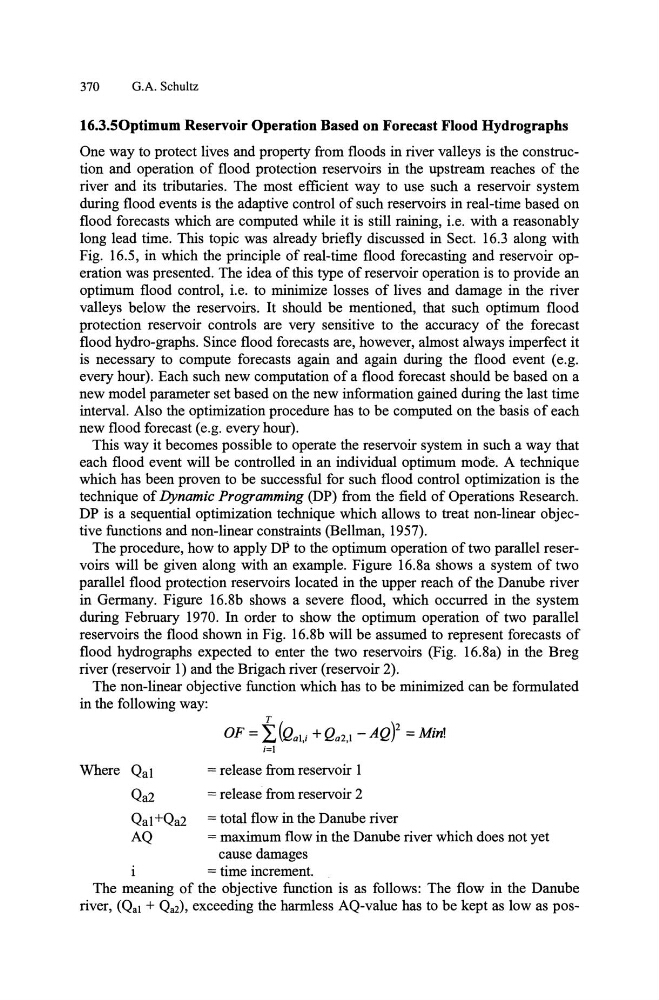
The non-linear objective function which has to be minimized can be formulated
in the following way:
Where Qal
Qa2
Qal+Qa2
AQ
T
OF = L (Qal,i + Qa2,1 - AQ)2 = Min!
i=l
= release from reservoir 1
= release from reservoir 2
= total flow in the Danube river
= maximum flow in the Danube river which does not yet
cause damages
i
= time increment.
The meaning of the objective function is as follows: The flow in the Danube
river, (Qal + Qa2), exceeding the harmless AQ-value has to be kept as low as pos-
G.A. Schultz
16.3.50ptimum Reservoir Operation Based on Forecast Flood Hydrograpbs
One way to protect lives and property from floods in river valleys is the construction and operation of flood protection reservoirs in the upstream reaches of the
river and its tributaries. The most efficient way to use such a reservoir system
during flood events is the adaptive control of such reservoirs in real-time based on
flood forecasts which are computed while it is still raining, i.e. with a reasonably
long lead time. This topic was already briefly discussed in Sect. 16.3 along with
Fig. 16.5, in which the principle of real-time flood forecasting and reservoir operation was presented. The idea of this type of reservoir operation is to provide an
optimum flood control, i.e. to minimize losses of lives and damage in the river
valleys below the reservoirs. It should be mentioned, that such optimum flood
protection reservoir controls are very sensitive to the accuracy of the forecast
flood hydro-graphs. Since flood forecasts are, however, almost always imperfect it
is necessary to compute forecasts again and again during the flood event (e.g.
every hour). Each such new computation of a flood forecast should be based on a
new model parameter set based on the new information gained during the last time
interval. Also the optimization procedure has to be computed on the basis of each
new flood forecast (e.g. every hour).
This way it becomes possible to operate the reservoir system in such a way that
each flood event will be controlled in an individual optimum mode. A technique
which has been proven to be successful for such flood control optimization is the
technique of DynamiC Programming (DP) from the field of Operations Research.
DP is a sequential optimization technique which allows to treat non-linear objective functions and non-linear constraints (Bellman, 1957).
The procedure, how to apply DP to the optimum operation of two parallel reservoirs will be given along with an example. Figure 16.8a shows a system of two
parallel flood protection reservoirs located in the upper reach of the Danube river
in Germany. Figure 16.8b shows a severe flood, which occurred in the system
during February 1970. In order to show the optimum operation of two parallel
reservoirs the flood shown in Fig. 16.8b will be assumed to represent forecasts of
flood hydro graphs expected to enter the two reservoirs (Fig. 16.8a) in the Breg
river (reservoir 1) and the Brigach river (reservoir 2).
The non-linear objective function which has to be minimized can be formulated
in the following way:
Where Qal
Qa2
Qal+Qa2
AQ
T
OF = L (Qal,i + Qa2,1 - AQ)2 = Min!
i=l
= release from reservoir 1
= release from reservoir 2
= total flow in the Danube river
= maximum flow in the Danube river which does not yet
cause damages
i
= time increment.
The meaning of the objective function is as follows: The flow in the Danube
river, (Qal + Qa2), exceeding the harmless AQ-value has to be kept as low as pos-