

15 Introduction to and General Aspects of Water Management
345
: ..................... -... .
,
1...... _____ . : :li:.~_:.~~~:.~~~:.:.:::.~:.~~·::::::::::::::::.::r·~&
I
Objects for
~rshed
.....•.
~w .... -.
Output .. J
m~ User
, ... ~~
I
I
~. :
,Create_subbasin j :
;
I
,
I
...
I
.=.= . . . . . . =.~.=. =··=····~+""···==· •• -=' ••• • ... n~i~~:.~i1!
GeCshed_slo~
~~-CC----'H::·::·=-'~~-'~=~~~:~·7 Start_reasoning! I
Legend
c:=:=> Object netwo/1(
~ Hypothesis of rule
O
System component other
than object & rule
models
RA
Be
SU
GA
HF
Right-hand side action
Backward chaining
Suggesting
Semantic gates
Hypothesis forward
~ Inference direction ~
··_········1 Rule-object interaction
- - - - Jobs, performed outside
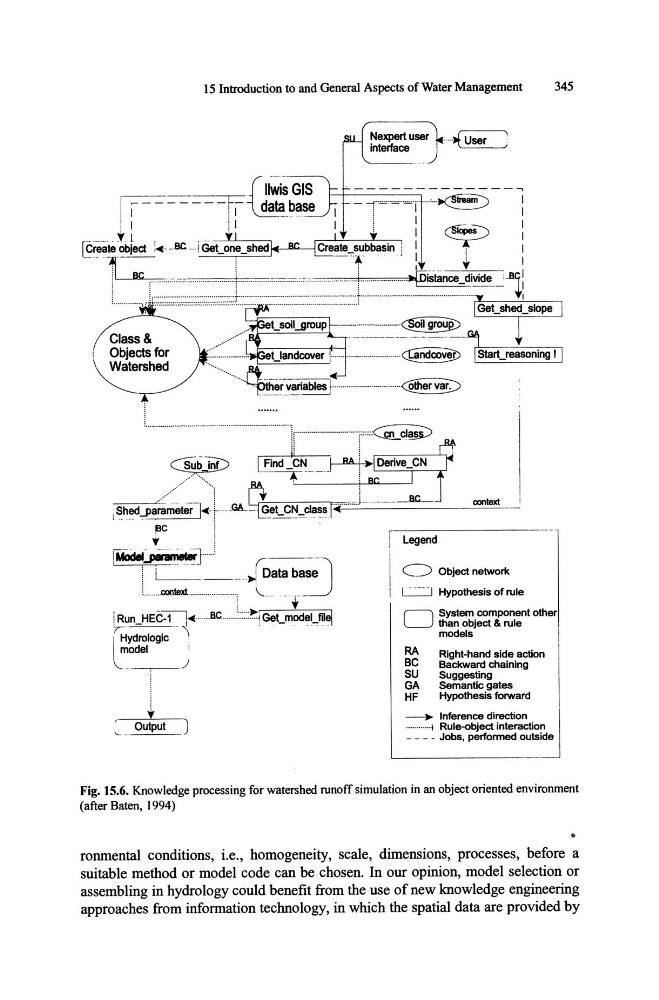
Fig. 15.6. Knowledge processing for watershed runoff simulation in an object oriented environment
(after Baten, I 994)
ronmental conditions, i.e., homogeneity, scale, dimensions, processes, before a
suitable method or model code can be chosen. In our opinion, model selection or
assembling in hydrology could benefit from the use of new knowledge engineering
approaches from information technology, in which the spatial data are provided by
345
: ..................... -... .
,
1...... _____ . : :li:.~_:.~~~:.~~~:.:.:::.~:.~~·::::::::::::::::.::r·~&
I
Objects for
~rshed
.....•.
~w .... -.
Output .. J
m~ User
, ... ~~
I
I
~. :
,Create_subbasin j :
;
I
,
I
...
I
.=.= . . . . . . =.~.=. =··=····~+""···==· •• -=' ••• • ... n~i~~:.~i1!
GeCshed_slo~
~~-CC----'H::·::·=-'~~-'~=~~~:~·7 Start_reasoning! I
Legend
c:=:=> Object netwo/1(
~ Hypothesis of rule
O
System component other
than object & rule
models
RA
Be
SU
GA
HF
Right-hand side action
Backward chaining
Suggesting
Semantic gates
Hypothesis forward
~ Inference direction ~
··_········1 Rule-object interaction
- - - - Jobs, performed outside
Fig. 15.6. Knowledge processing for watershed runoff simulation in an object oriented environment
(after Baten, I 994)
ronmental conditions, i.e., homogeneity, scale, dimensions, processes, before a
suitable method or model code can be chosen. In our opinion, model selection or
assembling in hydrology could benefit from the use of new knowledge engineering
approaches from information technology, in which the spatial data are provided by