

15 Introduction to and General Aspects of Water Management
343
vegetation classes. Relations can also be formulated in qualitative indicators or rating
factors for evaluation of effects as is practiced in environmental impact assessment
(Janssen, 1992). As such qualitative knowledge is generally contained in procedures,
sets of decision rules, or logic assertions. A logical rule can be simply a conditional
statement with the following format: "if (condition) then (exist or do. action) ".
Besides this more conventional rule-based or expert system approach (Engel et aI.,
1988), knowledge-based applications using other formalizations of artificial intelligence are being developed (Schlumberger, 1994, Wolbring & Schultz, 1996). We
refer to Abbott et aI. (1994) for more information on the use of advanced information
technologies and knowledge engineering in the hydrologic sciences.
Decision support systems. A decision support system (DSS) can be defined as an
interactive computer-based system which permits a combination of knowledge
sources from various domains in order to help decision makers to solve ill-structured
or complex problems. DSS have evolved from practices in the management of
information systems, particularly in the field of data processing in business sciences.
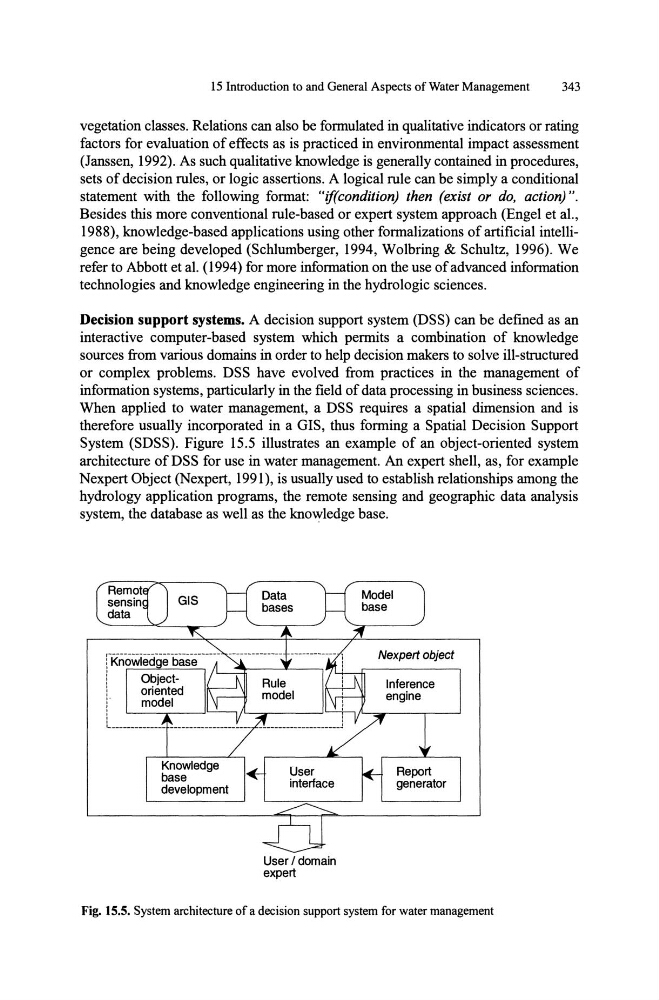
When applied to water management, a DSS requires a spatial dimension and is
therefore usually incorporated in a GIS, thus forming a Spatial Decision Support
System (SDSS). Figure 15.5 illustrates an example of an object-oriented system
architecture of DSS for use in water management. An expert shell, as, for example
Nexpert Object (Nexpert, 1991), is usually used to establish relationships among the
hydrology application programs, the remote sensing and geographic data analysis
system, the database as well as the knowledge base.
Knowledge
base
development
User / domain
expert
Fig. 15.5. System architecture of a decision support system for water management
343
vegetation classes. Relations can also be formulated in qualitative indicators or rating
factors for evaluation of effects as is practiced in environmental impact assessment
(Janssen, 1992). As such qualitative knowledge is generally contained in procedures,
sets of decision rules, or logic assertions. A logical rule can be simply a conditional
statement with the following format: "if (condition) then (exist or do. action) ".
Besides this more conventional rule-based or expert system approach (Engel et aI.,
1988), knowledge-based applications using other formalizations of artificial intelligence are being developed (Schlumberger, 1994, Wolbring & Schultz, 1996). We
refer to Abbott et aI. (1994) for more information on the use of advanced information
technologies and knowledge engineering in the hydrologic sciences.
Decision support systems. A decision support system (DSS) can be defined as an
interactive computer-based system which permits a combination of knowledge
sources from various domains in order to help decision makers to solve ill-structured
or complex problems. DSS have evolved from practices in the management of
information systems, particularly in the field of data processing in business sciences.
When applied to water management, a DSS requires a spatial dimension and is
therefore usually incorporated in a GIS, thus forming a Spatial Decision Support
System (SDSS). Figure 15.5 illustrates an example of an object-oriented system
architecture of DSS for use in water management. An expert shell, as, for example
Nexpert Object (Nexpert, 1991), is usually used to establish relationships among the
hydrology application programs, the remote sensing and geographic data analysis
system, the database as well as the knowledge base.
Knowledge
base
development
User / domain
expert
Fig. 15.5. System architecture of a decision support system for water management