

13 Water Quality
289
Development of remote sensing techniques for monitoring water quality began in
the early 1970s. These early techniques used the visible and infrared portions of the
electromagnetic spectrum to measure spectral differences and thermal infrared to
measure emitted energy from water surfaces. Generally, empirical relationships
between spectral properties and water quality parameters were established. Morel and
Gordon (1980) discussed three general methods to determine relationships between
radiance or reflectance and the concentration of constituents in water. These methods
are an empirical approach, a semi-empirical approach and an analytical approach. The
general form of the empirical and semi-empirical equations is:
Y=A+BX
or
Y=AB x
Where Y is the measured radiance, reflectance, or energy and X is the water quality
parameter of interest (suspended sediment, turbidity, chlorophyll, etc.). A and Bare
empirically derived factors or empirical factors modified based on a knowledge of the
interaction of water quality parameters and optical/thermal properties of water. These
relationships are often nonlinear in form.
In the empirical approach a statistical relationship is determined between measured
spectral properties and measured water quality parameters. In the semi-empirical
approach, information about the spectral/optical characteristic of the water quality
parameter is used in statistical analyses to aid in the selection of best wavelength(s)
or best model. In both approaches the empirical characteristics of the relationships
limit their applications to the condition for which the data were collected. Such
empirical models should only be used to estimate water quality parameters for water
bodies with similar conditions.
.
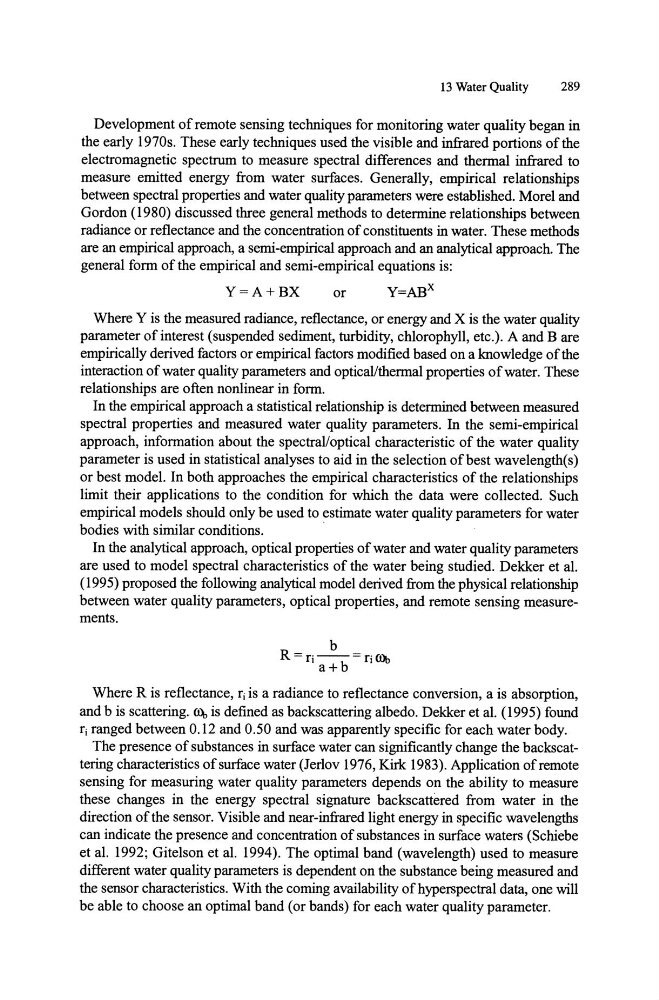
In the analytical approach, optical properties of water and water quality parameters
are used to model spectral characteristics of the water being studied. Dekker et al.
(1995) proposed the following analytical model derived from the physical relationship
between water quality parameters, optical properties, and remote sensing measurements.
b
R=fi a + b =fiCJlb
Where R is reflectance, rj is a radiance to reflectance conversion, a is absorption,
and b is scattering. 0\, is defined as backscattering albedo. Dekker et al. (1995) found
rj ranged between 0.12 and 0.50 and was apparently specific for each water body.
The presence of substances in surface water can significantly change the backscattering characteristics of surface water (Jerlov 1976, KiIk 1983). Application of remote
sensing for measuring water quality parameters depends on the ability to measure
these changes in the energy spectral signature backscattered from water in the
direction of the sensor. Visible and near-infrared light energy in specific wavelengths
can indicate the presence and concentration of substances in surface waters (Schiebe
et al. 1992; Gitelson et al. 1994). The optimal band (wavelength) used to measure
different water quality parameters is dependent on the substance being measured and
the sensor characteristics. With the coming availability ofhyperspectral data, one will
be able to choose an optimal band (or bands) for each water quality parameter.
289
Development of remote sensing techniques for monitoring water quality began in
the early 1970s. These early techniques used the visible and infrared portions of the
electromagnetic spectrum to measure spectral differences and thermal infrared to
measure emitted energy from water surfaces. Generally, empirical relationships
between spectral properties and water quality parameters were established. Morel and
Gordon (1980) discussed three general methods to determine relationships between
radiance or reflectance and the concentration of constituents in water. These methods
are an empirical approach, a semi-empirical approach and an analytical approach. The
general form of the empirical and semi-empirical equations is:
Y=A+BX
or
Y=AB x
Where Y is the measured radiance, reflectance, or energy and X is the water quality
parameter of interest (suspended sediment, turbidity, chlorophyll, etc.). A and Bare
empirically derived factors or empirical factors modified based on a knowledge of the
interaction of water quality parameters and optical/thermal properties of water. These
relationships are often nonlinear in form.
In the empirical approach a statistical relationship is determined between measured
spectral properties and measured water quality parameters. In the semi-empirical
approach, information about the spectral/optical characteristic of the water quality
parameter is used in statistical analyses to aid in the selection of best wavelength(s)
or best model. In both approaches the empirical characteristics of the relationships
limit their applications to the condition for which the data were collected. Such
empirical models should only be used to estimate water quality parameters for water
bodies with similar conditions.
.
In the analytical approach, optical properties of water and water quality parameters
are used to model spectral characteristics of the water being studied. Dekker et al.
(1995) proposed the following analytical model derived from the physical relationship
between water quality parameters, optical properties, and remote sensing measurements.
b
R=fi a + b =fiCJlb
Where R is reflectance, rj is a radiance to reflectance conversion, a is absorption,
and b is scattering. 0\, is defined as backscattering albedo. Dekker et al. (1995) found
rj ranged between 0.12 and 0.50 and was apparently specific for each water body.
The presence of substances in surface water can significantly change the backscattering characteristics of surface water (Jerlov 1976, KiIk 1983). Application of remote
sensing for measuring water quality parameters depends on the ability to measure
these changes in the energy spectral signature backscattered from water in the
direction of the sensor. Visible and near-infrared light energy in specific wavelengths
can indicate the presence and concentration of substances in surface waters (Schiebe
et al. 1992; Gitelson et al. 1994). The optimal band (wavelength) used to measure
different water quality parameters is dependent on the substance being measured and
the sensor characteristics. With the coming availability ofhyperspectral data, one will
be able to choose an optimal band (or bands) for each water quality parameter.