

208
E.T. Engman
used for any cover type. Furthermore they speculate on how this parameter could
be estimated using visible and near infrared satellite data in an operational sense.
These studies point out the possibility of a total satellite remote sensing approach
for soil moisture without any ground sampling.
Dead vegetation can also have an attenuating effect on the microwave emissions
from the soil as was demonstrated by Schmugge et al. (1988). Aircraft experiments
with an L-band pushbroom microwave radiometer over the Konza prairie grasslands showed that, for areas that had not been burned, a buildup of a thatch layer
serves as a highly emissive layer above the soil, thus masking the emission of the
soil itself. Where there was an absence of this thatch layer because of burning or
grazing, the microwave sensitivity to soil moisture was as expected for bare soil.
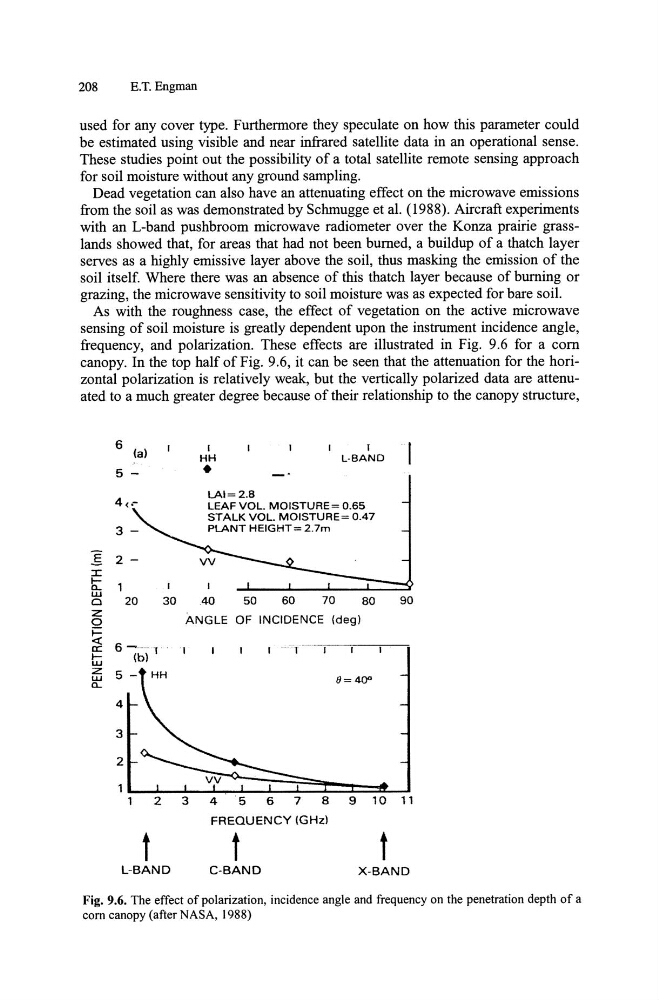
As with the roughness case, the effect of vegetation on the active microwave
sensing of soil moisture is greatly dependent upon the instrument incidence angle,
frequency, and polarization. These effects are illustrated in Fig. 9.6 for a corn
canopy. In the top half of Fig. 9.6, it can be seen that the attenuation for the horizontal polarization is relatively weak, but the vertically polarized data are attenuated to a much greater degree because of their relationship to the canopy structure,
6 (a)
I
T
HH
L·BAND
5 -
•
4(0LAI=2.B
LEAF VOL. MOISTURE = 0.65
STALK VOL. MOISTURE= 0.47
PLANT HEIGHT= 2.7m
~ 2 -
:r:
Ii: 1
w
a
20
30
.40
50
60
70
80
90
z
ANGLE OF INCIDENCE (deg)
0
;:::
<1: 6- I
a:
J
T
I(b)
w
z 5 -
w
0= 40"
a..
4
3
2
lL-~~C:~~~~~~.
1
2
3
4
5
6
7
8
9 10 11
FREQUENCY (GHz)
t
t
t
L-BAND
C-BAND
X-BAND
Fig. 9.6. The effect of polarization, incidence angle and frequency on the penetration depth of a
com canopy (after NASA, 1988)
E.T. Engman
used for any cover type. Furthermore they speculate on how this parameter could
be estimated using visible and near infrared satellite data in an operational sense.
These studies point out the possibility of a total satellite remote sensing approach
for soil moisture without any ground sampling.
Dead vegetation can also have an attenuating effect on the microwave emissions
from the soil as was demonstrated by Schmugge et al. (1988). Aircraft experiments
with an L-band pushbroom microwave radiometer over the Konza prairie grasslands showed that, for areas that had not been burned, a buildup of a thatch layer
serves as a highly emissive layer above the soil, thus masking the emission of the
soil itself. Where there was an absence of this thatch layer because of burning or
grazing, the microwave sensitivity to soil moisture was as expected for bare soil.
As with the roughness case, the effect of vegetation on the active microwave
sensing of soil moisture is greatly dependent upon the instrument incidence angle,
frequency, and polarization. These effects are illustrated in Fig. 9.6 for a corn
canopy. In the top half of Fig. 9.6, it can be seen that the attenuation for the horizontal polarization is relatively weak, but the vertically polarized data are attenuated to a much greater degree because of their relationship to the canopy structure,
6 (a)
I
T
HH
L·BAND
5 -
•
4(0LAI=2.B
LEAF VOL. MOISTURE = 0.65
STALK VOL. MOISTURE= 0.47
PLANT HEIGHT= 2.7m
~ 2 -
:r:
Ii: 1
w
a
20
30
.40
50
60
70
80
90
z
ANGLE OF INCIDENCE (deg)
0
;:::
<1: 6- I
a:
J
T
I(b)
w
z 5 -
w
0= 40"
a..
4
3
2
lL-~~C:~~~~~~.
1
2
3
4
5
6
7
8
9 10 11
FREQUENCY (GHz)
t
t
t
L-BAND
C-BAND
X-BAND
Fig. 9.6. The effect of polarization, incidence angle and frequency on the penetration depth of a
com canopy (after NASA, 1988)