

206
E.T. Engman
SPM
POM GOM
DIIIJrn ~ ~
8
6
Kcr 4
2
10
15
20
KI
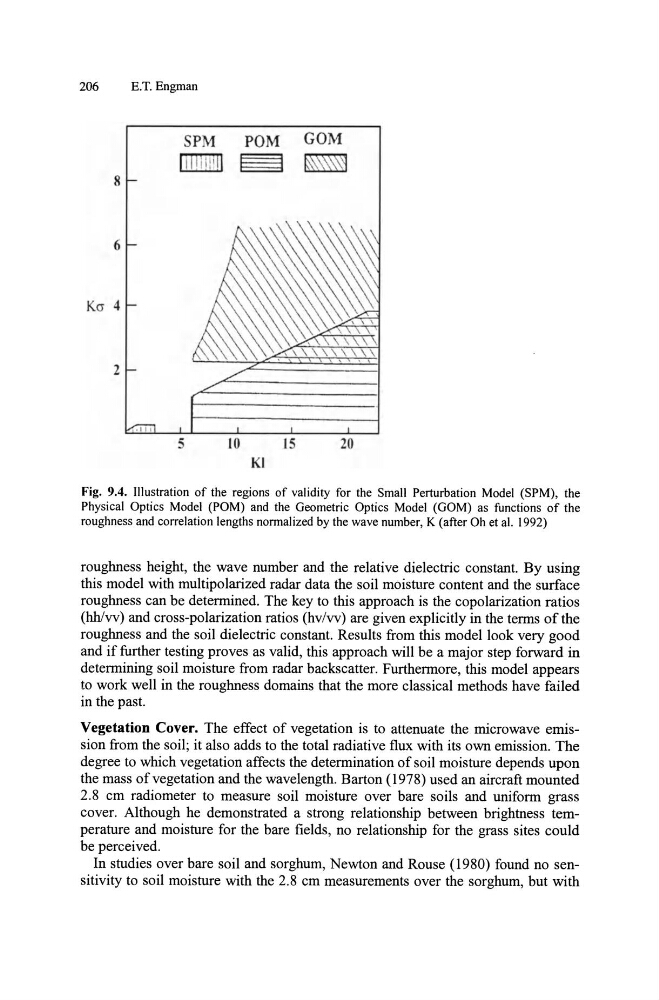
Fig. 9.4. Illustration of the regions of validity for the Small Perturbation Model (SPM), the
Physical Optics Model (POM) and the Geometric Optics Model (GOM) as functions of the
roughness and correlation lengths normalized by the wave number, K (after Oh et al. 1992)
roughness height, the wave number and the relative dielectric constant. By using
this model with multipolarized radar data the soil moisture content and the surface
roughness can be determined. The key to this approach is the copolarization ratios
(hh/vv) and cross-polarization ratios (hv/vv) are given explicitly in the terms of the
roughness and the soil dielectric constant. Results from this model look very good
and if further testing proves as valid, this approach will be a major step forward in
determining soil moisture from radar backscatter. Furthermore, this model appears
to work well in the roughness domains that the more classical methods have failed
in the past.
Vegetation Cover. The effect of vegetation is to attenuate the microwave emission from the soil; it also adds to the total radiative flux with its own emission. The
degree to which vegetation affects the determination of soil moisture depends upon
the mass of vegetation and the wavelength. Barton (1978) used an aircraft mounted
2.8 cm radiometer to measure soil moisture over bare soils and uniform grass
cover. Although he demonstrated a strong relationship between brightness temperature and moisture for the bare fields, no relationship for the grass sites could
be perceived.
In studies over bare soil and sorghum, Newton and Rouse (1980) found no sensitivity to soil moisture with the 2.8 cm measurements over the sorghum, but with
E.T. Engman
SPM
POM GOM
DIIIJrn ~ ~
8
6
Kcr 4
2
10
15
20
KI
Fig. 9.4. Illustration of the regions of validity for the Small Perturbation Model (SPM), the
Physical Optics Model (POM) and the Geometric Optics Model (GOM) as functions of the
roughness and correlation lengths normalized by the wave number, K (after Oh et al. 1992)
roughness height, the wave number and the relative dielectric constant. By using
this model with multipolarized radar data the soil moisture content and the surface
roughness can be determined. The key to this approach is the copolarization ratios
(hh/vv) and cross-polarization ratios (hv/vv) are given explicitly in the terms of the
roughness and the soil dielectric constant. Results from this model look very good
and if further testing proves as valid, this approach will be a major step forward in
determining soil moisture from radar backscatter. Furthermore, this model appears
to work well in the roughness domains that the more classical methods have failed
in the past.
Vegetation Cover. The effect of vegetation is to attenuate the microwave emission from the soil; it also adds to the total radiative flux with its own emission. The
degree to which vegetation affects the determination of soil moisture depends upon
the mass of vegetation and the wavelength. Barton (1978) used an aircraft mounted
2.8 cm radiometer to measure soil moisture over bare soils and uniform grass
cover. Although he demonstrated a strong relationship between brightness temperature and moisture for the bare fields, no relationship for the grass sites could
be perceived.
In studies over bare soil and sorghum, Newton and Rouse (1980) found no sensitivity to soil moisture with the 2.8 cm measurements over the sorghum, but with