

204
E.T. Engman
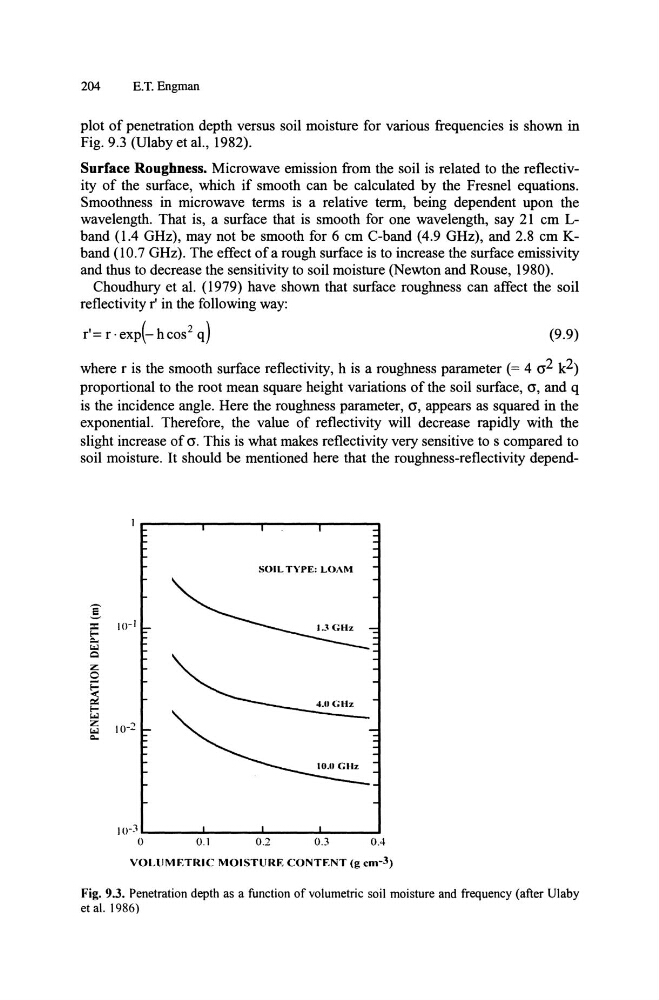
plot of penetration depth versus soil moisture for various frequencies is shown in
Fig. 9.3 (Ulaby et aI., 1982).
Surface Roughness. Microwave emission from the soil is related to the reflectivity of the surface, which if smooth can be calculated by the Fresnel equations.
Smoothness in microwave terms is a relative term, being dependent upon the
wavelength. That is, a surface that is smooth for one wavelength, say 21 cm Lband (1.4 GHz), may not be smooth for 6 cm C-band (4.9 GHz), and 2.8 cm Kband (10.7 GHz). The effect of a rough surface is to increase the surface emissivity
and thus to decrease the sensitivity to soil moisture (Newton and Rouse, 1980).
Choudhury et al. (1979) have shown that surface roughness can affect the soil
reflectivity r' in the following way:
r'= r· exp(- h cos 2 q)
(9.9)
where r is the smooth surface reflectivity, h is a roughness parameter (= 4 cr 2 k 2 )
proportional to the root mean square height variations of the soil surface, cr, and q
is the incidence angle. Here the roughness parameter, cr, appears as squared in the
exponential. Therefore, the value of reflectivity will decrease rapidly with the
slight increase of cr. This is what makes reflectivity very sensitive to s compared to
soil moisture. It should be mentioned here that the roughness-reflectivity dependSOIL TYPE: LOAM
4.0Gl1z
]0-3 ..... _ _ --''--_ _ ...... _ _ _ ....... _ _ --'
o
0.1
0.2
0.3
0.4
V()UJMETI{IC MOISTlTI{E CONTENT (g cm-3)
Fig. 9.3. Penetration depth as a function of volumetric soil moisture and frequency (after Ulaby
et al. 1986)
E.T. Engman
plot of penetration depth versus soil moisture for various frequencies is shown in
Fig. 9.3 (Ulaby et aI., 1982).
Surface Roughness. Microwave emission from the soil is related to the reflectivity of the surface, which if smooth can be calculated by the Fresnel equations.
Smoothness in microwave terms is a relative term, being dependent upon the
wavelength. That is, a surface that is smooth for one wavelength, say 21 cm Lband (1.4 GHz), may not be smooth for 6 cm C-band (4.9 GHz), and 2.8 cm Kband (10.7 GHz). The effect of a rough surface is to increase the surface emissivity
and thus to decrease the sensitivity to soil moisture (Newton and Rouse, 1980).
Choudhury et al. (1979) have shown that surface roughness can affect the soil
reflectivity r' in the following way:
r'= r· exp(- h cos 2 q)
(9.9)
where r is the smooth surface reflectivity, h is a roughness parameter (= 4 cr 2 k 2 )
proportional to the root mean square height variations of the soil surface, cr, and q
is the incidence angle. Here the roughness parameter, cr, appears as squared in the
exponential. Therefore, the value of reflectivity will decrease rapidly with the
slight increase of cr. This is what makes reflectivity very sensitive to s compared to
soil moisture. It should be mentioned here that the roughness-reflectivity dependSOIL TYPE: LOAM
4.0Gl1z
]0-3 ..... _ _ --''--_ _ ...... _ _ _ ....... _ _ --'
o
0.1
0.2
0.3
0.4
V()UJMETI{IC MOISTlTI{E CONTENT (g cm-3)
Fig. 9.3. Penetration depth as a function of volumetric soil moisture and frequency (after Ulaby
et al. 1986)