

9 Soil Moisture
199
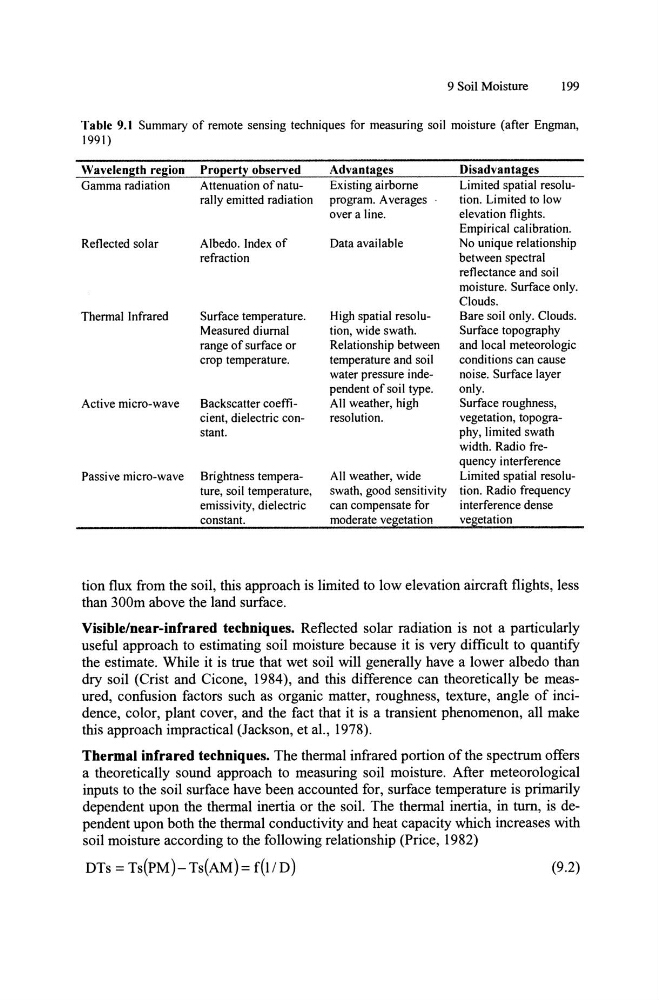
Table 9.1 Summary of remote sensing techniques for measuring soil moisture (after Engman,
1991)
Wavelength region Pro~ert~ observed
Advantages
Disadvantages
Gamma radiation
Attenuation of natuExisting airborne
Limited spatial resolurally emitted radiation program. Averages
tion. Limited to low
over a line.
elevation flights.
Empirical calibration.
Reflected solar
Albedo. Index of
Data available
No unique relationship
refraction
between spectral
reflectance and soil
moisture. Surface only.
Clouds.
Thermal Infrared
Surface temperature.
High spatial resoluBare soil only. Clouds.
Measured diurnal
tion, wide swath.
Surface topography
range of surface or
Relationship between
and local meteorologic
crop temperature.
temperature and soil
conditions can cause
water pressure indenoise. Surface layer
pendent of soil type.
only.
Active micro-wave
Backscatter coeffiAll weather, high
Surface roughness,
cient, dielectric conresolution.
vegetation, topograstant.
phy, limited swath
width. Radio frequency interference
Passive micro-wave Brightness temperaAll weather, wide
Limited spatial resoluture, soil temperature, swath, good sensitivity tion. Radio frequency
emissivity, dielectric
can compensate for
interference dense
constant.
moderate ve~etation
ve~etation
tion flux from the soil, this approach is limited to low elevation aircraft flights, less
than 300m above the land surface.
Visible/near-infrared techniques. Reflected solar radiation is not a particularly
useful approach to estimating soil moisture because it is very difficult to quantify
the estimate. While it is true that wet soil will generally have a lower albedo than
dry soil (Crist and Cicone, 1984), and this difference can theoretically be measured, confusion factors such as organic matter, roughness, texture, angle of incidence, color, plant cover, and the fact that it is a transient phenomenon, all make
this approach impractical (Jackson, et aI., 1978).
Thermal infrared techniques. The thermal infrared portion of the spectrum offers
a theoretically sound approach to measuring soil moisture. After meteorological
inputs to the soil surface have been accounted for, surface temperature is primarily
dependent upon the thermal inertia or the soil. The thermal inertia, in tum, is dependent upon both the thermal conductivity and heat capacity which increases with
soil moisture according to the following relationship (Price, 1982)
DTs = Ts(PM)- Ts(AM)= f(lID)
(9.2)
199
Table 9.1 Summary of remote sensing techniques for measuring soil moisture (after Engman,
1991)
Wavelength region Pro~ert~ observed
Advantages
Disadvantages
Gamma radiation
Attenuation of natuExisting airborne
Limited spatial resolurally emitted radiation program. Averages
tion. Limited to low
over a line.
elevation flights.
Empirical calibration.
Reflected solar
Albedo. Index of
Data available
No unique relationship
refraction
between spectral
reflectance and soil
moisture. Surface only.
Clouds.
Thermal Infrared
Surface temperature.
High spatial resoluBare soil only. Clouds.
Measured diurnal
tion, wide swath.
Surface topography
range of surface or
Relationship between
and local meteorologic
crop temperature.
temperature and soil
conditions can cause
water pressure indenoise. Surface layer
pendent of soil type.
only.
Active micro-wave
Backscatter coeffiAll weather, high
Surface roughness,
cient, dielectric conresolution.
vegetation, topograstant.
phy, limited swath
width. Radio frequency interference
Passive micro-wave Brightness temperaAll weather, wide
Limited spatial resoluture, soil temperature, swath, good sensitivity tion. Radio frequency
emissivity, dielectric
can compensate for
interference dense
constant.
moderate ve~etation
ve~etation
tion flux from the soil, this approach is limited to low elevation aircraft flights, less
than 300m above the land surface.
Visible/near-infrared techniques. Reflected solar radiation is not a particularly
useful approach to estimating soil moisture because it is very difficult to quantify
the estimate. While it is true that wet soil will generally have a lower albedo than
dry soil (Crist and Cicone, 1984), and this difference can theoretically be measured, confusion factors such as organic matter, roughness, texture, angle of incidence, color, plant cover, and the fact that it is a transient phenomenon, all make
this approach impractical (Jackson, et aI., 1978).
Thermal infrared techniques. The thermal infrared portion of the spectrum offers
a theoretically sound approach to measuring soil moisture. After meteorological
inputs to the soil surface have been accounted for, surface temperature is primarily
dependent upon the thermal inertia or the soil. The thermal inertia, in tum, is dependent upon both the thermal conductivity and heat capacity which increases with
soil moisture according to the following relationship (Price, 1982)
DTs = Ts(PM)- Ts(AM)= f(lID)
(9.2)