

166
M. Menenti
and! or reo We may conclude that (To-Ta) is a straightforward indicator of evaporation when a limited range of environmental conditions is considered. A robust
model of the dependence LE on (T 0-Ta) should account properly for all radiative,
boundary layer and surface forcing factors.
With the availability of easy to use thermal infrared thermometers agricultural
scientists undertook detailed experiments to study the dependence of leaf and canopy temperature on weather conditions and specifically on radiative forcing. Stone
et al. (1975) documented the rapid response of canopy temperature (sorghum) to
changes in net radiation due to passing clouds. Fluctuations in canopy temperature
of up to 3 K over three minutes was observed. Heilman et al. (1976) presented
estimates of evaporation using a simple resistance equation and the surface to air
temperature difference. Remote sensing studies of the land surface heat balance,
and of actual evaporation has been an active field of research during the last 25
years. A review of methods is presented in the following pages. In anticipation it
may be mentioned that while no general and robust method is at hand, most methods described are applicable under specific conditions. The materials presented
aim to help identifying the merits of different approaches. To help readers through
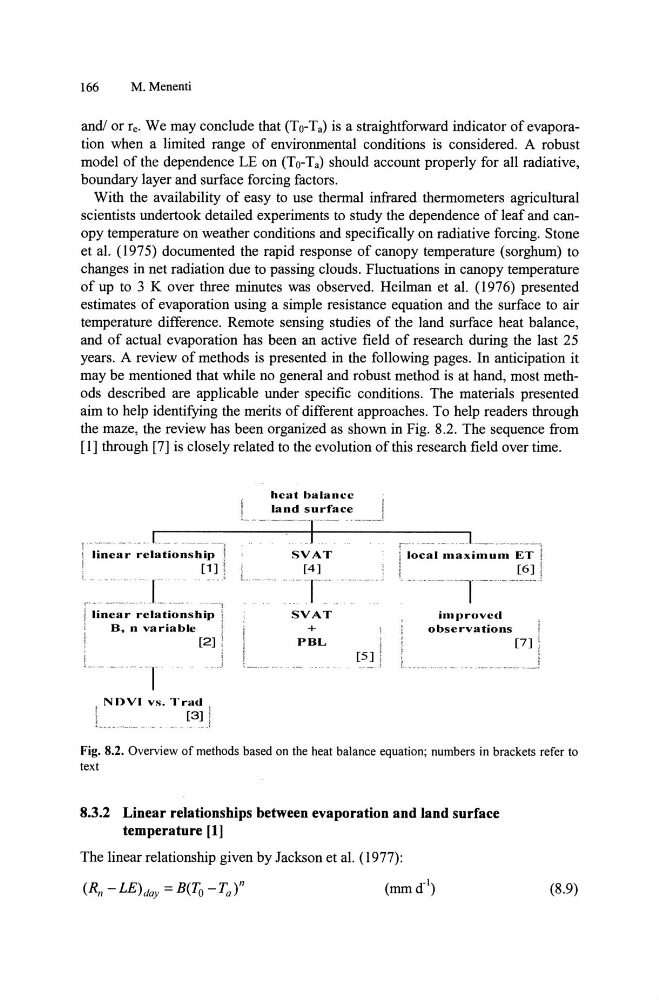
the maze, the review has been organized as shown in Fig. 8.2. The sequence from
[1] through [7] is closely related to the evolution of this research field over time.
L
linear relationship -!
[1] !
hcat hah,ncc
land surface
SVAT
[4 ]
-----T:-_SVAT
+
PBL
[5]
inlprovcd
observations
[7]
Fig. 8.2. Overview of methods based on the heat balance equation; numbers in brackets refer to
text
8.3.2 Linear relationships between evaporation and land surface
temperature [1]
The linear relationship given by Jackson et al. (1977):
(8.9)
M. Menenti
and! or reo We may conclude that (To-Ta) is a straightforward indicator of evaporation when a limited range of environmental conditions is considered. A robust
model of the dependence LE on (T 0-Ta) should account properly for all radiative,
boundary layer and surface forcing factors.
With the availability of easy to use thermal infrared thermometers agricultural
scientists undertook detailed experiments to study the dependence of leaf and canopy temperature on weather conditions and specifically on radiative forcing. Stone
et al. (1975) documented the rapid response of canopy temperature (sorghum) to
changes in net radiation due to passing clouds. Fluctuations in canopy temperature
of up to 3 K over three minutes was observed. Heilman et al. (1976) presented
estimates of evaporation using a simple resistance equation and the surface to air
temperature difference. Remote sensing studies of the land surface heat balance,
and of actual evaporation has been an active field of research during the last 25
years. A review of methods is presented in the following pages. In anticipation it
may be mentioned that while no general and robust method is at hand, most methods described are applicable under specific conditions. The materials presented
aim to help identifying the merits of different approaches. To help readers through
the maze, the review has been organized as shown in Fig. 8.2. The sequence from
[1] through [7] is closely related to the evolution of this research field over time.
L
linear relationship -!
[1] !
hcat hah,ncc
land surface
SVAT
[4 ]
-----T:-_SVAT
+
PBL
[5]
inlprovcd
observations
[7]
Fig. 8.2. Overview of methods based on the heat balance equation; numbers in brackets refer to
text
8.3.2 Linear relationships between evaporation and land surface
temperature [1]
The linear relationship given by Jackson et al. (1977):
(8.9)