

126
e.G. Collier
280
- - - Ocean
120
100
Rain rate (mm h" )
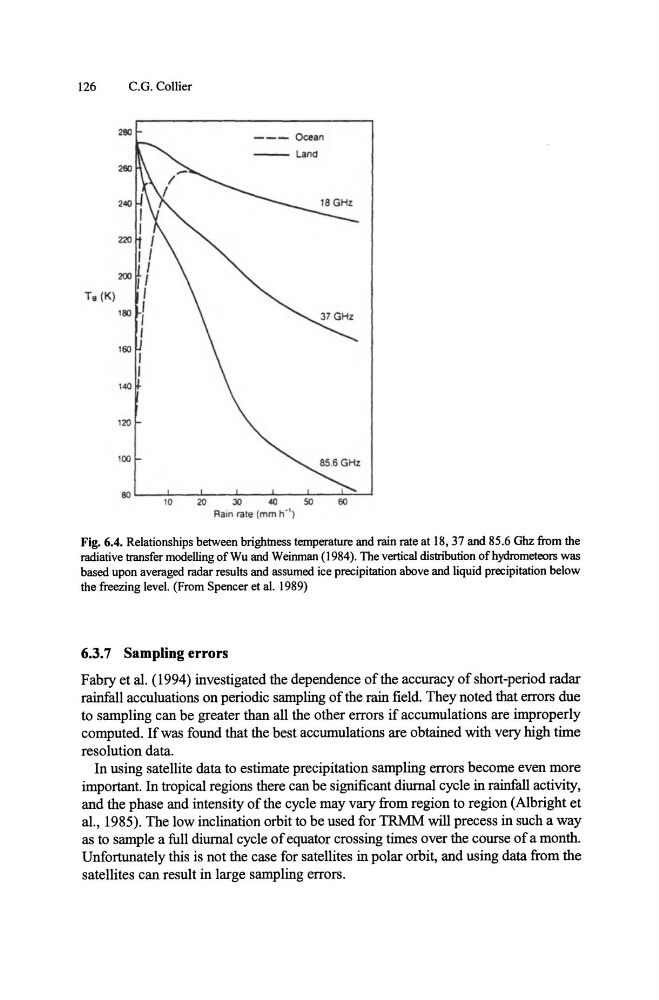
Fig. 6.4. Relationships between brightness temperature and rain rate at 18,37 and 85.6 Ghz from the
radiative transfer modelling of Wu and Weinman (1984). The vertical distribution of hydrometeors was
based upon averaged radar results and assumed ice precipitation above and liquid precipitation below
the freezing level. (From Spencer et al. 1989)
6.3.7 Sampling errors
Fabry et al. (1994) investigated the dependence of the accuracy of short-period radar
rainfall acculuations on periodic sampling of the rain field. They noted that errors due
to sampling can be greater than all the other errors if accumulations are improperly
computed. Ifwas found that the best accumulations are obtained with very high time
resolution data.
In using satellite data to estimate precipitation sampling errors become even more
important. In tropical regions there can be significant diurnal cycle in rainfall activity,
and the phase and intensity of the cycle may vary from region to region (Albright et
al., 1985). The low inclination orbit to be used for 1RMM will precess in such a way
as to sample a full diurnal cycle of equator crossing times over the course of a month.
Unfortunately this is not the case for satellites in polar orbit, and using data from the
satellites can result in large sampling errors.
e.G. Collier
280
- - - Ocean
120
100
Rain rate (mm h" )
Fig. 6.4. Relationships between brightness temperature and rain rate at 18,37 and 85.6 Ghz from the
radiative transfer modelling of Wu and Weinman (1984). The vertical distribution of hydrometeors was
based upon averaged radar results and assumed ice precipitation above and liquid precipitation below
the freezing level. (From Spencer et al. 1989)
6.3.7 Sampling errors
Fabry et al. (1994) investigated the dependence of the accuracy of short-period radar
rainfall acculuations on periodic sampling of the rain field. They noted that errors due
to sampling can be greater than all the other errors if accumulations are improperly
computed. Ifwas found that the best accumulations are obtained with very high time
resolution data.
In using satellite data to estimate precipitation sampling errors become even more
important. In tropical regions there can be significant diurnal cycle in rainfall activity,
and the phase and intensity of the cycle may vary from region to region (Albright et
al., 1985). The low inclination orbit to be used for 1RMM will precess in such a way
as to sample a full diurnal cycle of equator crossing times over the course of a month.
Unfortunately this is not the case for satellites in polar orbit, and using data from the
satellites can result in large sampling errors.