

6 Precipitation
113
from precipitation particles in volumes above the ground. Given a radar wavelength
' ). . " and considering a spherical raindrop with diameter D, we may define a back
scattering cross section O"b(D) and a total attenuating cross section O"a(D) as proportional to D 6 /')..,4. This is the justification for introducing a physical parameter called
'radar reflectivity factor', Z, defined as:
~
Z= fN(D)D 6 dD
(6.1)
o
where N(D) is the drop size distribution (DSD) within the resolution cell (Z in rom 6
. m- 3 , D in rom, N(D) in rom- 1 m- 3 ). In the absence of attenuation along the radar path,
and as long as the Rayleigh theory holds (targets very small compared to the radar
wavelength), the back scattered power from a resolution cell is proportional to Z.
However, when the ratio ltD/').., becomes larger than 0.1, then Mie theory should be
used in place of Rayleigh theory. To take account of this effect, an 'equivalent' radar
reflectivity fraction Ze is generally considered. Ze is the same as Z for light rain
(mainly composed of small rain drops) but departs from it as the rainfall rate increases; the departure increases more rapidly as the radar wavelength decreases. It
may be shown that if liquid precipitation uniformly fills the pulse volume, then the
average power returned from precipitation at range r is proportional to Z/r2, where Z
is the so-called radar reflectivity factor given by the sum of the precipitation particle
diameters raised to the sixth power.
Z=ARB
(6.2)
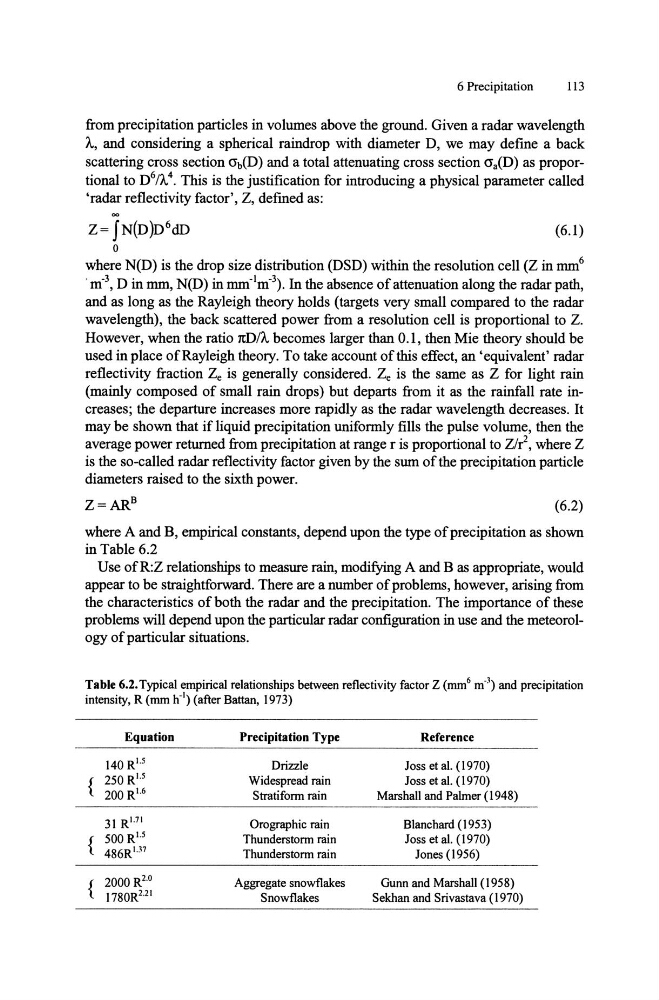
where A and B, empirical constants, depend upon the type of precipitation as shown
in Table 6.2
Use ofR:Z relationships to measure rain, modifying A and B as appropriate, would
appear to be straightforward. There are a number of problems, however, arising from
the characteristics of both the radar and the precipitation. The importance of these
problems will depend upon the particular radar configuration in use and the meteorology of particular situations.
Table 6.2. Typical empirical relationships between reflectivity factor Z (mm 6 mol) and precipitation
intensity, R (mm h-I) (after Battan, 1973)
Equation
Precipitation Type
Reference
140Rl. 5
Drizzle
Joss et al. (1970)
{
250 Rl. 5
Widespread rain
Joss et al. (1970)
200 Rl.6
Stratiform rain
Marshall and Palmer (1948)
31 Rl.71
Orographic rain
Blanchard (1953)
{
500 Rl. 5
Thunderstorm rain
Joss et aI. (1970)
486R l.J7
Thunderstorm rain
Jones (1956)
{
2000 R Z ' o
Aggregate snowflakes
Gunn and Marshall (1958)
1780R z . ZI
Snowflakes
Sekhan and Srivastava (1970)
113
from precipitation particles in volumes above the ground. Given a radar wavelength
' ). . " and considering a spherical raindrop with diameter D, we may define a back
scattering cross section O"b(D) and a total attenuating cross section O"a(D) as proportional to D 6 /')..,4. This is the justification for introducing a physical parameter called
'radar reflectivity factor', Z, defined as:
~
Z= fN(D)D 6 dD
(6.1)
o
where N(D) is the drop size distribution (DSD) within the resolution cell (Z in rom 6
. m- 3 , D in rom, N(D) in rom- 1 m- 3 ). In the absence of attenuation along the radar path,
and as long as the Rayleigh theory holds (targets very small compared to the radar
wavelength), the back scattered power from a resolution cell is proportional to Z.
However, when the ratio ltD/').., becomes larger than 0.1, then Mie theory should be
used in place of Rayleigh theory. To take account of this effect, an 'equivalent' radar
reflectivity fraction Ze is generally considered. Ze is the same as Z for light rain
(mainly composed of small rain drops) but departs from it as the rainfall rate increases; the departure increases more rapidly as the radar wavelength decreases. It
may be shown that if liquid precipitation uniformly fills the pulse volume, then the
average power returned from precipitation at range r is proportional to Z/r2, where Z
is the so-called radar reflectivity factor given by the sum of the precipitation particle
diameters raised to the sixth power.
Z=ARB
(6.2)
where A and B, empirical constants, depend upon the type of precipitation as shown
in Table 6.2
Use ofR:Z relationships to measure rain, modifying A and B as appropriate, would
appear to be straightforward. There are a number of problems, however, arising from
the characteristics of both the radar and the precipitation. The importance of these
problems will depend upon the particular radar configuration in use and the meteorology of particular situations.
Table 6.2. Typical empirical relationships between reflectivity factor Z (mm 6 mol) and precipitation
intensity, R (mm h-I) (after Battan, 1973)
Equation
Precipitation Type
Reference
140Rl. 5
Drizzle
Joss et al. (1970)
{
250 Rl. 5
Widespread rain
Joss et al. (1970)
200 Rl.6
Stratiform rain
Marshall and Palmer (1948)
31 Rl.71
Orographic rain
Blanchard (1953)
{
500 Rl. 5
Thunderstorm rain
Joss et aI. (1970)
486R l.J7
Thunderstorm rain
Jones (1956)
{
2000 R Z ' o
Aggregate snowflakes
Gunn and Marshall (1958)
1780R z . ZI
Snowflakes
Sekhan and Srivastava (1970)