

90
R.O. Dubayah, E.F. Wood, E.T. Engman et aI.
relative HSU area
0.2
0.4
0.6
0.8
relative HSU area
o
0.2
0.4
0.6
0.8
relative HSU area
relative HSU area
0.2
0.4
0.6
0.8
relative HSU area
measured distribution. e.g. by
the method shown in Colour
Plate 5.A
adapted distribution
function
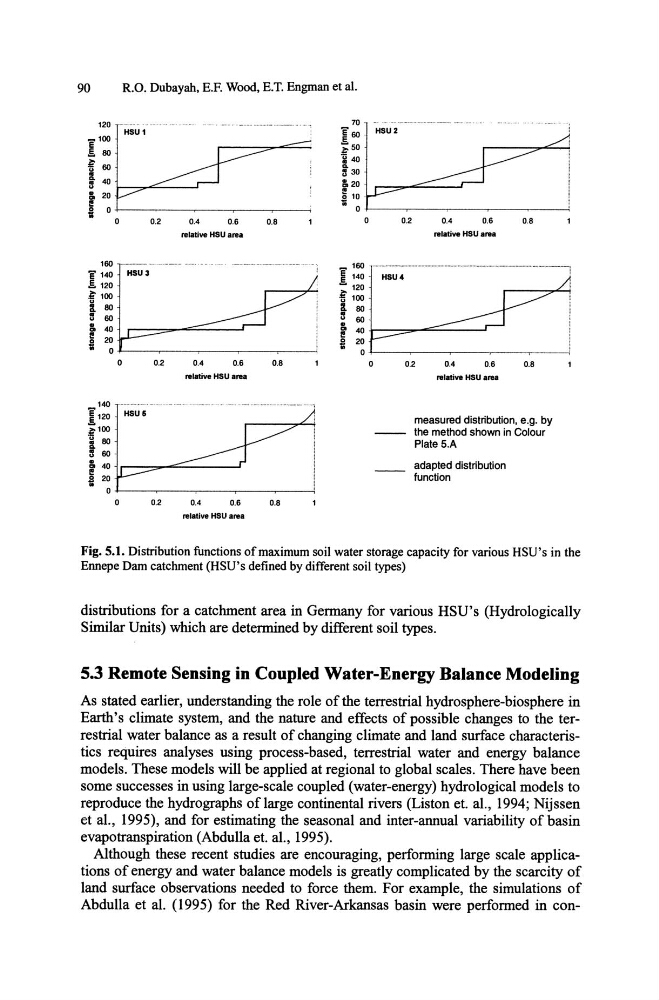
Fig. 5.1. Distribution functions of maximum soil water storage capacity for various HSU's in the
Ennepe Dam catchment (HSU's defined by different soil types)
distributions for a catchment area in Gennany for various HSU's (Hydrologically
Similar Units) which are detennined by different soil types.
5.3 Remote Sensing in Coupled Water-Energy Balance Modeling
As stated earlier, understanding the role of the terrestrial hydrosphere-biosphere in
Earth's climate system, and the nature and effects of possible changes to the terrestrial water balance as a result of changing climate and land surface characteristics requires analyses using process-based, terrestrial water and energy balance
models. These models will be applied at regional to global scales. There have been
some successes in using large-scale coupled (water-energy) hydrological models to
reproduce the hydro graphs oflarge continental rivers (Liston et. al., 1994; Nijssen
et aI., 1995), and for estimating the seasonal and inter-annual variability of basin
evapotranspiration (Abdulla et. aI., 1995).
Although these recent studies are encouraging, perfonning large scale applications of energy and water balance models is greatly complicated by the scarcity of
land surface observations needed to force them. For example, the simulations of
Abdulla et aI. (1995) for the Red River-Arkansas basin were perfonned in con-
R.O. Dubayah, E.F. Wood, E.T. Engman et aI.
relative HSU area
0.2
0.4
0.6
0.8
relative HSU area
o
0.2
0.4
0.6
0.8
relative HSU area
relative HSU area
0.2
0.4
0.6
0.8
relative HSU area
measured distribution. e.g. by
the method shown in Colour
Plate 5.A
adapted distribution
function
Fig. 5.1. Distribution functions of maximum soil water storage capacity for various HSU's in the
Ennepe Dam catchment (HSU's defined by different soil types)
distributions for a catchment area in Gennany for various HSU's (Hydrologically
Similar Units) which are detennined by different soil types.
5.3 Remote Sensing in Coupled Water-Energy Balance Modeling
As stated earlier, understanding the role of the terrestrial hydrosphere-biosphere in
Earth's climate system, and the nature and effects of possible changes to the terrestrial water balance as a result of changing climate and land surface characteristics requires analyses using process-based, terrestrial water and energy balance
models. These models will be applied at regional to global scales. There have been
some successes in using large-scale coupled (water-energy) hydrological models to
reproduce the hydro graphs oflarge continental rivers (Liston et. al., 1994; Nijssen
et aI., 1995), and for estimating the seasonal and inter-annual variability of basin
evapotranspiration (Abdulla et. aI., 1995).
Although these recent studies are encouraging, perfonning large scale applications of energy and water balance models is greatly complicated by the scarcity of
land surface observations needed to force them. For example, the simulations of
Abdulla et aI. (1995) for the Red River-Arkansas basin were perfonned in con-