

Chapter 2: SEA SURFACE MICROLAYER
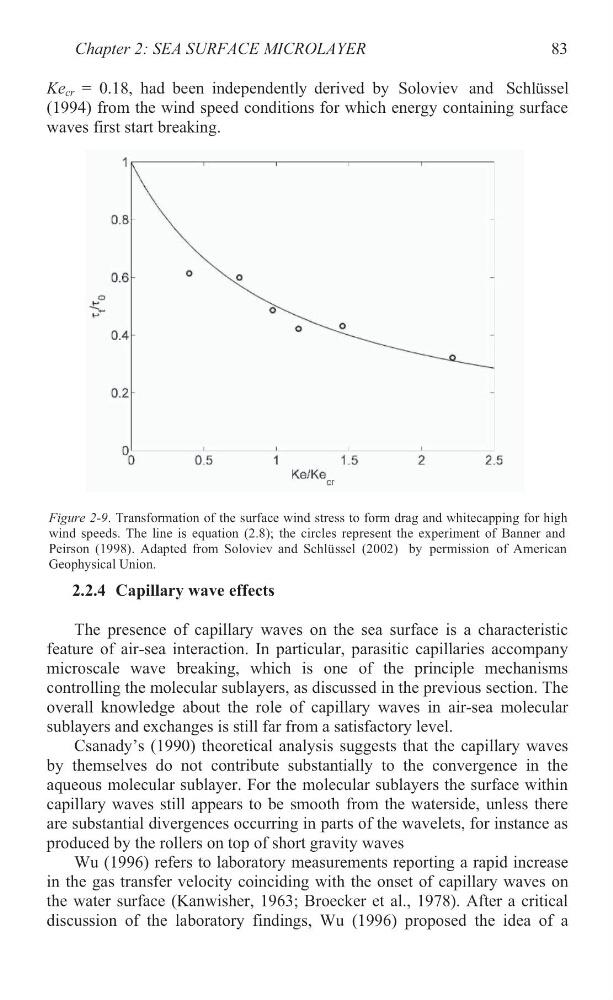
Ke cr = 0.18, had been independently derived by Soloviev and S
(1994) from the wind speed conditions for which energy containing surface
waves first start breaking.
2.2.4 Capillary wave effects
The presence of capillary waves on the sea surface is a characteristic
feature of air-sea interaction. In particular, parasitic capillaries accompany
microscale wave breaking, which is one of the principle mechanisms
controlling the molecular sublayers, as discussed in the previous section. The
overall knowledge about the role of capillary waves in air-sea molecular
sublayers and exchanges is still far from a satisfactory level.
Csanady’s (1990) theoretical analysis suggests that the capillary waves
by themselves do not contribute substantially to the convergence in the
aqueous molecular sublayer. For the molecular sublayers the surface within
capillary waves still appears to be smooth from the waterside, unless there
are substantial divergences occurring in parts of the wavelets, for instance as
produced by the rollers on top of short gravity waves
Wu (1996) refers to laboratory measurements reporting a rapid increase
in the gas transfer velocity coinciding with the onset of capillary waves on
the water surface (Kanwisher, 1963; Broecker et al., 1978). After a critical
discussion of the laboratory findings, Wu (1996) proposed the idea of a
83
Figure 2-9. Transformation of the surface wind stress to form drag and whitecapping for high
wind speeds. The line is equation (2.8); the circles represent the experiment of Banner and
Peirson (1998). Adapted from Soloviev and Schlüssel (2002) by permission of American
Geophysical Union.
chl ssel
ü
Ke cr = 0.18, had been independently derived by Soloviev and S
(1994) from the wind speed conditions for which energy containing surface
waves first start breaking.
2.2.4 Capillary wave effects
The presence of capillary waves on the sea surface is a characteristic
feature of air-sea interaction. In particular, parasitic capillaries accompany
microscale wave breaking, which is one of the principle mechanisms
controlling the molecular sublayers, as discussed in the previous section. The
overall knowledge about the role of capillary waves in air-sea molecular
sublayers and exchanges is still far from a satisfactory level.
Csanady’s (1990) theoretical analysis suggests that the capillary waves
by themselves do not contribute substantially to the convergence in the
aqueous molecular sublayer. For the molecular sublayers the surface within
capillary waves still appears to be smooth from the waterside, unless there
are substantial divergences occurring in parts of the wavelets, for instance as
produced by the rollers on top of short gravity waves
Wu (1996) refers to laboratory measurements reporting a rapid increase
in the gas transfer velocity coinciding with the onset of capillary waves on
the water surface (Kanwisher, 1963; Broecker et al., 1978). After a critical
discussion of the laboratory findings, Wu (1996) proposed the idea of a
83
Figure 2-9. Transformation of the surface wind stress to form drag and whitecapping for high
wind speeds. The line is equation (2.8); the circles represent the experiment of Banner and
Peirson (1998). Adapted from Soloviev and Schlüssel (2002) by permission of American
Geophysical Union.
chl ssel
ü