

THE NEAR-SURFACE LAYER OF THE OCEAN
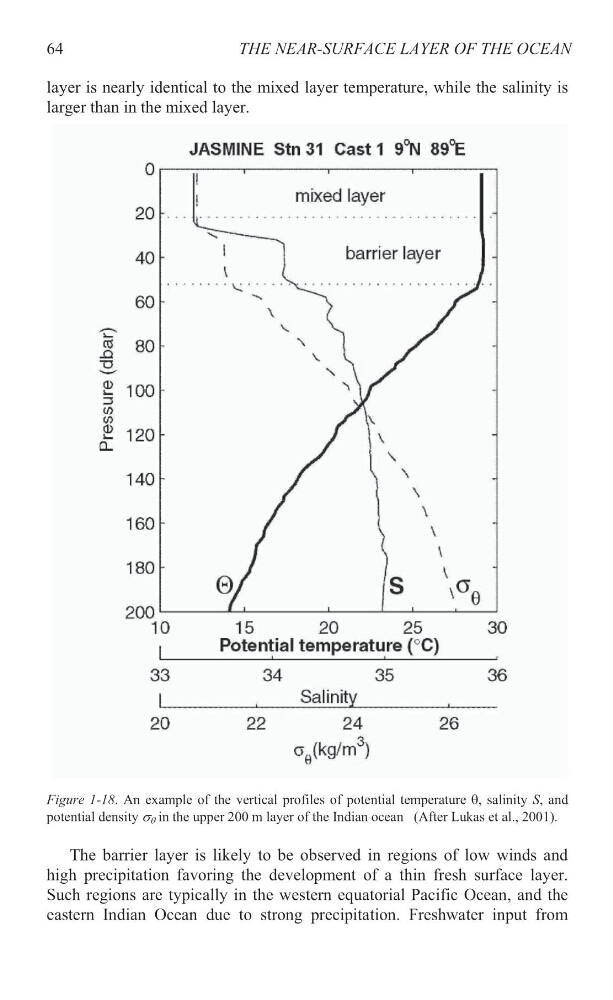
layer is nearly identical to the mixed layer temperature, while the salinity is
larger than in the mixed layer.
Figure 1-18. An example of the vertical profiles of potential temperature T, salinity S, and
potential density V T in the upper 200 m layer of the Indian ocean (After Lukas et al., 2001).
The barrier layer is likely to be observed in regions of low winds and
high precipitation favoring the development of a thin fresh surface layer.
Such regions are typically in the western equatorial Pacific Ocean, and the
eastern Indian Ocean due to strong precipitation. Freshwater input from
64
layer is nearly identical to the mixed layer temperature, while the salinity is
larger than in the mixed layer.
Figure 1-18. An example of the vertical profiles of potential temperature T, salinity S, and
potential density V T in the upper 200 m layer of the Indian ocean (After Lukas et al., 2001).
The barrier layer is likely to be observed in regions of low winds and
high precipitation favoring the development of a thin fresh surface layer.
Such regions are typically in the western equatorial Pacific Ocean, and the
eastern Indian Ocean due to strong precipitation. Freshwater input from
64