

Chapter 1: INTRODUCTION
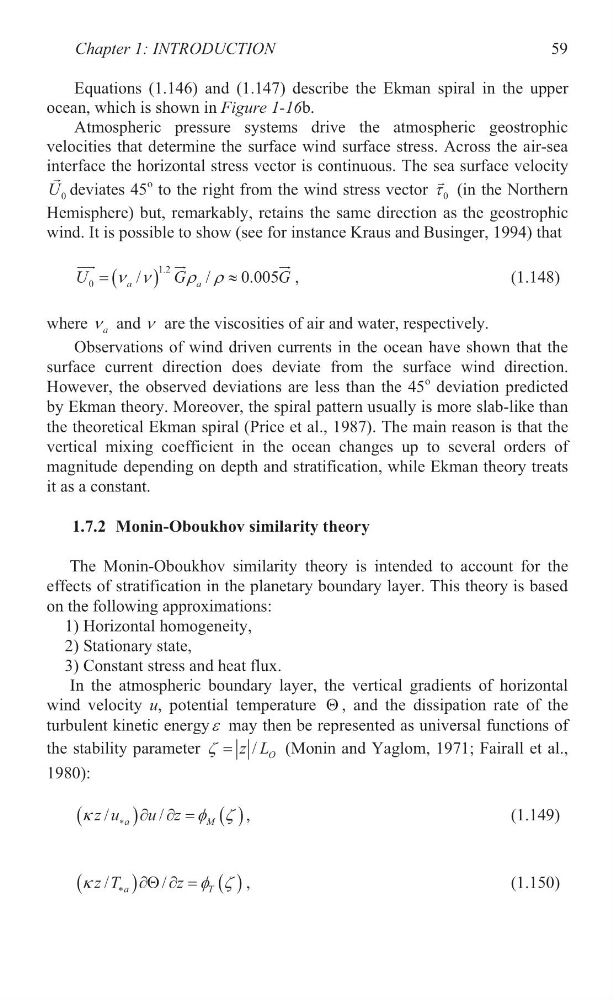
Equations (1.146) and (1.147) describe the Ekman spiral in the upper
ocean, which is shown in Figure 1-16b.
Atmospheric pressure systems drive the atmospheric geostrophic
velocities that determine the surface wind surface stress. Across the air-sea
interface the horizontal stress vector is continuous. The sea surface velocity
0
U
G
deviates 45
o to the right from the wind stress vector 0
W
G (in the Northern
Hemisphere) but, remarkably, retains the same direction as the geostrophic
wind. It is possible to show (see for instance Kraus and Businger, 1994) that
1.2
0
/
/
0 . 0 0 5
a
a
U
G
G
Q Q
U U |
JJG
JG
JG
,
(1.148)
where a
Q and Q are the viscosities of air and water, respectively.
Observations of wind driven currents in the ocean have shown that the
surface current direction does deviate from the surface wind direction.
However, the observed deviations are less than the 45
o deviation predicted
by Ekman theory. Moreover, the spiral pattern usually is more slab-like than
the theoretical Ekman spiral (Price et al., 1987). The main reason is that the
vertical mixing coefficient in the ocean changes up to several orders of
magnitude depending on depth and stratification, while Ekman theory treats
it as a constant.
1.7.2 Monin-Oboukhov similarity theory
The Monin-Oboukhov similarity theory is intended to account for the
effects of stratification in the planetary boundary layer. This theory is based
on the following approximations:
1) Horizontal homogeneity,
2) Stationary state,
3) Constant stress and heat flux.
In the atmospheric boundary layer, the vertical gradients of horizontal
wind velocity u, potential temperature 4 , and the dissipation rate of the
turbulent kinetic energy H may then be represented as universal functions of
the stability parameter
/ O
z L
]
(Monin and Yaglom, 1971; Fairall et al.,
1980):
/
/
a
M
z u
u z
N
I ]
w w
,
(1.149)
/
/
a
T
z T
z
N
I ]
w4 w
,
(1.150)
59
Equations (1.146) and (1.147) describe the Ekman spiral in the upper
ocean, which is shown in Figure 1-16b.
Atmospheric pressure systems drive the atmospheric geostrophic
velocities that determine the surface wind surface stress. Across the air-sea
interface the horizontal stress vector is continuous. The sea surface velocity
0
U
G
deviates 45
o to the right from the wind stress vector 0
W
G (in the Northern
Hemisphere) but, remarkably, retains the same direction as the geostrophic
wind. It is possible to show (see for instance Kraus and Businger, 1994) that
1.2
0
/
/
0 . 0 0 5
a
a
U
G
G
Q Q
U U |
JJG
JG
JG
,
(1.148)
where a
Q and Q are the viscosities of air and water, respectively.
Observations of wind driven currents in the ocean have shown that the
surface current direction does deviate from the surface wind direction.
However, the observed deviations are less than the 45
o deviation predicted
by Ekman theory. Moreover, the spiral pattern usually is more slab-like than
the theoretical Ekman spiral (Price et al., 1987). The main reason is that the
vertical mixing coefficient in the ocean changes up to several orders of
magnitude depending on depth and stratification, while Ekman theory treats
it as a constant.
1.7.2 Monin-Oboukhov similarity theory
The Monin-Oboukhov similarity theory is intended to account for the
effects of stratification in the planetary boundary layer. This theory is based
on the following approximations:
1) Horizontal homogeneity,
2) Stationary state,
3) Constant stress and heat flux.
In the atmospheric boundary layer, the vertical gradients of horizontal
wind velocity u, potential temperature 4 , and the dissipation rate of the
turbulent kinetic energy H may then be represented as universal functions of
the stability parameter
/ O
z L
]
(Monin and Yaglom, 1971; Fairall et al.,
1980):
/
/
a
M
z u
u z
N
I ]
w w
,
(1.149)
/
/
a
T
z T
z
N
I ]
w4 w
,
(1.150)
59