

Chapter 1: INTRODUCTION
hemisphere. (Because K M generally is not constant with respect to z in the
turbulent boundary layer, the angle can be different.) The surface wind
stress, which is caused by the drag of the surface wind against the surface, is
in the same direction as the surface wind vector. Because, in this model, K M
does not depend on height, (1.133) with (1.138) and (1.139) at z = 0 result in
1/ 2
1/ 2
2
2
0
0
0
x
y
a
m
G K f
W
W
W
U
.
(1.140)
The Ekman layer depth is often defined as
/
E
E
h S J , which is the
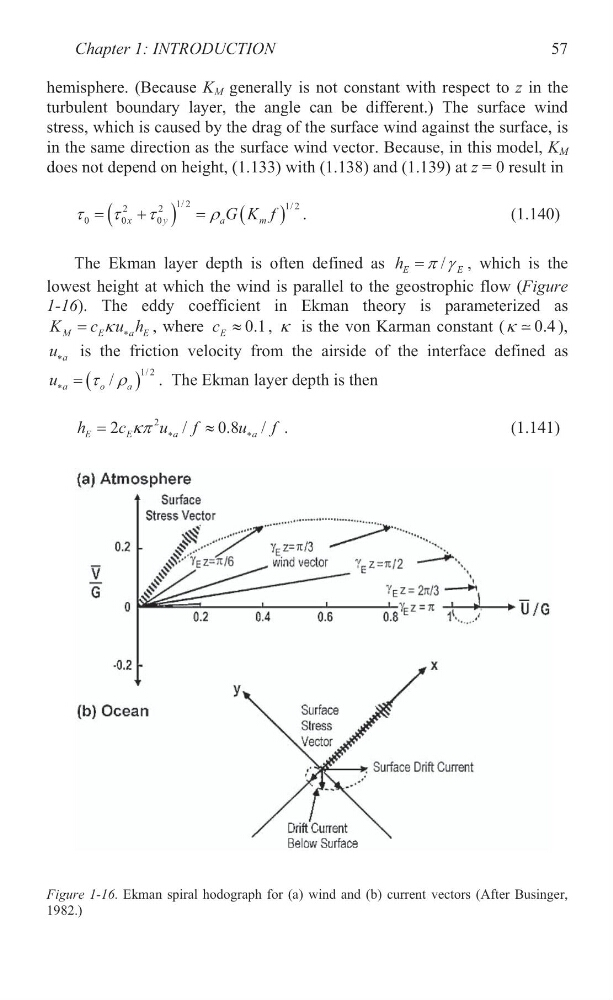
lowest height at which the wind is parallel to the geostrophic flow (Figure
1-16). The eddy coefficient in Ekman theory is parameterized as
M
E
a E
K
c u h
N , where
0.1
E
c |
, N is the von Karman constant (
0.4
N
),
a
u is the friction velocity from the airside of the interface defined as
1/ 2
/
a
o
a
u
W U
. The Ekman layer depth is then
2
2
/
0 . 8 /
E
E
a
a
h
c
u f
u f
NS
|
.
(1.141)
Figure 1-16. Ekman spiral hodograph for (a) wind and (b) current vectors (After Businger,
1982.)
57
hemisphere. (Because K M generally is not constant with respect to z in the
turbulent boundary layer, the angle can be different.) The surface wind
stress, which is caused by the drag of the surface wind against the surface, is
in the same direction as the surface wind vector. Because, in this model, K M
does not depend on height, (1.133) with (1.138) and (1.139) at z = 0 result in
1/ 2
1/ 2
2
2
0
0
0
x
y
a
m
G K f
W
W
W
U
.
(1.140)
The Ekman layer depth is often defined as
/
E
E
h S J , which is the
lowest height at which the wind is parallel to the geostrophic flow (Figure
1-16). The eddy coefficient in Ekman theory is parameterized as
M
E
a E
K
c u h
N , where
0.1
E
c |
, N is the von Karman constant (
0.4
N
),
a
u is the friction velocity from the airside of the interface defined as
1/ 2
/
a
o
a
u
W U
. The Ekman layer depth is then
2
2
/
0 . 8 /
E
E
a
a
h
c
u f
u f
NS
|
.
(1.141)
Figure 1-16. Ekman spiral hodograph for (a) wind and (b) current vectors (After Businger,
1982.)
57