

THE NEAR-SURFACE LAYER OF THE OCEAN
where Z p is the frequency of spectral peak.
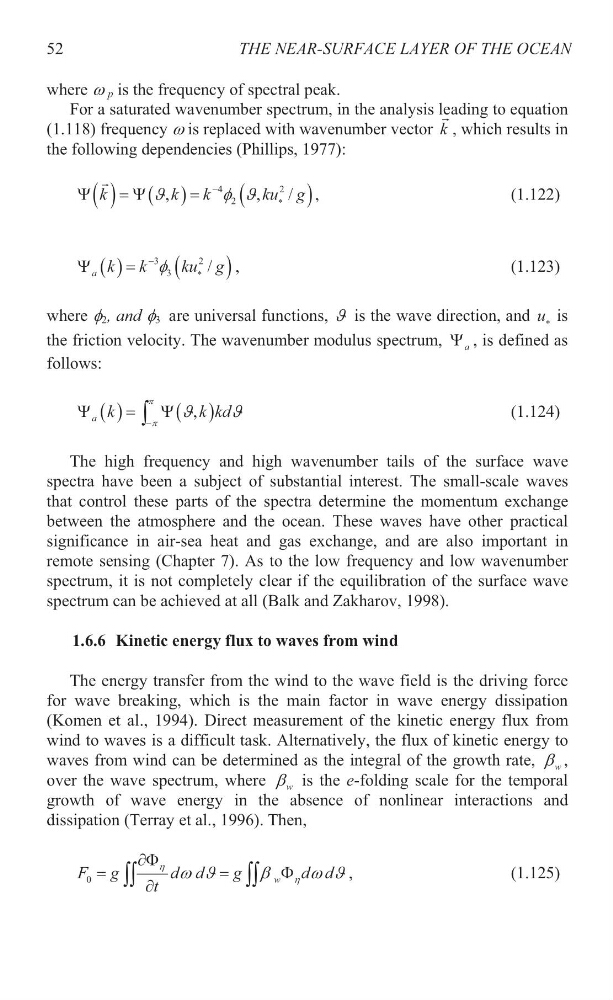
For a saturated wavenumber spectrum, in the analysis leading to equation
(1.118) frequency Z is replaced with wavenumber vector k
G
, which results in
the following dependencies (Phillips, 1977):
4
2
2
,
,
/
k
k k
k u g
-
I -
<
<
G
,
(1.122)
3
2
3
/
a k k
ku g
I
<
,
(1.123)
where I 2 , and I 3 are universal functions, - is the wave direction, and u is
the friction velocity. The wavenumber modulus spectrum, a
< , is defined as
follows:
,
a k
kk d
S
S
-
-
<
<
³
(1.124)
The high frequency and high wavenumber tails of the surface wave
spectra have been a subject of substantial interest. The small-scale waves
that control these parts of the spectra determine the momentum exchange
between the atmosphere and the ocean. These waves have other practical
significance in air-sea heat and gas exchange, and are also important in
remote sensing (Chapter 7). As to the low frequency and low wavenumber
spectrum, it is not completely clear if the equilibration of the surface wave
spectrum can be achieved at all (Balk and Zakharov, 1998).
1.6.6 Kinetic energy flux to waves from wind
The energy transfer from the wind to the wave field is the driving force
for wave breaking, which is the main factor in wave energy dissipation
(Komen et al., 1994). Direct measurement of the kinetic energy flux from
wind to waves is a difficult task. Alternatively, the flux of kinetic energy to
waves from wind can be determined as the integral of the growth rate, w
E ,
over the wave spectrum, where w
E is the e-folding scale for the temporal
growth of wave energy in the absence of nonlinear interactions and
dissipation (Terray et al., 1996). Then,
0
w
F g
d d
g
d d
t
K
K
Z -
E
Z -
w)
)
w
³³
³³
,
(1.125)
52
where Z p is the frequency of spectral peak.
For a saturated wavenumber spectrum, in the analysis leading to equation
(1.118) frequency Z is replaced with wavenumber vector k
G
, which results in
the following dependencies (Phillips, 1977):
4
2
2
,
,
/
k
k k
k u g
-
I -
<
<
G
,
(1.122)
3
2
3
/
a k k
ku g
I
<
,
(1.123)
where I 2 , and I 3 are universal functions, - is the wave direction, and u is
the friction velocity. The wavenumber modulus spectrum, a
< , is defined as
follows:
,
a k
kk d
S
S
-
-
<
<
³
(1.124)
The high frequency and high wavenumber tails of the surface wave
spectra have been a subject of substantial interest. The small-scale waves
that control these parts of the spectra determine the momentum exchange
between the atmosphere and the ocean. These waves have other practical
significance in air-sea heat and gas exchange, and are also important in
remote sensing (Chapter 7). As to the low frequency and low wavenumber
spectrum, it is not completely clear if the equilibration of the surface wave
spectrum can be achieved at all (Balk and Zakharov, 1998).
1.6.6 Kinetic energy flux to waves from wind
The energy transfer from the wind to the wave field is the driving force
for wave breaking, which is the main factor in wave energy dissipation
(Komen et al., 1994). Direct measurement of the kinetic energy flux from
wind to waves is a difficult task. Alternatively, the flux of kinetic energy to
waves from wind can be determined as the integral of the growth rate, w
E ,
over the wave spectrum, where w
E is the e-folding scale for the temporal
growth of wave energy in the absence of nonlinear interactions and
dissipation (Terray et al., 1996). Then,
0
w
F g
d d
g
d d
t
K
K
Z -
E
Z -
w)
)
w
³³
³³
,
(1.125)
52